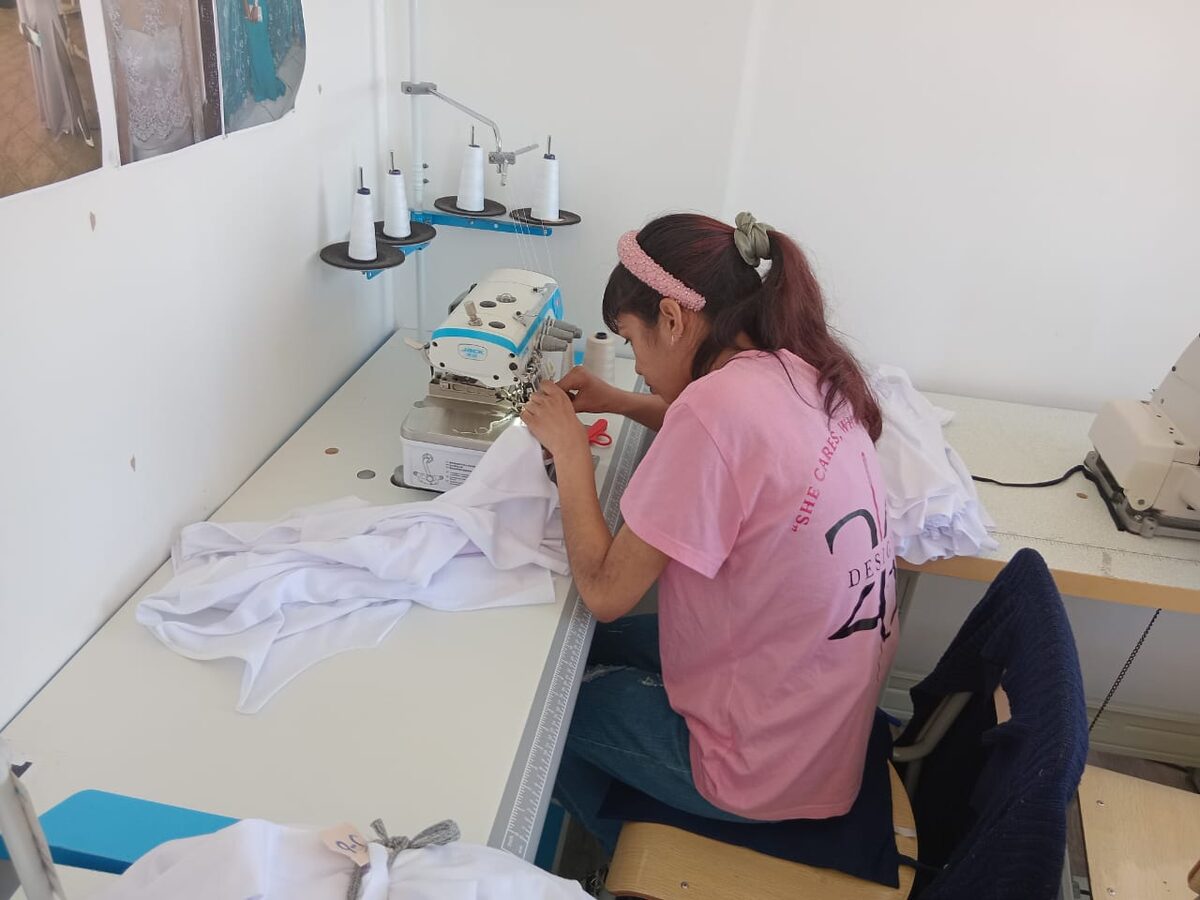


Government, labour and private sector stakeholders have agreed to work together on a new model of industrial park aimed at bringing back South African light manufacturing.
Light manufacturing refers to the production of smaller consumer goods such as clothing, rather than heavy industries like steel or car manufacturing.
Key industry stakeholders last week endorsed the blueprint for Scaled Labour Intensive Manufacturing (SLIM) parks. The 34-page document was launched on Thursday 17 September by the Cape Chamber of Commerce and Industry.
Based on extensive clothing sector research, the strategy details how SLIM parks could significantly reduce the cost of producing local clothing. It offers a model that could be expanded to other light manufacturing sectors. Talks are already under way to turn the research into a first pilot park at a Western Cape site outside Cape Town.
Government backing
“I love the model — it shows a structural shift in operating models, and that is what we are looking for,” said Jo-Ann Johnston, head of the Western Cape Department of Economic Development and Tourism. “We need transformative ways of bringing back manufacturing.”
The SLIM concept draws on support from the Cape Clothing and Textiles Cluster, as well as research by Professor Justin Barnes, a leading expert in global supply networks — the international systems of people, companies and resources involved in creating and delivering a product — and manufacturing sector stalwart Graham Choice.
Speaking at the launch, Choice noted that SLIM was ready for trial. “We’ve tested every one of the SLIM elements individually, but we’ve never tested them collectively,” he said.
How the parks would work
The blueprint includes several key elements:
- Work schedules — A “4×4” rotation system where two teams work four longer days, totalling 42 hours a week, followed by four days off. This gives workers structured rest while keeping factories running throughout the year. The pilot is designed to accommodate at least three factories with 800 staff each, sustaining a total workforce of 2 400. The broader economic impact includes the creation of an estimated 12 000 indirect jobs across the clothing and textile supply chain and a R220 million wage injection into the local economy.
- Lower costs — Shared utility arrangements offering lower factory rentals, shared industrial services and affordable onsite renewable energy. Parks would be sited directly next to large high-density communities so workers can walk to work.
- Cheaper production — Structural changes designed to deliver a lower cost per minute of production, targeting R1,50 compared with current industry averages of R4,50 to R5,00 in cities. This would ensure local products reach shops and export markets at competitive prices.
- Worker training — Industrial parks situated close to residential areas reduce commuting times and staff transport costs. Every employee will have access to training aligned with a national qualification.
- Retail support — Major local retailers have agreed to provide a consistent, high-volume market for mass-produced clothing.
- Targeted investment — Strategic equipment investments supported by public sector finance, drawing on skills development funding through the National Skills Fund and Sector Education and Training Authorities, known as Setas.
- Public-private cooperation — Backing from three national ministries: Labour; Trade, Industry and Competition; and Higher Education.
A complete solution
Choice emphasised that while alternative labour shift systems have long been debated, SLIM represents a complete structural solution.
“If you don’t have light manufacturing at scale, you can’t meet the opportunities presented by the sizeable local demand already identified in various research projects,” he said.
He added that while SLIM is a national project, launching the pilot in the Western Cape provides a crucial foundation.
“We are hoping that in the future we will have parks across all provinces. We’ve had extensive consultation with organised labour, including Cosatu and Sactwu, and we have their support to partner with us,” Choice said.
Making it work
Despite past declines across the local manufacturing sector, a comprehensive pilot combining all the cost-saving elements has yet to be deployed in South Africa.
Cape Chamber CEO John Lawson said the blueprint provides a practical roadmap for industrial change.
“What each party needs to do is entirely viable; what has been missing is our collective ability in South Africa to cooperate in this way to achieve shared goals,” he said.
“Unions want more jobs, manufacturers want to produce competitively, retailers want to source locally at lower prices, and municipalities want investors. Everybody wants this to work, but we need all the jigsaw puzzle pieces to fit together,” Lawson said.
“This blueprint is the architecture of how those pieces connect,” he said.
The Cape Chamber concluded the launch with a call to action, inviting all relevant economic stakeholders to collaborate on turning the SLIM blueprint into reality as soon as possible.
ALSO READ: Cape Chamber launches free online learning hub for businesses