

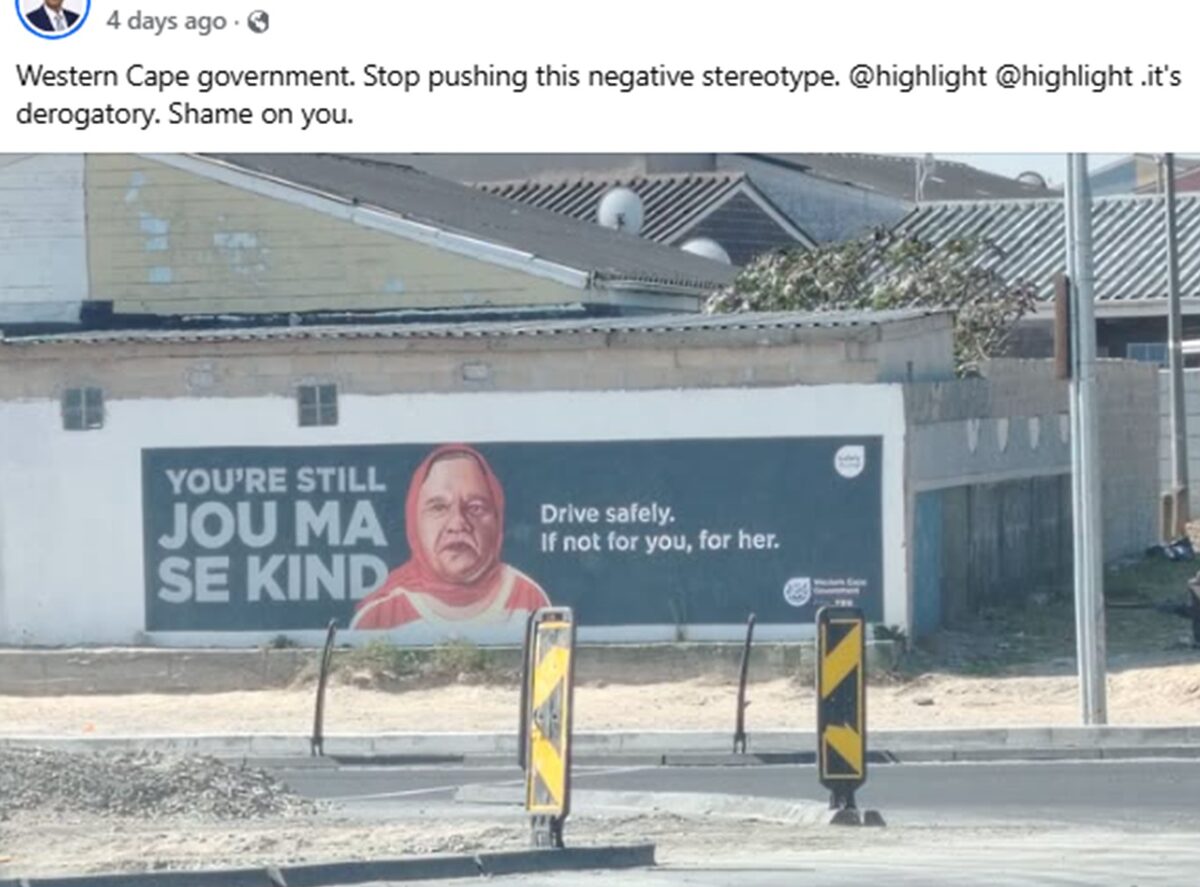
A road safety mural has attracted ire and sparked a debate on racism and language on Facebook.
The mural, painted on a wall alongside AZ Berman Drive in Beacon Valley, Mitchells Plain, reads: “You’re still jou ma se kind. Drive safely. If not for you, for her.” The text is painted alongside the portrait of a coloured woman wearing an orange scarf.
The mural is part of the Western Cape Government’s Safely Home campaign and has variations all over the province.
Last week a content creator posted a photo of the mural on Facebook with the caption: “Western Cape government. Stop pushing this negative stereotype. It’s derogatory. Shame on you. “
Explosion of comments
The post was shared dozens of times and attracted a plethora of comments, some agreeing that the language was derogatory and offensive and others disclaiming that it was not. Within days the post had more than 400 comments, including multiple trolls using the platform to insult the content creator and accuse him of attention seeking.
“How the hell is this offensive?” one commenter asked.
Another responded: “ ‘Ma se kind’ is documented Sabela terminology meaning brother/blood brother. So, if you are okay being addressed as a gang member, that’s okay, but I do take offense.”
The thread then debated whether the phrase “ma se kind” was Sabela or Kaaps while another thread raged on whether the post was racist or not.
Language expert weighs in
TygerBurger asked Quentin Williams, Professor of linguistics in the linguistics department at the University of the Western Cape (UWC) his opinion.
He replied that the phrase was neither Sabela, nor Kaaps but Afrikaans.
“From a purely linguistic perspective, if you read the phrase out loud, you’re not reading Kaaps. You’re also not reading Sabela,” he said. “When you read ‘jou ma se kind’, it is clear that here the phrase is written in Afrikaans and not Kaaps or Sabela. It is clear that Afrikaans spelling rules was applied to the phrase, quite a lot; actually there’s too much Afrikaans in it: it is the /e/ vowel in ‘se’ which is Afrikaans spelling, not Kaaps — written as ‘i’ — , and the final /-d/ in ‘kind’ is Afrikaans not Kaaps — either written as ‘t’ or without, as kin. If we actually followed the spelling conventions developed in the Kaaps Woriboek (dictionary), it should actually have been written as ‘jou masikint’.”
Williams, who is also the Director of the Centre for Multilingualism and Diversities Research (CMDR), and Editor-in-Chief of the Kaaps Woriboek, said that had the Western Cape Government intended to use Kaaps, they should have consulted an expert.
“If the phrase was actually in Kaaps, the Kaaps word, masikin, spelled according to the writing conventions in the Kaaps dictionary, the producers would have invoked three senses of the word.”
The phrase as it is used in the campaign with an Afrikaans spelling, changes the meaning, he said.
“If you translate this phrase from Afrikaans — as it is — to English it would mean, ‘your mother’s child’. But you lose a lot. If they consulted a Kaaps linguist, I would have written it in Kaaps as ‘jou masikint’.”
Is it derogative?
Williams said that had the intended use been Kaaps, then context could have made it derogative.
“Most Kaaps speakers are still regarded negatively as gangsters, as speakers who speak a low, not worthy type of language. Some language groups in South Africa actually believe Kaaps speakers do not exist. So, yes, not set in its proper context, it is also a derogatory phrase.”
Whether the phrase’s roots are Sabela or Kaaps is also an entirely different debate, Williams said.
“Kaaps is a language that mixes in with other languages and vice versa. It is the English to Latin of contemporary South Africa, or Potjek to Malay. So, it makes sense that it is a numbers gang phrase that got baked into Kaaps, or vice versa — we just don’t know because we do not have a reliable history of language use by the number gangs who Sabela. Importantly, this is the most insidious and most hurtful error to Kaaps speakers because Kaaps speakers internalise this negativity and are reminded in schools, church and other contexts of power that if they use this phrase, which is so baked into their language, they are less than nothing because they do not speak a language. This is not true. Kaaps speakers have a rich language used by all the masikinnis.”
Campaign’s design
TygerBurger asked the Western Cape Government for comment.
Spokesperson Muneera Allie said: “The Western Cape Mobility Department designed and ran this campaign over the previous festive season. The campaign forms part of our Safely Home road safety initiative. The purpose of the campaign was a poignant emotional reminder: no matter how old or confident you are, you are still your mother’s child.”
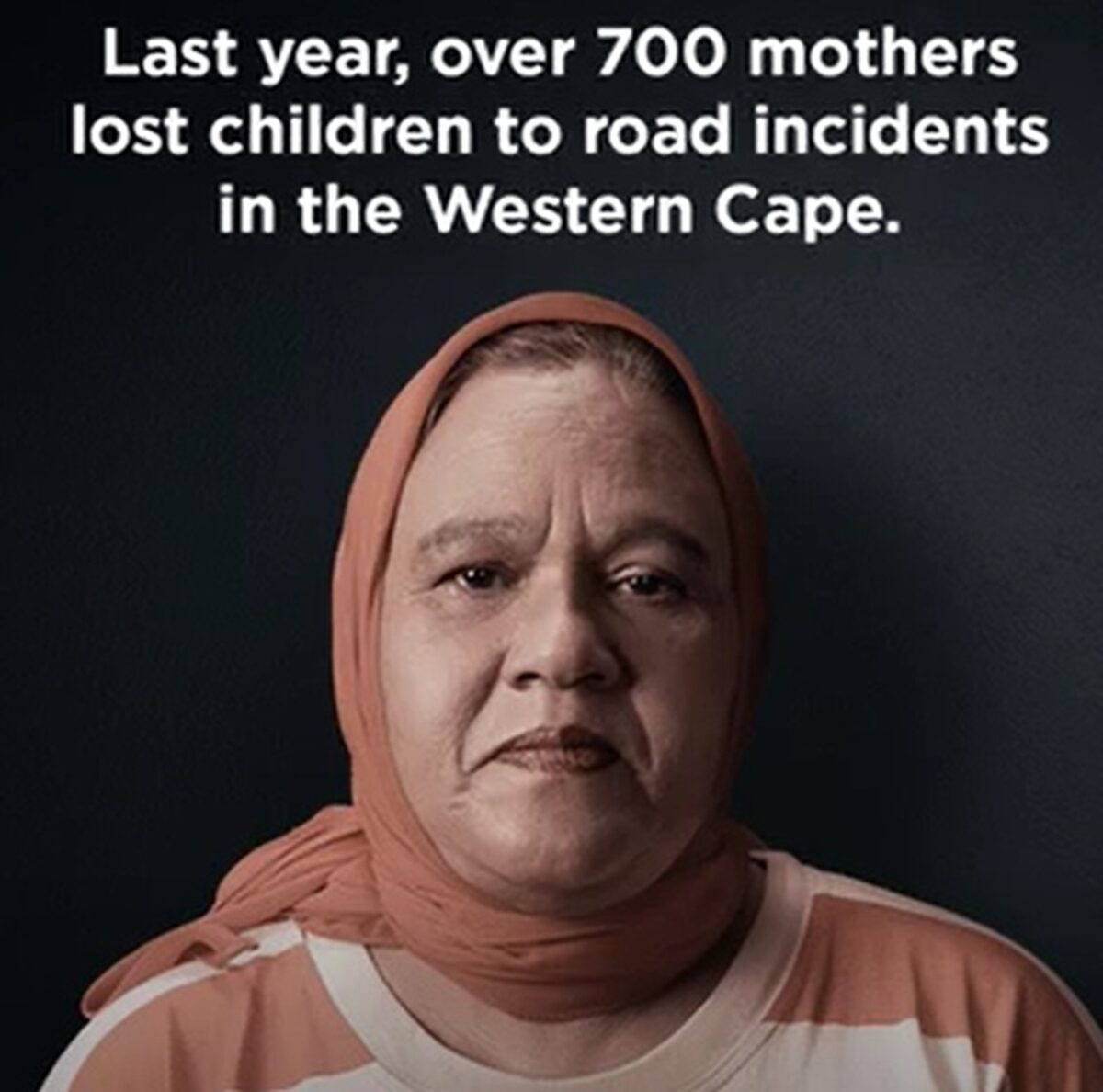
Allie referred TygerBurger to the campaign’s online content which showed a plethora of varied videos mixing multiple South African languages. The emotive campaign features stories of many mothers, of varying cultures and colours, recounting how they lost children to reckless drivers. All the videos feature the tagline “jou ma se kind“.
One of the women in the videos is the same mother depicted in the Beacon Valley mural.
ALSO READ: Kaaps Dictionary provides access ‘tôt vannie outsti tali in Syt Afrieka’




You must be logged in to post a comment.