
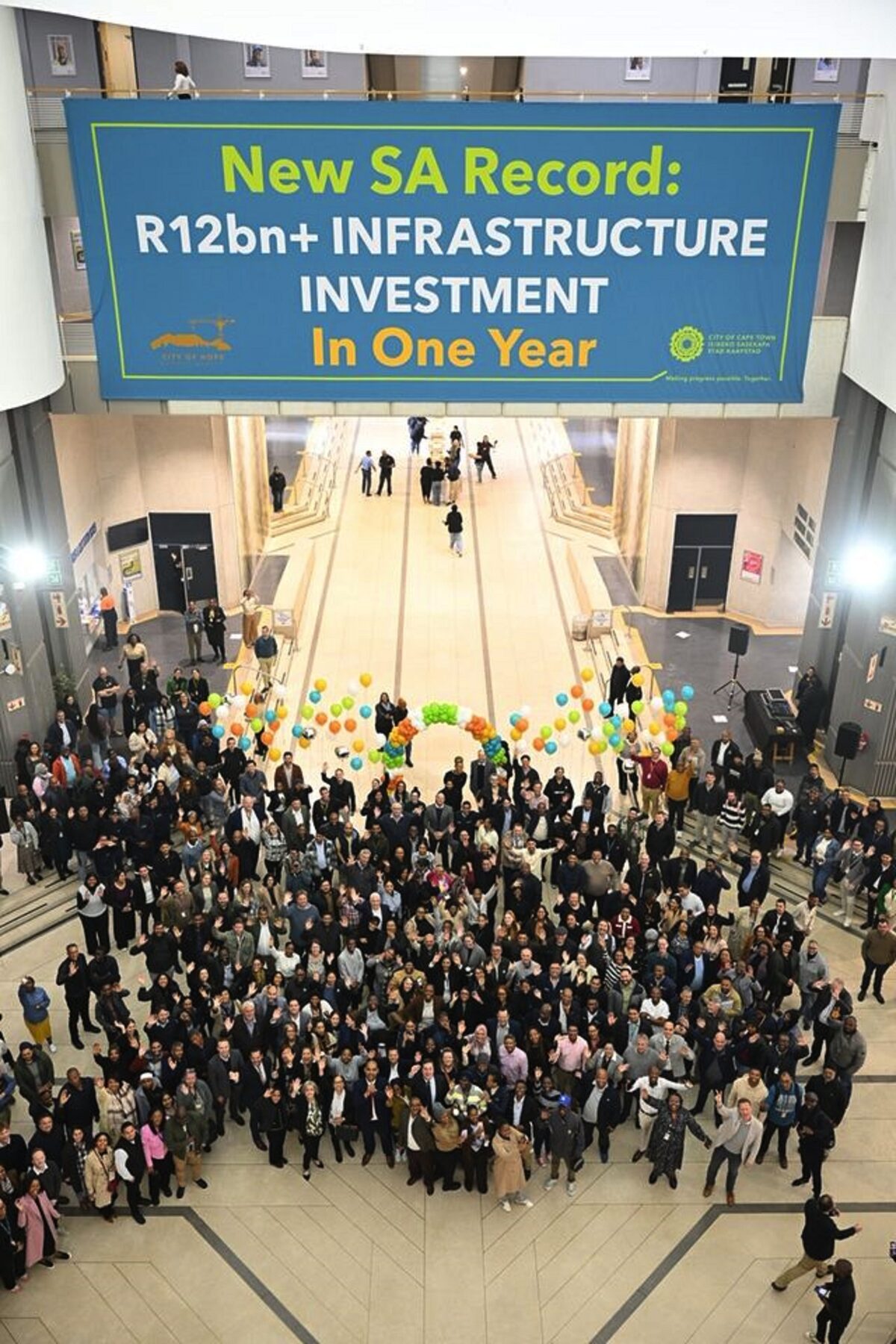
Cape Town has smashed a national record, spending more than R12.2 billion on infrastructure in a single financial year, but not everyone is celebrating, with opposition questioning whether ratepayers can keep shouldering the cost.
Cape Town Mayor Geordin Hill-Lewis today announced the City’s capital expenditure tally of over R12.2 billion for the 2025-26 financial year as being not only a record infrastructure investment for Cape Town, but as a South African-record for a city in a single year.
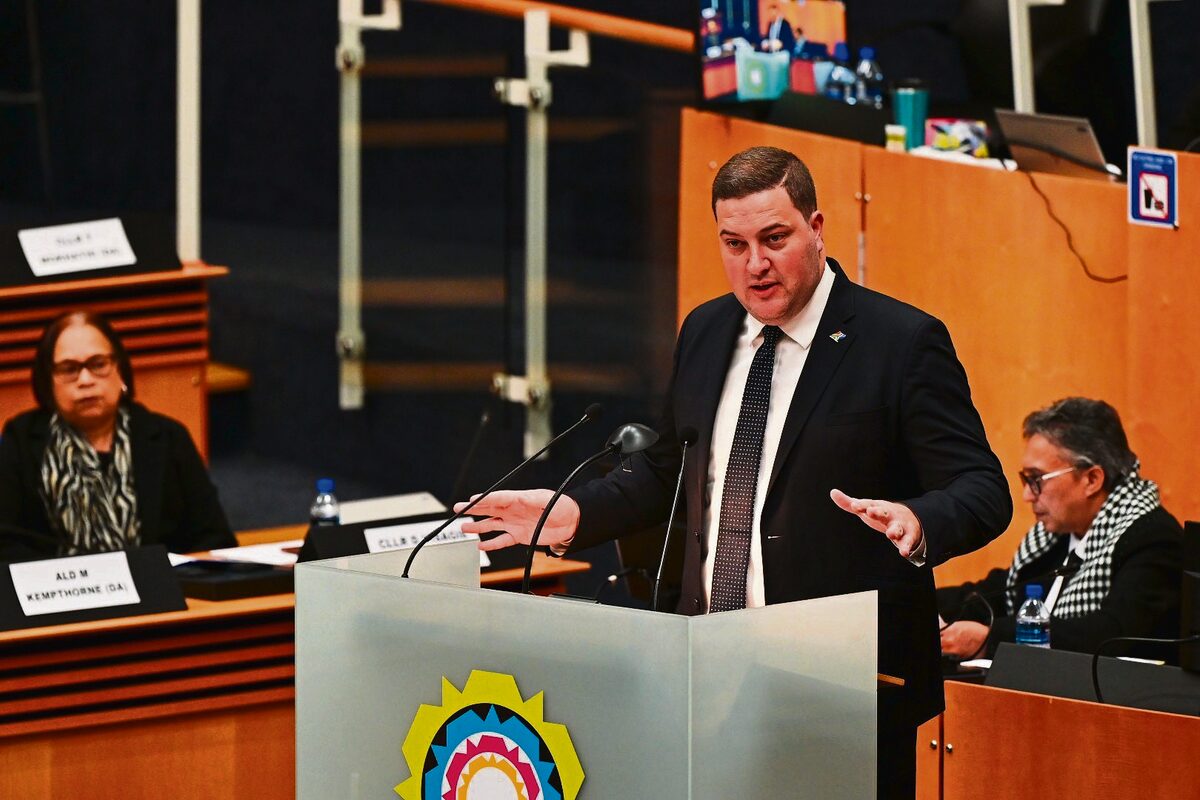
“The record R12.24 billion capital investment in this past financial year demonstrates not only to Capetonians – but to South Africans right across the country – what it takes to build for the future, to build a City of Hope,” said Hill-Lewis in his address to council. “Not a day goes by that we don’t read another heartbreaking report of the decay, neglect and collapse of public infrastructure in so many of our country’s other cities and towns.
I firmly believe this is the minimum required investment that Cape Town – and every other major metro in the country – should be making.
“We made a vow that this would never happen to Cape Town. When we started this term of office, the City could achieve no more than R6 billion investment in a year, but now we have more than doubled that to over R12 bilion. I firmly believe this is the minimum required investment that Cape Town – and every other major metro in the country – should be making in basic infrastructure every year as a golden rule, growing annually to account for inflation and population growth.”
“Whether it is pipe replacement across our water and sewer network, the massive upgrades to our wastewater treatment works, the new Cape Flats MyCiti route across the Cape Flats to Khayelitsha and Mitchells Plain, critical investments to our electricity grid, informal settlements upgrade programmes, or any of the hundreds of projects to improve public amenities, roads, waterways and public spaces – each and every one of them is vital to Cape Town’s future,” said Hill-Lewis.
The City’s top three directorates for percentage by budget spent were Safety and Security (99,85%), Finance (99,45%), and Urban Waste Management (98,37%).
Of the directorates in the City’s “billion club” with major investment portfolios of highly complex projects, Energy spent 96.53% (R1.29 billion) of its budget, followed by Human Settlements (93.38% or R1.34 billion) and Water and Sanitation (92.1% or R4.47 billion).
Mayor Hill-Lewis said the City’s water and sanitation investment was bigger than the entire capital budget of most cities.
“On the very first day of this term of office, I went to Khayelitsha and deliberately stood at an overflowing sewer, and said this must change. At that time, the City was replacing and upgrading just 25km of sewer pipes each year. Since then, we have set our target at 100km a year. Both the largest, and the second largest sewer pipe upgrade projects in South Africa are currently under construction here in Cape Town, being the Cape Flats main sewer upgrade, and the Philippi main line upgrade,” he said, adding that they have seen sewer spills and blockages come down across the city by 33% in this term.
75% of spend benefits lower-income homes
He said around 75% of Cape Town’s infrastructure investment directly benefits lower-income households based on the City’s estimates for the 2025/26 capital budget.
ALSO READ: Cape Town claims infrastructure investment lead over Gauteng metros
Furthermore, around 130 000 construction-related jobs will flow from capital investment in the current term of office alone according to City estimates.
“When we published our first annual Infrastructure Report, the pipe laying companies told me they could not handle the amount of pipe replacements we wanted to do,” he said. But over the course of this term, they and many other construction firms and engineering firms all around South Africa have risen to the occasion. They’ve scaled up, and hired many more professionals, because of the investments we have made here. I want to thank them too.”
Infrastructure investment highlights over the next three years include R16.7 billion for water and sanitation — 40% of total spending — covering major wastewater works upgrades, a R2 billion pipe replacement programme, and expanded water supply sources. The electrical grid will receive R6 billion in upgrades and maintenance as the City prepares for a decentralised energy future with reduced reliance on Eskom, while R3.7 billion has been allocated to road maintenance, pothole repairs and stormwater upgrades, alongside R653 million for congestion relief. Public transport receives a significant boost through R3.2 billion for the MyCiTi Cape Flats expansion — the largest project of its kind in South Africa — with a further R3.3 billion set aside for informal settlement upgrading and state-subsidised housing. Sports facilities will see R203 million in upgrades, and R300 million has been allocated to the Strandfontein Pavilion redevelopment.
Ratepayers overburdened
Member of the City’s Finance Portfoliio Committee, and budget specialist Sandra Dickson from the GOOD Party asks the question.
“Do the ratepayers of Cape Town fit anywhere in the Mayor’s spending extravaganza?”
“Today, City Council was turned into an awards ceremony for spending ratepayers’ money,” she said shortly after the announcement.
“The Mayor boasted that the City spent R12.24 billion of its capital budget, while directorates were ranked, praised and handed certificates for achieving the highest spending percentages,” she said.
“But this is not prize money. Every rand comes from residents already battling rising electricity, water, sanitation, refuse and property rates bills. Many households are cutting back on food and other necessities simply to keep their municipal accounts paid.”
Spending almost every cent of a budget is not automatically an achievement. The real test is affordability, value for money and whether residents actually receive reliable services.
She said the Mayor had indicated that future capital-budget increases must equal population growth plus inflation. While this may explain the growth in expenditure, she said, the question remains whether ratepayers can afford to keep funding it.
“Spending almost every cent of a budget is not automatically an achievement. The real test is affordability, value for money and whether residents actually receive reliable services. Cape Town does not need a competition to spend ratepayers’ money. It needs accountability for what every billion delivered, and what it cost struggling households.”