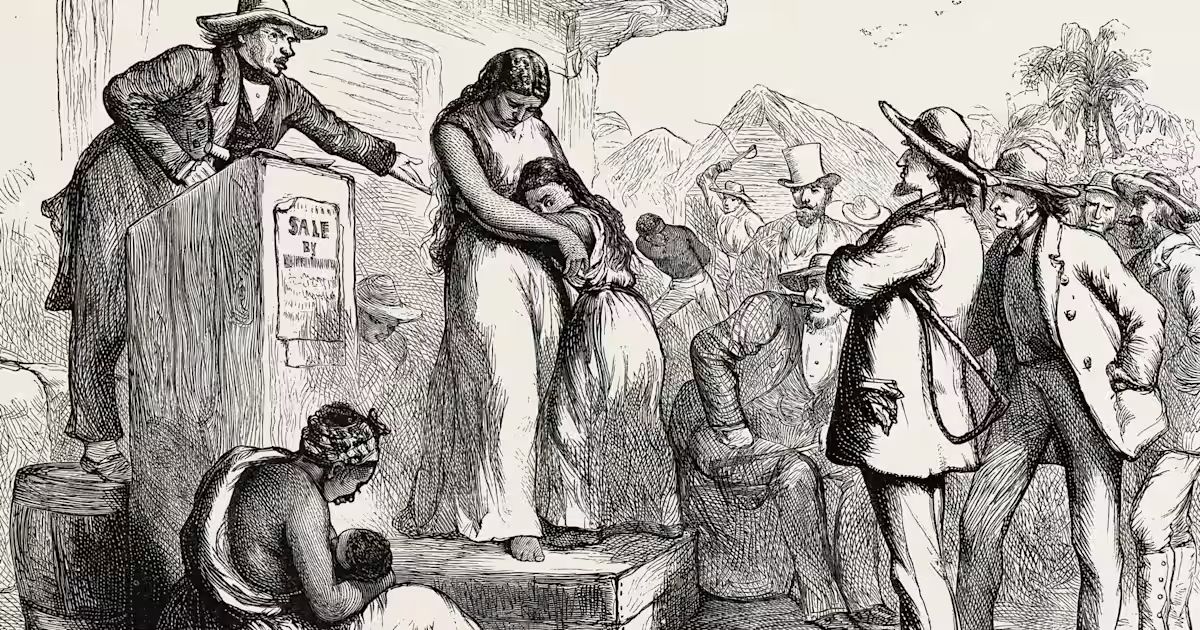
A United Nations watchdog says countries involved in the transatlantic slave trade of the 16th to 19th century are legally obliged to compensate for the harm they caused.
But while most of the many countries implicated agree to symbolic or commemorative measures, they are reluctant to address the sensitive issue of financial or material reparations for the trade, which saw millions of African men, women and children shipped to the Americas to work in appalling conditions.
A total of 182 countries – including the United States, Britain, France, the Netherlands, Portugal and Spain – are parties to the international treaty aimed at eliminating racial discrimination.
In many of those same countries, black people continue to face discrimination and poverty today.
Slave owners, not slaves, received compensation
“No former slave society has paid restitutions to the descendents of formerly enslaved people,” US historian Ana Lucia Araujo stressed in “Reparations for Slavery and the Slave Trade”.
Instead, almost all of them paid compensation to former slave owners, she said.
Slaves – essentially an unpaid workforce who were bought, sold and inherited like inanimate goods – were used in the British, Dutch, French, Portuguese and Spanish colonies in the Americas.
Humans continued to be enslaved after independence in the United States, Brazil and other Latin American countries.
Haiti is a notable example of this backwards approach. In exchange for French King Charles X recognising its independence, the former French colony agreed in 1825 to pay 150 million gold francs in compensation to the former landowners and slave owners, a sum that was eventually reduced to 90 million.
To do so, the young Caribbean republic founded by former slaves had to take on debt with French banks. It took several decades to settle this double debt.
In 2025, French President Emmanuel Macron launched a “work of remembrance” on slavery. But he did not explicitly mention the prospect of any financial compensation.
Modern initiatives offer mixed responses
The agrarian reform that followed Cuba’s 1959 revolution greatly benefitted the black rural population, even though it was not designed specifically to redress the legacy of slavery. The reform, and programmes including access to free healthcare and education, enabled Afro-Cubans to benefit from symbolic and material restitution that was not offered to most descendants of slaves in other parts of the Americas, Araujo said.
In 2022, Dutch Prime Minister Mark Rutte apologised for his country’s role in slavery. King Willem-Alexander followed suit in 2023. The government also allocated 200 million euros (R4.1 billion) to raising awareness of the Dutch trade in humans and its consequences today.
In the absence of concrete commitments from governments, a number of institutions and local authorities have taken independent initiatives.
The Church of England apologised for its historical links to slavery and in 2023 announced plans to invest 100 million pounds to address the generational damage slavery caused to several communities. The project is still in the development phase.
In 2023, insurance market Lloyd’s of London said it would spend 52 million pounds on racial equality causes after a report found it played a “significant role” in the slave trade.
International community remains divided
In March 2026, the UN General Assembly declared the slave trade and slavery of Africans to be “the gravest crime against humanity” – a cause championed by Ghana, which organised the first global conference on compensations two months later.
The United States opposed the UN decision, while Britain and the 27-nation European Union abstained.
EU member France, the first country in the world to recognise the slave trade and slavery as crimes against humanity, sought to justify its abstention by saying it did not wish to establish a hierarchy among crimes.
In May, the French parliament started repealing outdated decrees that define slaves in its colonies as “moveable goods” who can be inherited, outline brutal punishments for trying to escape and condemn the children of slaves to the same bondage fate as their parents.
Since 1989, the US Congress has repeatedly been asked to create a body to investigate slavery and its consequences. But it has never voted this into law.
The town of Evanston in Illinois has chosen to address the issue on its own by tackling housing discrimination against its black population. The local press says more than six million dollars has been distributed since 2021 to eligible residents as part of the scheme, which is being challenged in the courts but is still ongoing.
ALSO READ: France inches towards symbolic repealing of slavery legislation