

From the mud-caked boots of World War I infantrymen to the sleek running shoes of modern ultra-athletes, the Comrades Marathon has evolved into the world’s oldest and largest ultramarathon. As runners prepare for the 99th edition on Sunday 14 June, the legendary race continues to honour its founding purpose whilst setting new benchmarks in human endurance.
The birth of a living memorial
The Comrades Marathon was born from the trenches of the Great War. Vic Clapham, a veteran of the 8th South African Infantry, endured a brutal 2 700km route march through German East Africa. Haunted by the suffering and deaths of his comrades, Clapham envisioned a different kind of memorial – not a static monument, but a living tribute that would celebrate humanity’s triumph over adversity.
His reasoning was simple: If infantrymen, plucked from sedentary civilian jobs, could survive forced marches across vast distances carrying 27 kg packs, then trained athletes should manage a 90 km race between Pietermaritzburg and Durban.
The proposal met fierce resistance. Clapham applied for permission in 1919 and 1920, but the League of Comrades of the Great War refused both times. Undeterred, he persisted until 1921, when the organisation finally relented, granting permission and providing £1 to stage the event.
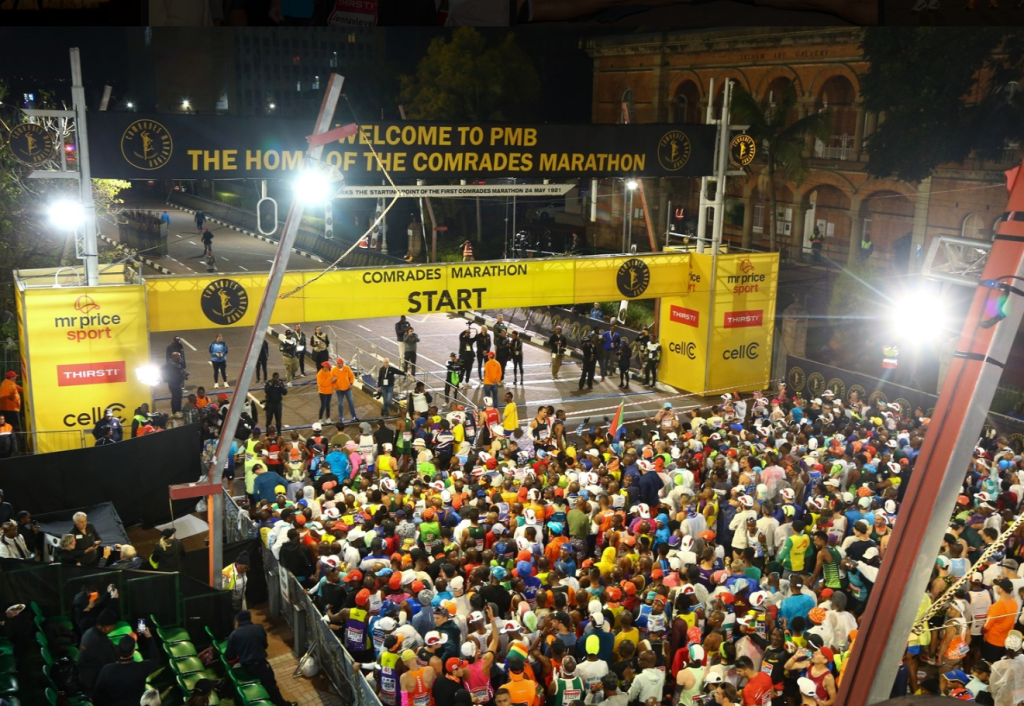
On 24 May 1921, Empire Day, the inaugural Comrades Marathon began outside Pietermaritzburg City Hall with 34 runners, most of them former infantrymen. Of these, 16 completed the course within the 12-hour time limit. Bill Rowan crossed the line first in eight hours and 59 minutes.
A race of firsts and legends
The Comrades Marathon has witnessed remarkable milestones throughout its 105-year history. The race officially opened to women and runners of colour in 1975. That year, Vincent Rakabele became the first Black runner to officially win a medal, whilst Elizabeth Cavanaugh became the first official women’s winner.
No discussion of Comrades legends is complete without mentioning Bruce Fordyce (70). The former South African ultramarathon champion holds the record for the most victories with nine wins, including an unprecedented eight consecutive titles from 1981 to 1988, followed by another victory in 1990. His “down run” record of 5:24:07, set in 1986, stood for 21 years.
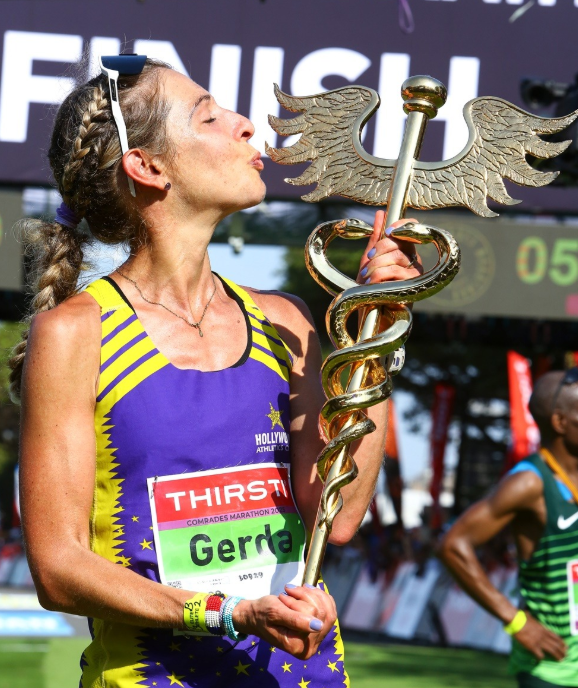
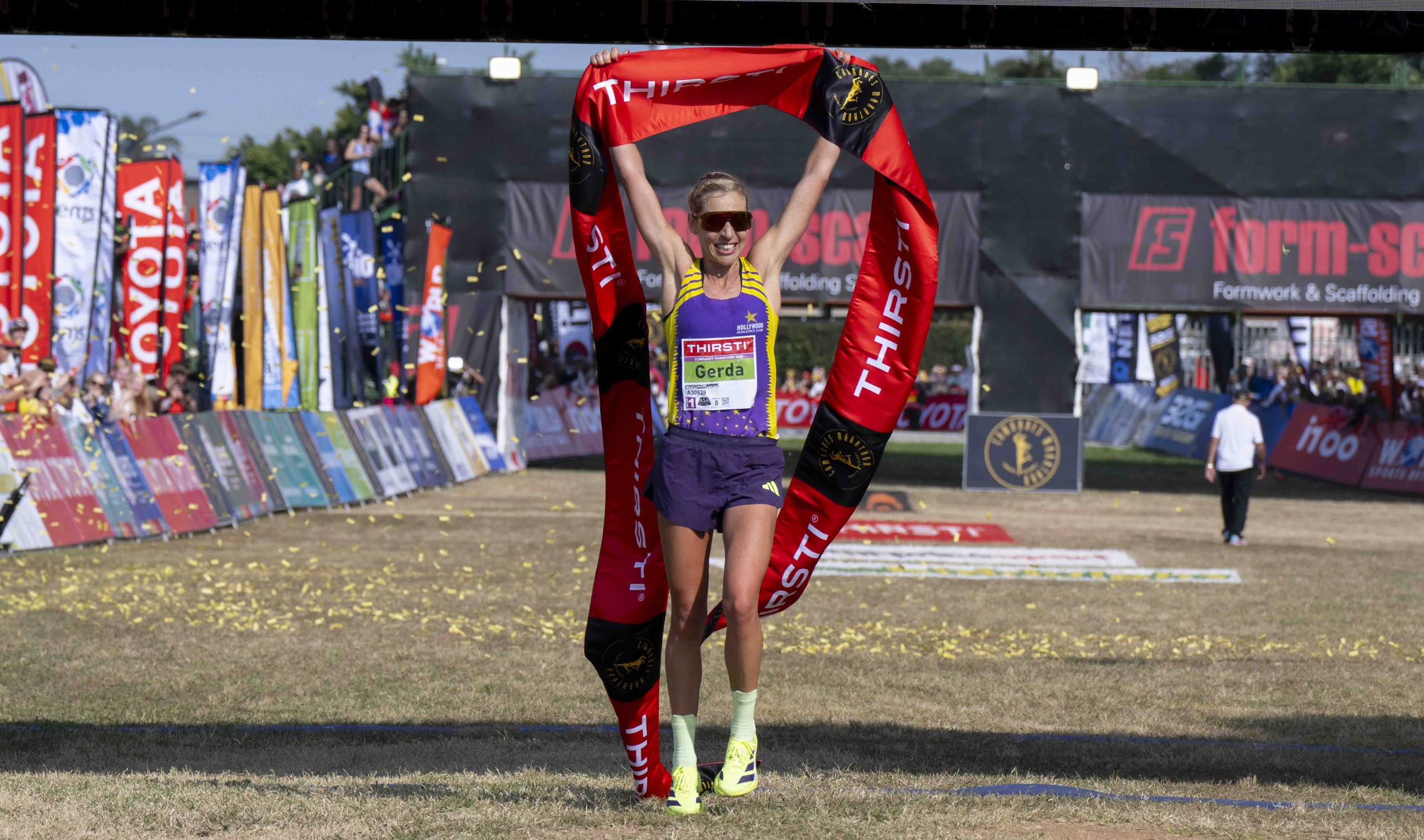
Among women, Russia’s Elena Nurgalieva reigns supreme with eight titles (2003, 2004, 2006, 2008, 2010, 2011, 2012 and 2013). However, South Africa’s Gerda Steyn is rapidly ascending the ranks. The 34-year-old claimed her fourth victory in 2025, becoming only the second woman to win more than three times. She holds both the women’s “down run” record (5:44:54, set in 2023) and “up run” record (5:49:46, set in 2024).
The current men’s records belong to Tete Dijana, who ran 5:13:58 on the “down run” in 2023, and Leonid Shvetsov, who clocked 5:24:49 on the “up run” in 2008.
Age is just a number
The Comrades Marathon has proven that extraordinary achievement knows no age limit. In 2025, Johannes Mosehla (83) became the oldest finisher in the race’s history, having previously set records at 81 in 2023 and 82 in 2024. At the opposite end of the spectrum, Xander McNeil became the 2025 race’s youngest finisher at just 20 years and six days old.
Perhaps no story better illustrates Comrades dedication than that of Louis Massyn. In 2025, the 74-year-old became the first person to complete 50 Comrades Marathons. He is attempting number 51 in 2026, though he is being chased by Vic Boston (66) with 47 finishes, Wietse van der Westhuizen (68) with 46 finishes, and Alan Robb (72) with 44 finishes.
ALSO READ: Celebrating 50 years of Comrades Marathon excellence
Traditions that endure
The Comrades Marathon is steeped in unique traditions that connect modern runners to the race’s storied past. Each race begins with a specific ceremony: the South African national anthem, followed by the singing of “Shosholoza” (a traditional miner’s song), the playing of “Chariots of Fire” by Vangelis, and then the famous rooster crow.
The cock’s crow tradition began in 1948 when race official Max Trimborn began imitating the sound, either from nervous reaction or as a substitute for the starter’s gun. Today, a recording of Trimborn’s original crow is played before the gun fires.
Runners observe other traditions along the route. At Arthur’s Seat, a small recess in the bank near Drummond, participants traditionally greet “Arthur” or leave a flower at what is believed to have been a resting spot for five-time winner Arthur Newton, hoping for good luck in the second half of the race.
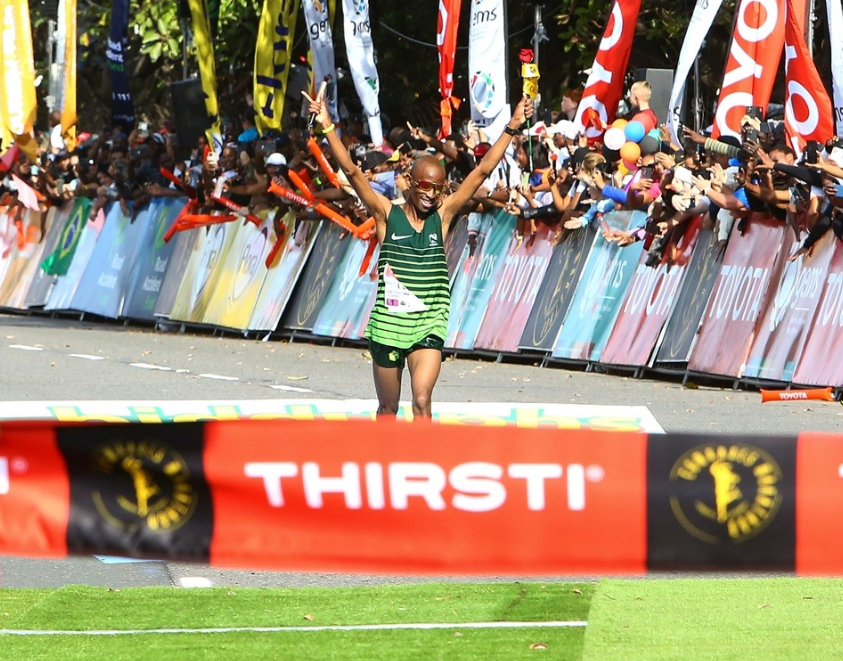
At the finish line, each of the top 10 male and female finishers receives a red rose upon entering the finishing straight. The leading man and woman receive a scroll containing a goodwill message from the mayor of the starting city to the mayor of the finishing city.
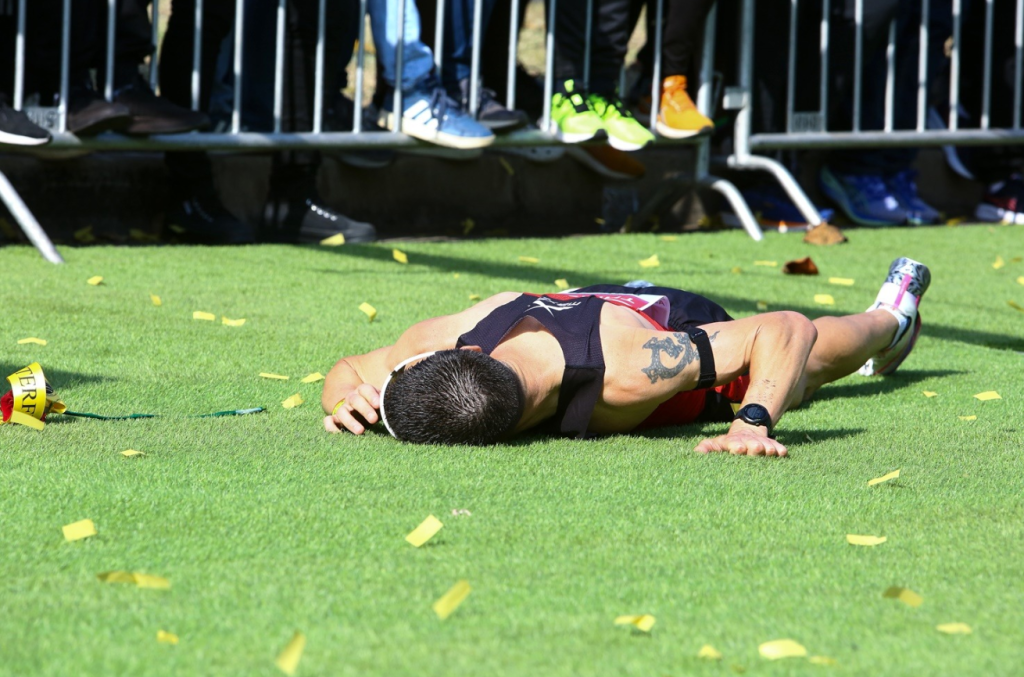
At precisely 12 hours after the start, a final gun is fired and a lone bugler plays “The Last Post”, signalling the end of the event. Any runner who crosses the line after this receives no official time or medal, making the final moments a desperate race against the clock.
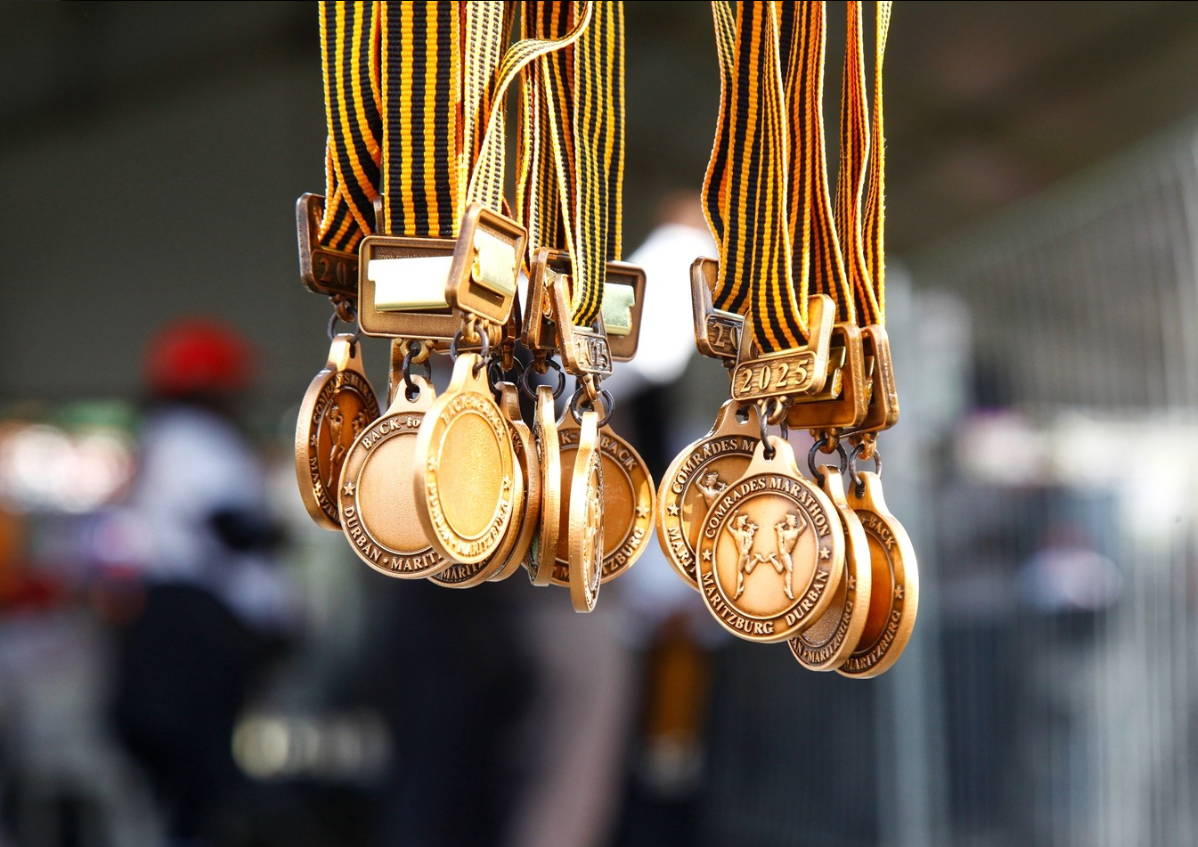
The medal system reflects runner achievement, with seven categories ranging from gold (awarded to the first 10 men and women) to the Vic Clapham medal (for those finishing between 11 and 12 hours). Bib colours signify experience: international runners receive blue bibs, those completing their 10th Comrades receive yellow bibs, and runners who have completed 10 or more marathons qualify for a permanent green bib featuring their own unique race number.
The ultimate test
The race alternates annually between an “up run” (Durban to Pietermaritzburg, approximately 85,777 km) and a “down run” (Pietermaritzburg to Durban, approximately 89,98 km). Despite the names, both directions feature significant elevation changes that test even elite athletes.
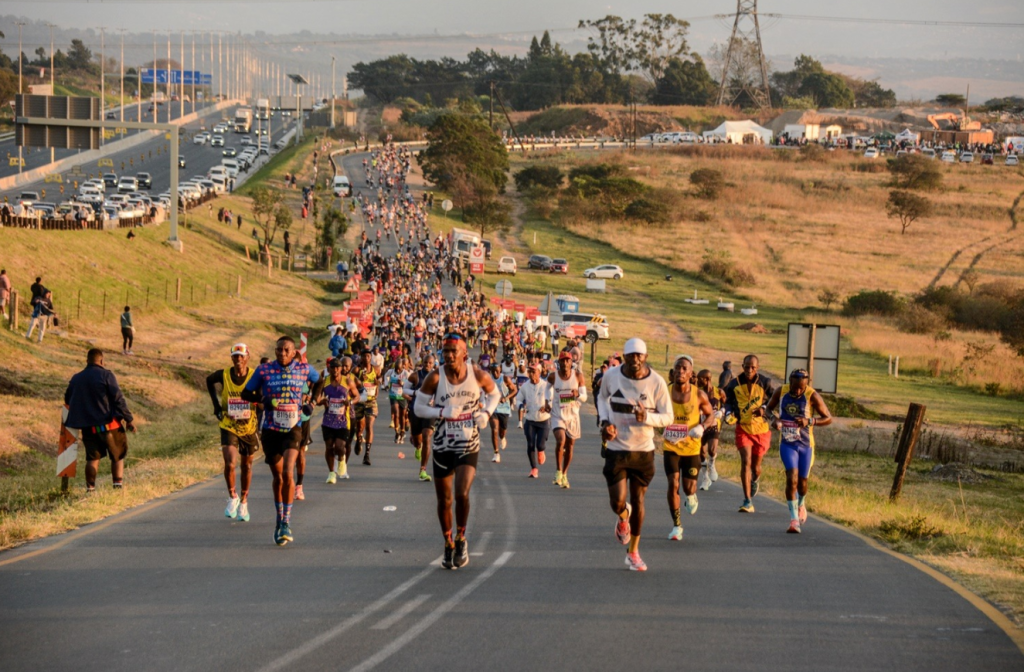
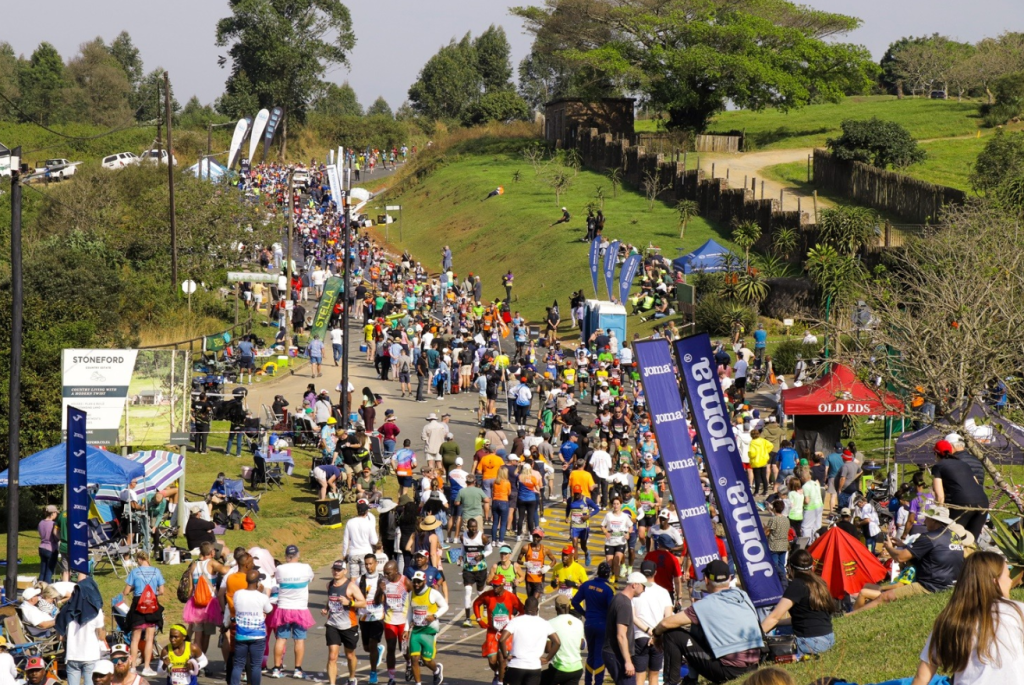
The 2025 edition, a “down run”, attracted 24 163 entries with 22 677 qualifying entrants. Approximately 20 000 runners started, and 18 207 finished within the time limit. The race represented more than 80 countries, including 3 064 international runners, with an average finisher age of 43,9.
For the first time in 2025, organisers implemented a two-wave start to manage congestion: Group 1 (batches A to J) started at 05:45, whilst Group 2 started at 06:00.
South African Tete Dijana claimed his third victory in 5:25:28, whilst Gerda Steyn dominated the women’s race, taking the lead shortly after halfway and never relinquishing it, finishing in 5:51:19.
ALSO READ: Comrades runner set to publish book on journey to recovery from addiction
This year’s race
The 2026 Comrades Marathon, scheduled for 14 June, marks the 99th edition and the 50th “up run” in the race’s history. The event sold out in record time, with entries reaching the 22 000 cap in less than 10 hours after opening to general registration on 3 November 2025.
Following the final qualification deadline of 4 May, 21 633 runners have been confirmed as qualified participants. The 2026 race features a new three-group start system designed to manage congestion whilst ensuring all runners have a full 12 hours to complete the course.
Group 1 (approximately 9 952 runners) starts at 05:00, Group 2 (approximately 6 704 runners) starts at 05:15, and Group 3 (approximately 4 972 runners) starts at 05:30. Each group operates on a gun-to-mat basis.
International participation continues to grow, with India showing the most significant increase. After South Africa, the top 10 participating nations for 2026 are Zimbabwe (489 runners), Botswana (293), India (279), United Kingdom (255), Brazil (172), Russian Federation (136), Zambia (118), Eswatini (107), Namibia (99) and the United States (96).
Notable international athletes to watch include South African Sibusiso Kubheka (the first person to break six hours for 100 kilometres), Lithuanian Aleksandr Sorokin (holder of the 100 km and 24-hour world records), and American Charlie Lawrence (holder of the 50 mile world record). All three used the Adidas Chasing 100 event as their qualifier.
ALSO READ: Record-breaking demand: 2026 Comrades Marathon sells out in just 10 hours
The human cost
Whilst the Comrades Marathon celebrates human achievement, it is not without risk. As of 2022, eight deaths have been officially recorded in direct association with the race over its history. The Comrades Marathon Association defines race-related fatalities as deaths of runners who were treated or hospitalised on race day. Deaths occurring days after the event, or involving runners not treated on race day, are generally not included in the official tally.
Medical professionals note that whilst determining precise causes is difficult, most fatalities appear related to cardiac arrest. The 2025 race saw no fatalities, though 440 runners were treated in the medical tent at the finish area and 200 were sent to hospitals for evaluation. Five runners remained hospitalised following the race but were reported as stable and recovering.
The event maintains significant medical infrastructure to support participants, recognising that pushing human limits carries inherent risks.
A global phenomenon
In 2010, the Comrades Marathon was recognised by Guinness World Records as the ultramarathon with the most runners, with 14 343 athletes finishing within the 12-hour limit. The race has inspired ultra-running events worldwide and maintains a network of international ambassadors who promote the Comrades story in their respective countries.
The race has raised substantial funds for charity, with the 2026 campaign already generating millions of rands for various causes through the Race4Charity initiative.
As the 99th Comrades Marathon approaches, Vic Clapham’s vision endures. What began as a memorial to 34 fallen soldiers has become a global celebration of human endurance, bringing together tens of thousands of runners from more than 80 nations. The race remains true to its constitution’s mandate: to celebrate mankind’s spirit over adversity.
For participants, the Comrades Marathon is more than a race. It is a pilgrimage, a test of will, and a connection to a century of runners who have trodden the same path between Durban and Pietermaritzburg. As the rooster crows and 21 633 runners surge forward on 14 June 2026, they will carry forward a legacy forged in the trenches of war and tempered by 105 years of human determination.
- Sources: Runners World; Comrades Marathon; Runningmann.co.za



You must be logged in to post a comment.