

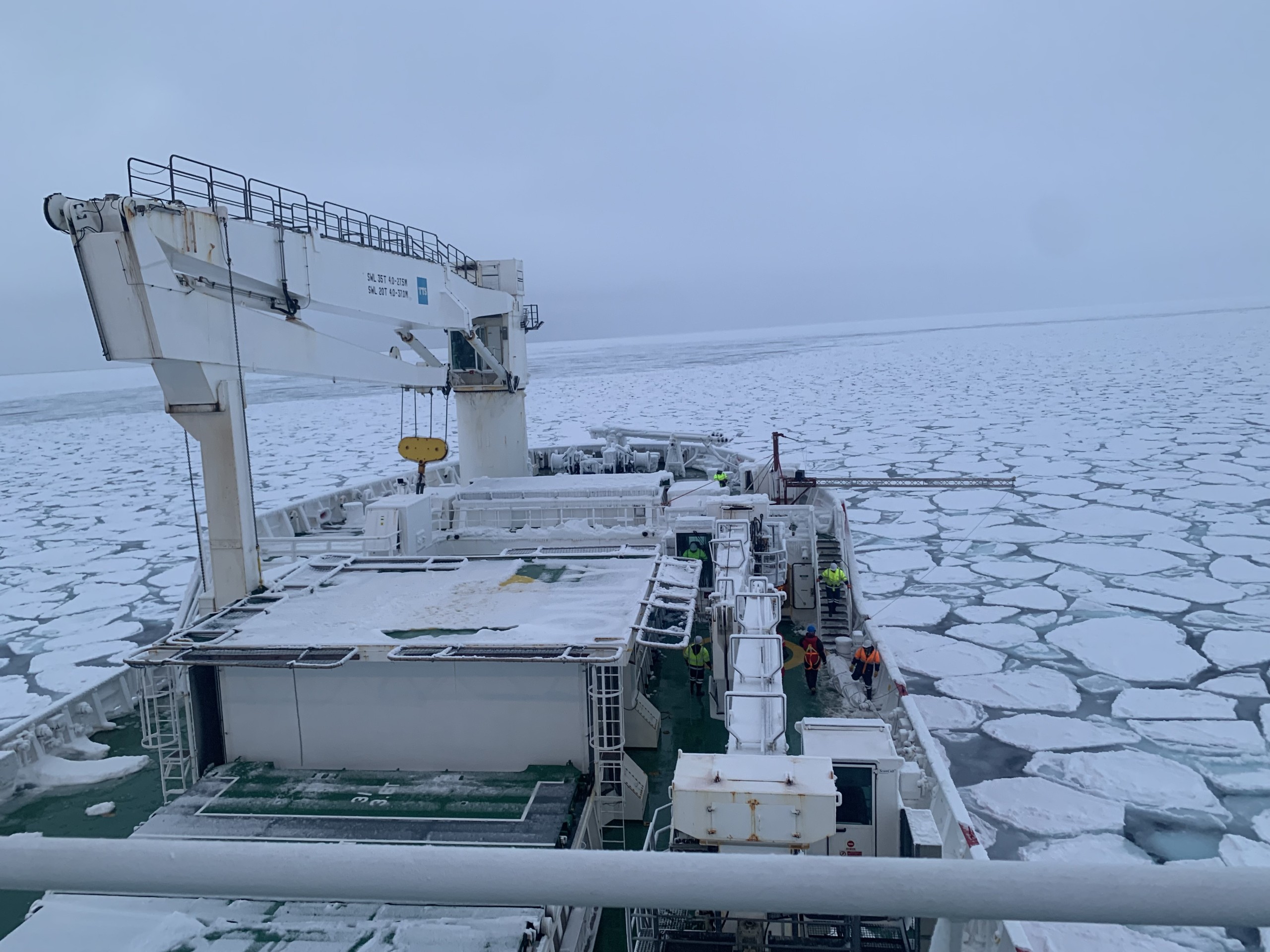
Beneath the vast sheets of ice that ring Antarctica every winter lies something scientists are only beginning to fully appreciate – a thriving microbial world with a surprising role in regulating Earth’s climate.
A new study published in Nature Communications on Thursday 18 June, led by scientists from Stellenbosch University (SU), has found that the sea ice surrounding Antarctica is a rich reservoir of microorganisms.
What makes this discovery especially striking is that an overwhelming majority of these microbes share a single remarkable trait: the ability to produce and break down a compound called DMSP (dimethylsulfoniopropionate).

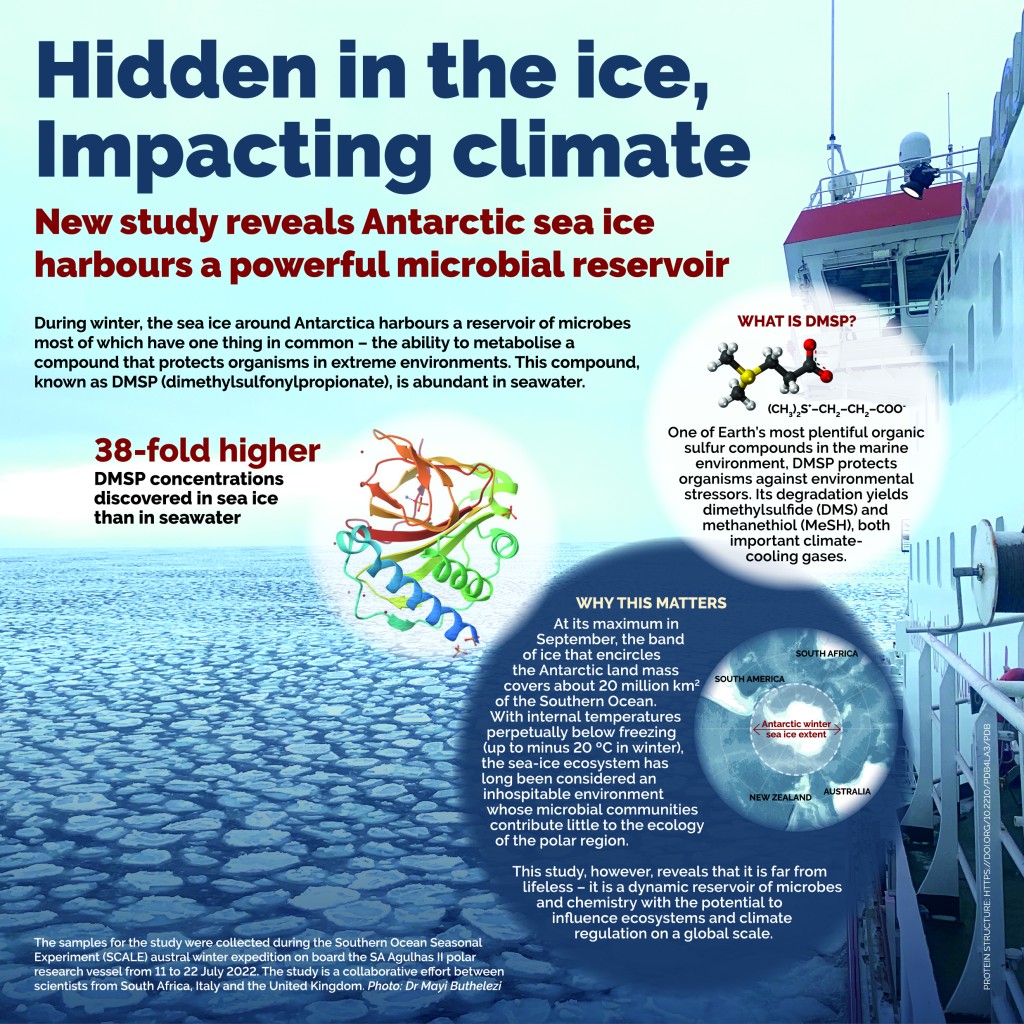
What is DMSP?
DMSP is one of the most abundant organic sulphur compounds in the ocean. It serves as a kind of biological shield, helping microbes survive in extreme environments by protecting them against stressors like freezing temperatures and high salt concentrations.
When DMSP breaks down, it releases two gases – dimethylsulfide (DMS) and methanethiol (MeSH) – that are known to have a climate-cooling effect. In short, these tiny organisms may be playing a significant role in keeping our planet cooler.
The research team found DMSP concentrations in Southern Ocean sea ice up to 38 times higher than in the surrounding seawater during the austral winter.
At its peak in September, the Antarctic sea ice covers roughly 20 million km², forming a frozen ring around the continent up to 1 900 km wide. That is an enormous area of potentially climate-active biological activity that has, until now, been largely overlooked.
Sampling in hostile environments
Collecting the data was no small feat. Samples were gathered aboard the SA Agulhas II polar research vessel during the Southern Ocean Seasonal Experiment (SCALE) winter expedition in July 2022.
Winter in the Southern Ocean brings some of the most ferocious conditions on Earth, making this kind of fieldwork both rare and exceptionally valuable.
First author Dr Mayi Buthelezi, a marine microbiologist at SU, explained that the ice’s extreme conditions – internal temperatures ranging from -1°C to -20°C – are precisely why microbes rely so heavily on DMSP. “Under stressful conditions, when organisms cannot afford to spend excessive energy for growth, they use DMSP as a buffering mechanism to survive,” he said.
The compound also serves as a vital source of carbon and sulphur, making it doubly useful for life in the ice.
ALSO READ: Researchers hunt for ancient Antarctic ice to unlock climate change secrets
Missing piece in climate puzzle
Senior author Prof. Thulani Makhalanyane, who holds the South African Research Chair in African Microbiome Innovation at SU, said the findings shed new light on the Southern Ocean’s role in global nutrient cycles and climate regulation.
“We show how microbial communities are contributing to the recycling of important sulphur-related compounds with important contributions to climate cooling,” he noted, adding that these communities now need to be incorporated into global Earth system models.
ALSO READ: Antarctic supply and research ship Agulhas off on her last journey
Co-author Dr Stéphane Pesant from the European Bioinformatics Institute echoed this, noting that advances in data infrastructure and artificial intelligence are helping scientists piece together a long-incomplete picture of ocean ecosystems.
“With the recent expansion of data infrastructures, bioinformatics skills and artificial intelligence, we are starting to exploit a treasure trove of historical data, and to identify important gaps in the geographic coverage of those observations. This study contributes to fill those gaps,” she adds.
Taken together, the findings firmly establish Antarctica’s winter sea ice not as a frozen wasteland, but as a dynamic, climate-relevant hotspot – one driven by microscopic life doing extraordinary work in the cold and dark.
- The paper “Dimethylsulfoniopropionate metabolism shapes microbial ecology and physiological adaptation during the austral winter in Southern Ocean sea ice and seawater”, was published in Nature Communications on 18 June 2026 and is available online.



You must be logged in to post a comment.