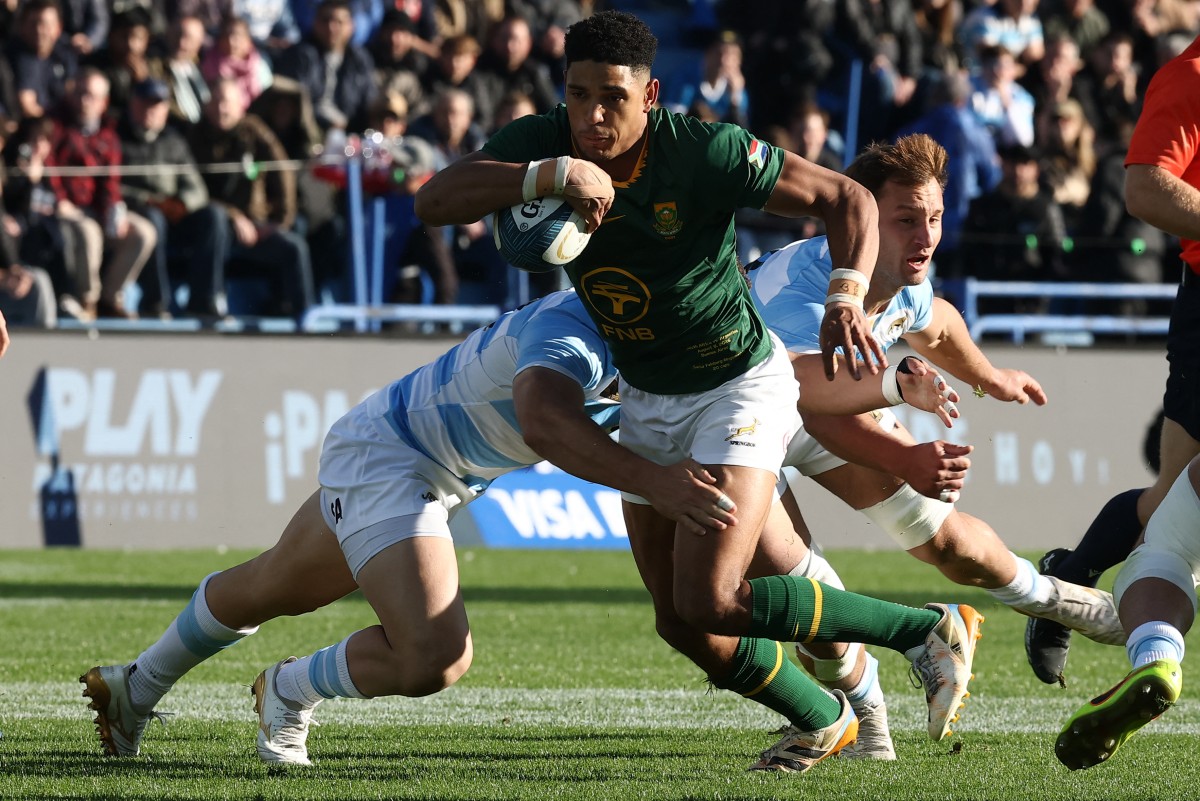
Forget cutthroat competition. Ditch the narrative of rivals battling for one golden jersey. The Springbok flyhalf stable operates on a completely different frequency, one built on mentorship, mutual respect, and the understanding that helping your “competitor” succeed actually strengthens the entire team.
Sacha Feinberg-Mngomezulu will start at flyhalf against Argentina on Saturday, earning his 20th Test cap as he returns from a lengthy injury layoff. With Handré Pollard and Manie Libbok also in the mix for the upcoming Greatest Rivalry series against New Zealand, the question seemed obvious: how does he handle the pressure of performing whilst competing for limited spots?
Also read: Magic man Sacha’s back, Siya leads on Bok return against Los Pumas
Before the 22-year-old could answer, Springbok coach Rassie Erasmus jumped in with a response that perfectly encapsulates why South African rugby operates differently to most international setups.
“For us, it’s not like that. It’s not him competing with Handré and Manie,” Erasmus stated flatly. “It’s Handré helping him this weekend to perform as well as he can. And Handré knows what Sacha needs to do at his age to get right. And that’s the way we operate.”
Then came the bombshell that kills any speculation about flyhalf battles defining selection for the next two years.
“So all three of them will definitely be in the Greatest Rivalry squad and definitely will go to the World Cup if they keep form.”
The only question is who starts which match, and even that’s determined collaboratively rather than competitively.
Pollard the Mentor, not the rival
Feinberg-Mngomezulu enthusiastically agreed with his coach’s assessment, revealing just how deeply the mentorship culture runs through the Springbok flyhalf group.
“I don’t think people understand how much we help each other,” the young pivot explained. “I mean, today Handré told me about the field, the dimensions of the field, how close the stands are to the pitch. Like, we really take good care of each other.”
In most international setups, that information stays locked away. You figure it out yourself. You don’t help the guy trying to take your jersey. But in the Springbok system, Pollard actively shares intelligence that helps Feinberg-Mngomezulu perform better, even though a stellar performance from the younger man could theoretically cost Pollard future starts.
That’s not naivety. That’s not weakness. That’s supreme confidence in the system and belief that collective strength trumps individual advancement.
Respect that transcends competition
Feinberg-Mngomezulu’s comments about Pollard revealed a relationship built on profound respect rather than rivalry.
“Even though I’m growing, and this is going to be my 20th cap on Saturday, I still have the utmost respect for Handré Pollard and what he’s done for the country and for this team,” he said.
“And not for a second will I see him in this competition. He’s my mentor. He’s my friend. And a great teammate to learn from.”
Twenty Test caps is significant, Feinberg-Mngomezulu isn’t a rookie anymore. He’s a genuine international-quality flyhalf who could walk into most Test teams on the planet. Yet he maintains humility, recognises what Pollard has achieved, and values the mentorship over any perceived advancement that might come from viewing Pollard as an obstacle rather than an asset.
The Erasmus philosophy
Rassie Erasmus has revolutionised many aspects of Springbok rugby, tactical innovation, squad rotation, media engagement, but perhaps his most underrated achievement is fostering this culture where depth doesn’t create internal division.
He has created an environment where the veteran understands his role includes developing the next generation, even when that development could theoretically cost him game time.
It’s the opposite of the “veteran protecting his position” narrative that plagues many teams. Instead, veterans are expected to accelerate younger players’ development, share knowledge freely, and trust that the system will reward everyone appropriately.
That trust is reciprocated. By guaranteeing all three flyhalves World Cup spots “if they keep form,” Erasmus removes the zero-sum competition that breeds toxicity. There’s no knife-edge selection where one player’s success means another’s exclusion.
Why this works
Cynics might argue this softens competitive edge or reduces individual hunger. The Springboks’ results suggest otherwise. Back-to-back World Cup victories. Consistent rankings at or near world number one. Depth that allows them to rotate entire packs without significant performance drop-off.
The system works because it’s built on three foundations:
First, clarity. Players know where they stand. Erasmus doesn’t create false competition or play mind games. He’s transparent about who’s in the mix, what’s required, and how decisions will be made.
Second, trust. Players trust the coach to manage selections fairly. The coach trusts players to prioritise collective over individual. That mutual trust allows mentorship rather than rivalry.
Third, depth security. By guaranteeing World Cup spots for all three flyhalves, Erasmus removes the scarcity mindset that breeds competition. There’s enough to go around, so help each other maximise collective potential.
The Buenos Aires test
Saturday’s match against Argentina provides the perfect stage for Feinberg-Mngomezulu to demonstrate the value of this approach. He’s returning from injury, facing quality opposition in a hostile environment, and carrying the weight of being just the third-choice flyhalf trying to prove he belongs.
Except he’s not third-choice in the traditional sense. He’s one of three options, equally valued, each bringing different qualities. Pollard has briefed him on field specifics. Libbok has presumably shared insights from his own experiences. The entire flyhalf group wants him to succeed because his success strengthens the collective.
That’s pressure, certainly, but it’s pressure shared across the entire squad rather than shouldered alone. When you know your teammates, including supposed rivals, genuinely want you to perform brilliantly, it changes the psychology of performance.
The greatest rivalry awaits
Erasmus’ confirmation that all three flyhalves will feature in the Greatest Rivalry series against New Zealand provides fascinating tactical possibilities. Different opponents, different conditions, different game plans, all served by three quality options with distinct strengths.
Pollard brings World Cup-winning experience and ice-cold composure under pressure. Libbok offers running threat and unpredictability. Feinberg-Mngomezulu provides versatility and the ability to cover multiple positions. Rather than picking one and leaving quality on the bench, the Springboks can deploy all three across the series.
That depth becomes a weapon rather than a headache because the culture ensures whoever doesn’t start remains fully invested in team success rather than sulking about individual disappointment.
The long game
Looking ahead to the 2027 World Cup, this flyhalf management could prove decisive. Pollard will be 33, still experienced but needing careful workload management. Feinberg-Mngomezulu will be 24, entering his prime with four years of Test rugby behind him. Libbok will be 30, offering the perfect blend of experience and athleticism.
By guaranteeing all three spots now, Erasmus ensures they continue developing collectively rather than fracturing into rival camps. The mentorship continues. The knowledge sharing accelerates. And when the World Cup arrives, South Africa fields not just one quality flyhalf but three, each capable of winning Test matches, each supported by the others.
The Springboks have built the culture. Saturday in Buenos Aires, Feinberg-Mngomezulu benefits from it. And somewhere, Handré Pollard and Manie Libbok will be watching, hoping their teammate excels, knowing his success strengthens the entire squad.
That’s not competition. That’s brotherhood. And it might just be the Springboks’ greatest competitive advantage.