

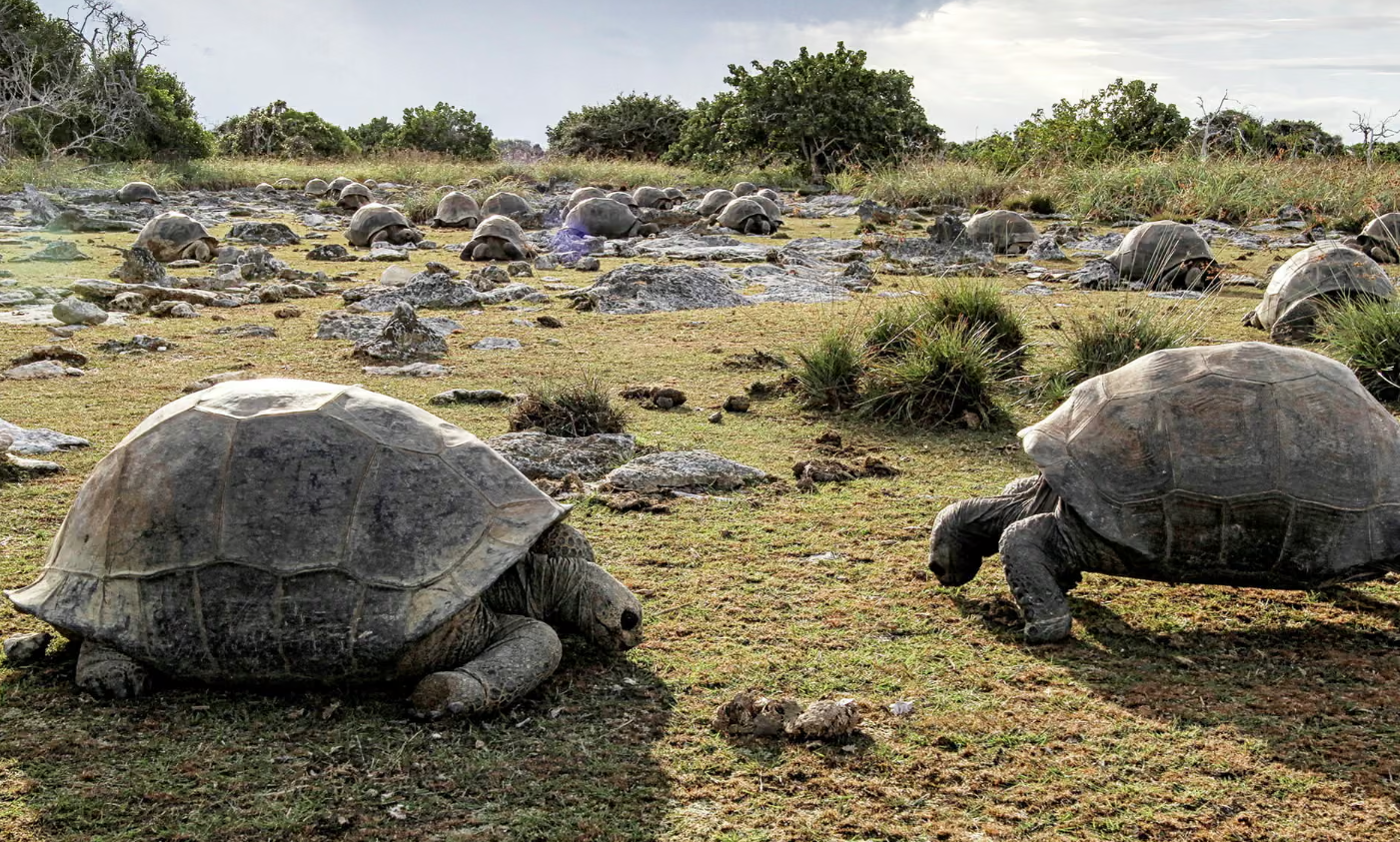
A once-endangered giant tortoise population is now thriving on a Seychelles atoll, with over 180 000 recorded. The highest population for the species yet.
The Aldabra giant tortoise was once hunted to fewer than 1 000. Now, a new survey has estimated that 183 000 adult and sub-adult tortoises live in the wild in the Seychelles.
Moreover, there are now more giant tortoises on Aldabra Atoll than humans.
Recorded on the Aldabra Atoll, the figure represents the highest population estimate yet for the species and confirms what researchers describe as a major conservation success in the Indian Ocean.
The survey was led by the Seychelles Islands Foundation (SIF) and the University of Exeter. It analysed five years of tortoise counts collected between 2018 and 2022.
Findings published in the scientific journal Ecology and Evolution provide the first major update since an estimate of 100 000 tortoises was widely cited in the 1990s.
According to the research, the population remained relatively stable during the study period.
Aldabra Atoll is one of only two places where giant tortoises occur naturally in the wild, with other population found in the Galápagos Islands.
Dr Frauke Fleischer-Dogley, SIF chief executive, said the population demonstrated what sustained conservation efforts could achieve.
“More than 180,000 giant tortoises roaming freely on our atoll is proof of what long-term commitment to conservation can achieve,” she said. “This is wonderful news for Seychelles, for the world, and for everyone who has worked to protect Aldabra.”
Conservation efforts save a declining species
In the 19th century, the species faced severed declines as a result of exploitation. This left fewer than 1 000 tortoises on the atoll.
Conservation efforts subsequently helped secure the animals’ future, with the Aldabra becoming a strict nature reserve in 1981 and a UNESCO World Heritage Site in 1982.
Researchers said the lates study provides a more reliable baseline for monitoring the population in the decades ahead.
Dr Nancy Bunbury, a co-author of the study, said that counting the tortoises remained challenging because of the atoll’s dense vegetation.
“By modelling what we didn’t see, as well as what we did, we’ve produced the most reliable baseline yet for this iconic Seychelles species, establishing a benchmark we can use to track the population for decades to come,” she said.
Despite the encouraging figures, researchers warned that the tortoises remain vulnerable to environmental changes.
Longer and more frequent droughts could reduce the availability of food and shade, while rising sea levels threaten low-lying areas of the atoll.
The findings highlight the scale of the species’ recovery while underscoring the importance of continued monitoring and conservation to protect one of the Indian Ocean’s most significant wildlife populations.


