
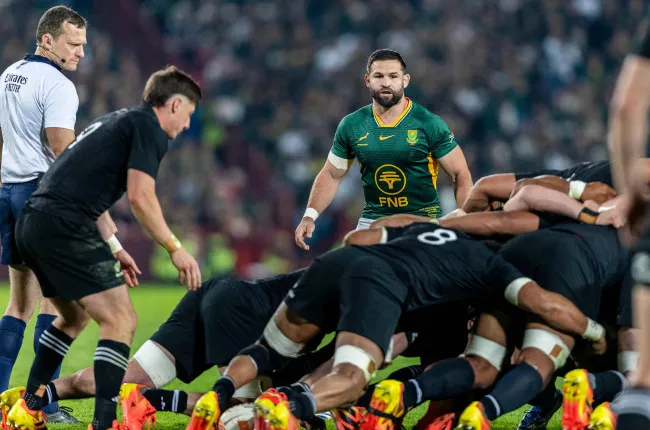
The scrum remains rugby’s most controversial set-piece, a technical battleground where eight forwards collide with bone-crunching force whilst coaches scream about illegalities, referees frantically monitor player safety and spectators wonder why nobody gets penalised for feeding the ball so crookedly it practically enters the scrum sideways.
ALSO READ: Rassie unleashes expletives over All Blacks’ scrum allegations
All Blacks coach Dave Rennie continued complaining about the Springboks’ scrum long after the Greatest Rivalry series concluded, claiming South Africa don’t scrum legally. Recently, Bulls coach Johan Ackermann joined the chorus of frustrated voices after his pack dominated Ulster’s scrum throughout their URC match yet received just one penalty reward late in the game.
Tappe Henning, the URC’s head of referees, spoke to Die Papier to explain why dominance doesn’t automatically equal penalties, what actually constitutes “walking around” and why crooked feeds remain unpunished despite law books clearly stating otherwise.
Where scrums are won and lost
“The setting up of the scrums remains the most important part because it will determine the success of the scrum,” Henning explained, cutting straight to the foundation issue coaches obsess over.
“The hookers form the centre of the scrum and how they position themselves on either side of the mark is crucial. It is vital to get the front rows’ binding position right so that they form a straight line on both sides.”
That setup phase determines everything. Get positioning fractionally wrong and your pack spends 80 minutes getting shoved backwards regardless of how much power they generate.
Explaining how teams gain scrum advantage, Henning said: “For a team to dominate, all three players in the front row must scrum straight ahead and, as a pack, move straight over the mark of the scrum. If the scrum then swings, they will still have the advantage of a penalty if the other team commits an offence in the process.”
But here’s the frustrating reality coaches hate hearing: “Dominance in the scrum does not necessarily lead to a penalty. One pack can drive the other team back several metres, but if the other pack is still scrummaging within the laws, the dominant team must use the ball and continue with play.”
Dominance without opposition illegality just means you get quick ball, not penalties.
The “walking around” controversy
Rennie’s accusations that the Springboks “walk around” scrums rather than driving straight sparked particular debate. Henning directly addressed the claim.
“It can sometimes happen when the Springbok scrum is under pressure, but the players are individually coached by Daan Human, the Springboks’ scrum coach, to scrum straight ahead,” Henning said. “That’s how his team gains the upper hand over their opponents.”
ALSO READ: Mind games begin as Rennie demands faster play
He explained what genuine “walking around” actually looks like: “The tighthead prop of a team can sometimes deliberately move slightly to the left, which means the rest of his front row has to follow. This results in the loosehead prop of the other team suddenly having nobody in front of him, leaving him with no choice but to walk around to maintain contact with the other front row.”
But loosehead props sometimes deliberately manufacture the offence themselves: “Loosehead props sometimes deliberately make themselves guilty of walking around, and it is clearly visible when their hips swing outwards. There is then a gap between the hips of the loosehead prop and the hooker, which is penalised.”
The crooked feed nobody penalises
Here’s where rugby’s law application becomes hilariously pragmatic. Law books clearly state scrumhalves must feed the ball straight down the scrum’s middle channel, with the hooker making contact. Reality? Almost nobody does it, and referees don’t care.
“We are fully aware that spectators are sometimes unhappy about the ball being fed crookedly into the scrum by the scrumhalf,” Henning admitted. “The law clearly states that the hooker must make contact with the ball, which to some extent neutralises the hooker’s scrummaging power at that moment. However, this does not happen in most scrums, and referees have so many aspects to focus on that they do not notice it most of the time.”
Player safety takes priority over feed straightness every time. Referees monitoring bind positions, angles, collapses and dangerous play simply can’t simultaneously police whether the scrumhalf fed the ball two degrees off-centre.
But here’s the stunning revelation: coaches don’t actually want crooked feeds penalised.
“Coaches have told us directly that they do not have a problem with scrumhalves feeding the ball crookedly, because their team should have the advantage anyway, as the other team has committed an offence,” Henning noted.
“We have not yet received a single video clip or complaint from coaches about a try being scored after the ball was fed crookedly into a scrum.”
The scrum remains rugby’s most technical, most controversial and most misunderstood set-piece. Coaches will keep complaining. Referees will keep prioritising safety over strict law application. And spectators will keep wondering why nobody gets penalised for feeds so crooked they could navigate around corners.