

BLOEMFONTEIN – Since the beginning of the new dispensation in 1994, support for the ANC is at an all-time low.
According to the newest research by Ipsos, no party commands a strong majority support as South Africa heads into coalition territory ahead of the 4 November Local Government Elections.
Mari Harris, Political Analyst at Ipsos in South Africa, says the biggest change was brought about when the ANC lost its majority in the 2024 National Election for the first time since 1994. This year surveys are showing a continuing decline in support for the ruling party, while no single party currently commands strong majority.
ALSO READ: OPINION | Window dressing won’t fix services: Why every vote counts on 4 November.
“Looking at the pre-election surveys conducted, we will probably have new coalition governments in most of the metropolitan municipalities after the elections, with numerous local and district councils also expected to be governed through coalition arrangements,” says Harris. “Two weeks of intense speculation and uncertainty are likely to follow the announcement of the final election results, as coalition negotiations take centre stage particularly in councils where no single party secures a majority.”
Interviewing for Ipsos’ latest Khayabus “Pulse of the People” study (Wave 2 2026) took place from 12 September to 13 October, during the time when campaigning intensified.
Voter turnout will be critical
Of the 44,9 million South Africans who are 18 years and older, and therefore eligible to vote, only 29,2 million are registered with the Electoral Commission (IEC). This figure represents 65% of those who are eligible to vote, thus 35% of citizens have disenfranchised themselves by not registering.
If turnout on 4 November mirrors that of the 2021 Local Government Election (LGE2021), only about 12,8 million will cast a vote. If turnout is similar to that of the 2024 National and Provincial elections, about 16,3 million voters can be expected to participate.
LEES OOK: Kiesers het keuse in samestelling van plaaslike regering.
Although more than 600 political parties are registered with the IEC for participation in LGE2026, 47% of South Africans eligible to vote said in Wave 1 of the “Pulse of the People” survey that: “There is no political party that represents my views”. In the latest Wave this has increased to 53%.
“Voter apathy is widely blamed, but voters are disappointed, disillusioned and frustrated with the situation in the country, especially with lack of service delivery and political promises without any action or any sense of responsibility on the side of many councils,” says Harris. “As illustration of this sentiment, 68% of registered voters say that “Politicians can’t be trusted”, while only 15% disagree.”
Nationally, no party commands majority support
Although the coming elections focus on South Africa’s 257 metropolitan, district and local councils, as well as 4 488 unique wards, the national view remains important. Current survey results suggest that no single party commands majority support nationally and that coalition politics is likely to remain a defining feature of South Africa’s political landscape in the next two-and-a-half years leading up to the next National Election.
Although hundreds of political parties are registered to contest the elections, only a small number currently attract meaningful levels of support among registered voters. The remaining parties each account for less than 1% of voter support.
The figures below reflect current levels of support for political parties among registered voters who selected a political party on the electronic ballot paper.
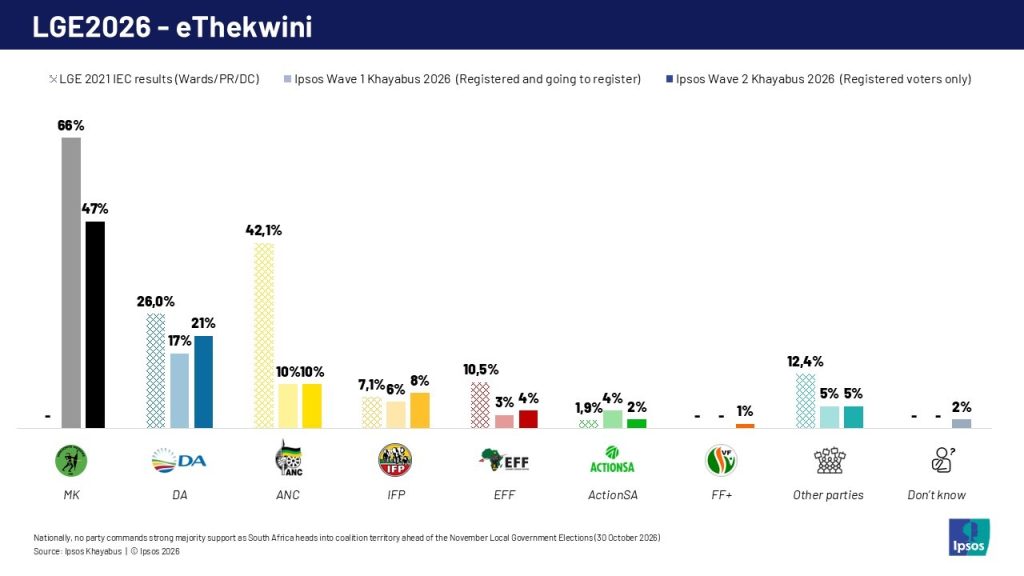
The first column refers to the results from the LGE2021, the second to the results from the Ipsos ”Pulse of the People” Wave 1 study published on 4 September 2026, and the last column refers to the latest results from the Wave 2 study.
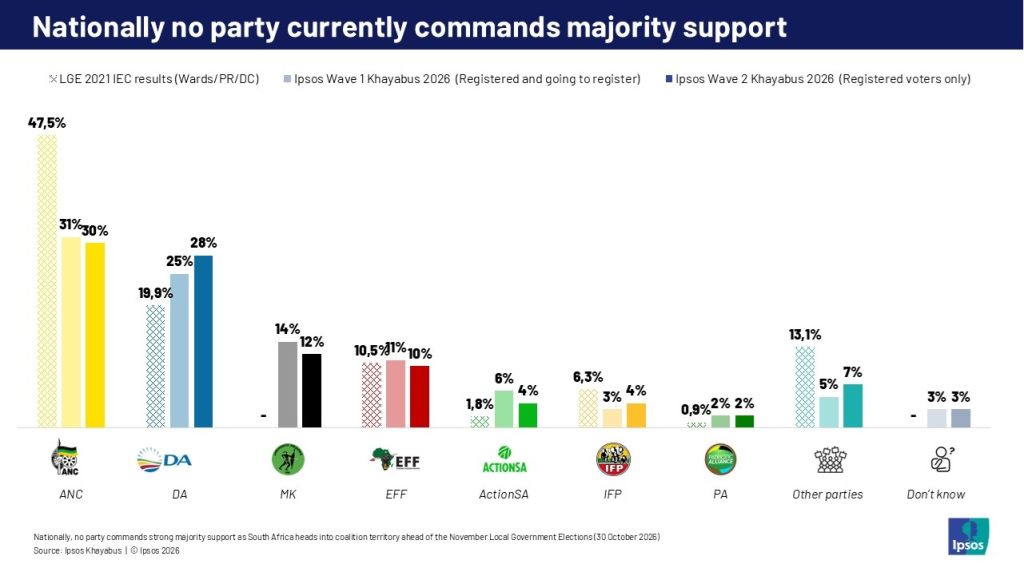
The results suggest that support for the ANC has declined significantly since the 2021 Local Government Elections. However, the party has historically strengthened its support during the final stages of election campaigns, and it remains to be seen whether a similar late mobilisation will occur ahead of LGE2026.
Consistent with other surveys conducted over the past year, the DA appears to have consolidated support beyond its 2021 and 2024 levels. The party is executing a very long campaign – especially in Johannesburg – and has also historically performed strongly in the final stages of election contests.
MK is contesting a local government election for the first time, and it appears as if they will largely emulate their performance in the 2024 national election. Support levels for most other political parties remain relatively close to their performances in the LGE2021 and earlier Ipsos polling in 2026. ActionSA is a notable exception. The increase in support for the party appears to be driven primarily by Gauteng.
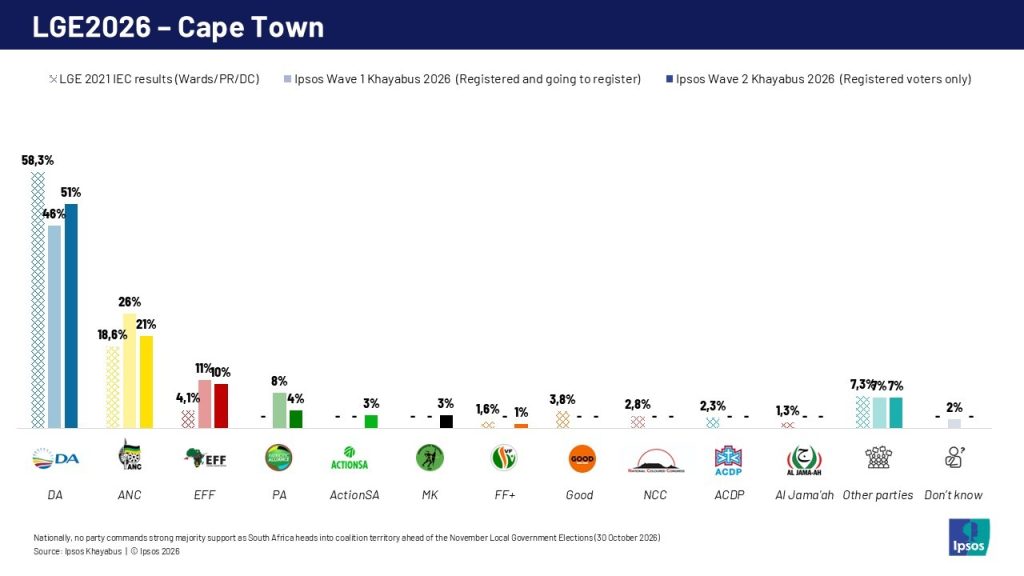
Despite an 8% point shift in support for MK in eThekwini, the party remains comfortably ahead of its competitors and continues to register as the largest party in the metro. However, one can argue that it was also influenced by uncertainty. The DA performance is relatively close to their position in LGE2021, while the ANC and EFF have not recovered the ground they lost to MK in the 2024 National election.
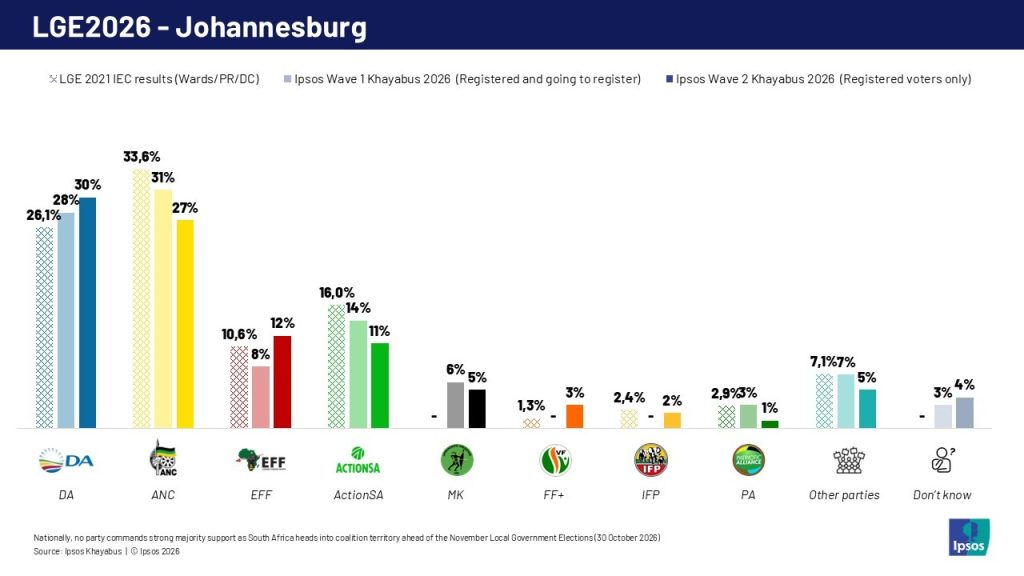
The levels of support recorded for the DA and ANC in Johannesburg broadly reflect the national view, but this time the DA registers slightly higher support than the ANC.
- Tshwane: In Tshwane the DA is 3 percentage points ahead of the ANC.
- Ekurhuleni: Currently the ANC is ahead of the DA, but the gap between the two parties is relatively narrow. They are followed by MK (with their best performance outside of eThekwini), ActionSA and the EFF. (The relative strong performance of Action SA in Gauteng is again observed.)
- Nelson Mandela Bay: Support levels between the DA and ANC remain extremely close, suggesting a highly competitive race, much as was observed earlier this year.
- Buffalo City: The ANC appears likely to remain the largest party in the metro, although current support levels suggest it may fall short of an outright majority.
- Mangaung: The ANC remains ahead, followed relatively closely by the DA and the EFF.
“If these survey results are indicative of the level of political support ahead of the elections, most metropolitan areas, if not all, depending on what happens with the DA in Cape Town and MK in eThekwini, are likely to require coalition governments,” says Harris.
“This places a significant responsibility on political parties to think carefully about potential coalition partners and the long-term implications of those partnerships.
“It may be tempting for parties to assemble coalition governments simply by securing enough partners to cross the 50% threshold, often through the allocation of key council positions or even mayoral posts, however, coalition negotiations should also consider the values, track record and governing principles of potential partners, as well as the practical realities of working together effectively,” notes Harris.


You must be logged in to post a comment.