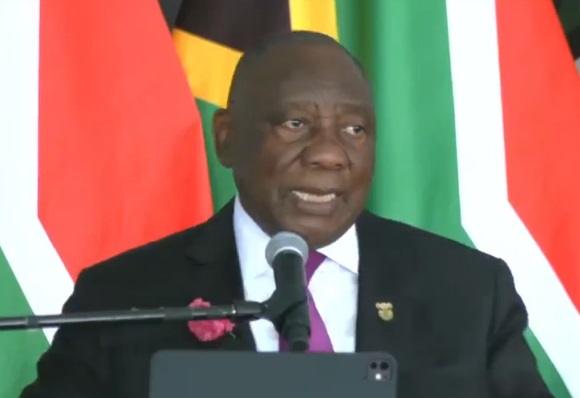
President Cyril Ramaphosa has launched a revised White Paper on Local Government that will fundamentally change how municipalities operate, just days before voters head to the polls on 4 November.
The sweeping reforms aim to fix a system where too many municipalities fail to deliver basic services, leaving millions of South Africans without reliable water, electricity and infrastructure.
Ramaphosa acknowledged the scale of the crisis during the official launch, saying municipalities owe Eskom more than R120 billion while communities grow accustomed to deteriorating infrastructure and unresponsive administrations.
“When these services work, people experience the promise of democracy. When they fail, it is not merely an inconvenience. It affects people’s health, their livelihoods, their safety and their dignity,” he said.
The White Paper marks the first major reset of the local government system since the original policy was adopted in 1998, nearly three decades ago.
What the 1998 White Paper tried to achieve
The original White Paper aimed to unite a fragmented apartheid-era system that created prosperous municipalities for a minority while denying most South Africans access to basic services.
The democratic government joined historically unequal municipalities, assigning them extensive powers and responsibilities while assuming economic growth would strengthen their revenue and capabilities over time.
This approach delivered results. Today, more than 90% of households have electricity access and more than 87% have piped water. Between 2004 and 2025, households with municipal piped water rose from 9.2 million to just under 16 million, while two-thirds now have flush toilets.
But Ramaphosa said the government underestimated how politicised appointments would open the door to corruption and failed to train enough engineers, town planners and municipal managers.
The major changes in the revised White Paper
The new policy ditches the one-size-fits-all approach that gave all municipalities the same powers regardless of their capability or resources.
Under the differentiated model, municipalities will receive powers and functions based on their size, capability and performance. Where a municipality cannot carry out a responsibility, it will be assigned elsewhere or handled through regional partnerships.
The White Paper separates the role of service authority from service provider and introduces compulsory licensing for all water and electricity providers. This aims to strengthen regulation of these essential services.
In a major financial reform, revenues from electricity and water sales will be ring-fenced and used to maintain infrastructure before anything else. Ramaphosa said municipalities have built new infrastructure while neglecting existing assets, with revenues diverted to other functions.
“We cannot build our way out of failure if we do not maintain what we have already built,” he said.
Building professional municipalities
The White Paper recommends sweeping changes to professionalise municipal administrations and build capacity.
It calls for councils that lead with integrity and administrators appointed for competence rather than political connections, with consequences when public resources are stolen or duties neglected.
The policy also links well-run local government to economic growth, arguing that investors need certainty and entrepreneurs need predictable municipal decisions.
Municipalities must plan for disasters before they strike, as floods, droughts and fires place growing pressure on communities and infrastructure.
ALSO READ: Failing municipalities choking local economic growth, warns president
How the reforms will roll out
Cabinet has endorsed a phased approach to implementation, supported by a time-bound Local Government Transition Management Body led by the Department of Cooperative Governance, The Presidency and National Treasury.
The body will not take over the duties of ministers, provinces or councils but will ensure reform does not fall between institutions and that commitments are followed through.
A single Local Government Transition Plan will set out what will change, who is responsible and how progress will be measured.
Some reforms will require new legislation, financing arrangements and possibly constitutional amendments, which will need careful consultation.
Ramaphosa urged every registered voter to make their voice heard in the 4 November local government elections, saying elected officials share an obligation to ensure municipalities work regardless of political disagreements.
“Our people must never be held hostage by political instability,” he said.
ALSO READ: Municipalities owe R1.79 billion in unpaid pension contributions