

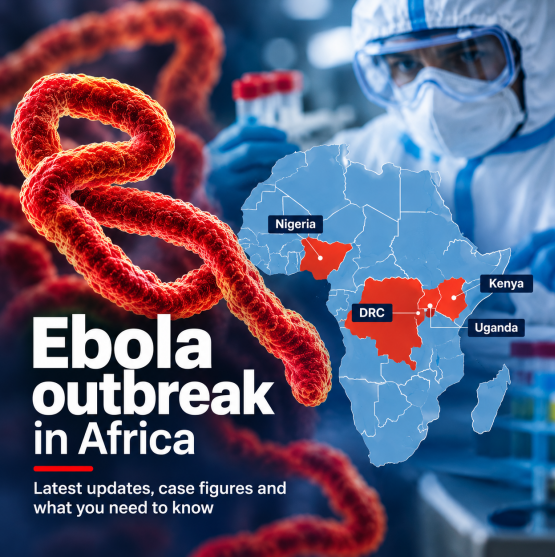
JOHANNESBURG – Africa is currently battling the most geographically widespread Ebola outbreak in history, driven by a hyper-rapid surge of cases in the Democratic Republic of the Congo (DRC) that is outpacing all previous epidemics.
As of 22 October the outbreak—which was first declared on 15 May—has rapidly escalated to near 10 000 confirmed cases.
Driven by the rare Bundibugyo virus strain, the outbreak has breached multiple regional borders, triggering emergency containment protocols across central and eastern Africa
Health authorities are monitoring the spread of Ebola across Africa after the Bundibugyo virus disease outbreak expanded beyond the Democratic Republic of the Congo (DRC), with cases reported in Kenya and Nigeria.
The outbreak has prompted renewed concern about cross-border transmission, particularly after Nigeria confirmed an imported case in its capital, Abuja, on 20 October.
According to the World Health Organization (WHO), the outbreak has become increasingly complex, with insecurity, population displacement and difficulties accessing affected communities complicating efforts to identify cases and trace contacts.
South Africa’s National Institute for Communicable Diseases (NICD) is monitoring the situation in collaboration with the National Department of Health, the WHO and the Africa Centres for Disease Control and Prevention (Africa CDC).
The NICD says preparedness measures include enhanced surveillance, laboratory readiness and infection prevention and control protocols for healthcare workers. No confirmed South African case was reported in the latest local information available for this article.
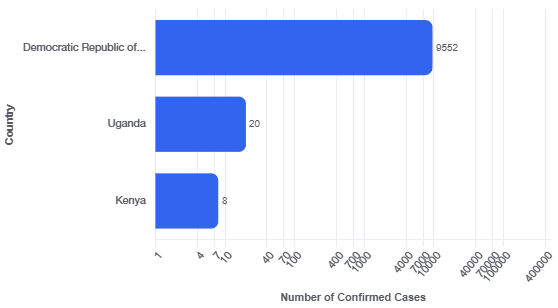
More than 9 600 confirmed cases have been reported in the Democratic Republic of the Congo, while new cases in Kenya and Nigeria raise concerns about further international spread. South Africa is monitoring the outbreak and maintaining its preparedness measures
More than 9 600 cases in the DRC
The DRC remains the epicentre of the outbreak.
The WHO’s regional situation report, using data available on 19 October, recorded 9 637 confirmed cases and 4 646 deaths in the DRC. The outbreak had spread across eight provinces and 66 health zones.
The NICD’s country-by-country update, based on data up to 18 October, reported 9 552 confirmed cases and 4 602 deaths in the DRC.
The figures differ because the reports use different reporting cut-off dates.
The reported death toll highlights the severity of the outbreak. The WHO’s figures put the crude case fatality ratio in the DRC at approximately 48%, although this measure can change as additional cases and outcomes are recorded.
Nigeria confirms imported case
Nigeria confirmed a case of Bundibugyo virus disease on 20 October after laboratory tests detected the virus in a woman with a recent travel history to Uganda.
The patient developed symptoms on 7 October, four days after arriving in Nigeria, and sought medical attention at a private health facility in Abuja on 11 October. She was subsequently placed in isolation and received medical care.
Authorities had identified 44 contacts for monitoring, while investigations continued to establish the likely source of infection and reconstruct the patient’s travel and exposure history.
The delayed diagnosis has raised concerns about the challenges of identifying Ebola in its early stages, when symptoms can resemble other illnesses.
Nigeria is the fifth country to detect the virus during the current outbreak, following the DRC, Uganda, France and Kenya.
Kenya reports additional cases
Kenya reported nine cases, including one death, by 20 October. The cases were linked to a cluster associated with the first imported case from the DRC.
The initial patient travelled through Uganda before arriving in Kenya and died on 5 October. Subsequent cases were identified among contacts, prompting isolation measures and contact tracing.
Uganda, which recorded 20 cases and two deaths during its outbreak, declared the outbreak over on 27 August after 42 days without a new confirmed case.
France reported one imported case in June. The patient recovered and was discharged in July.
Although the outbreaks in Uganda and France were declared over or contained, the latest developments in the DRC, Kenya and Nigeria demonstrate the continuing risk of international spread.
No approved vaccine for this Ebola strain
The current outbreak is caused by the Bundibugyo virus, a species of Ebola virus that differs from the Zaire ebolavirus responsible for several previous major outbreaks.
There is currently no approved vaccine or specific antiviral treatment for Bundibugyo virus disease. Early diagnosis, isolation, supportive medical care and effective infection prevention measures are therefore critical to managing cases and limiting transmission.
Ebola spreads through direct contact with the blood or other bodily fluids of an infected person who has developed symptoms. Transmission can also occur through contaminated objects, medical equipment and contact with the bodies of people who have died from the disease.
The virus is not spread through the air or through casual social contact.
Symptoms can appear between two and 21 days after exposure. Early signs include fever, headache, muscle pain, weakness and fatigue. Vomiting, diarrhoea and bleeding may occur as the illness progresses.
Because the early symptoms can resemble malaria and other common infections, people with compatible symptoms and a relevant travel or exposure history should seek urgent medical advice and inform healthcare workers of their possible exposure.
What South Africans should know
South African health authorities continue to monitor developments and maintain preparedness measures in case an imported case is identified.
Members of the public should follow official updates rather than rely on unverified social media reports. Anyone who develops compatible symptoms after possible exposure to Ebola should contact a healthcare provider urgently and call ahead before visiting a facility.
Healthcare professionals can contact the NICD‘s 24-hour hotline on 0800 212 552 for guidance on suspected cases.
The WHO has not recommended general travel or trade restrictions in response to the outbreak. Travellers should follow official health advice and disclose relevant travel or exposure histories if they become ill.
The situation remains serious, particularly in the DRC, where thousands of cases and deaths have been recorded. For South Africa, surveillance, early detection and accurate public information remain central to preparedness.
ALSO READ: New Ebola outbreak in DR Congo declared international health emergency


You must be logged in to post a comment.