
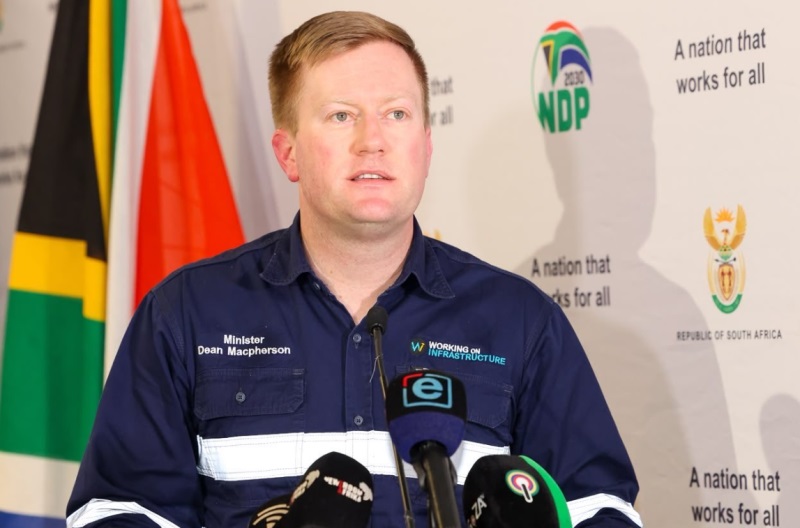
Public Works and Infrastructure Minister Dean Macpherson has announced the decisive removal of 13 construction companies from the Construction Industry Development Board’s (cidb) National Register of Contractors due to misrepresentation.
Following a critical resolution by the cidb Board on Thursday 15 October , the regularisations were enacted under sections 19(1) and 19(2) of the Construction Industry Development Board Act of 2000.
These specific legal provisions empower the Board to strip contractors of their credentials if they breach registration conditions or secure grading designations in error via deceptive applications.
Almost two years after the George building collapse tragedy that claimed 34 lives, there are still no clear answers as to who will be held accountable for the disaster that forensic investigators have attributed to systemic regulatory failures
ALSO READ: Demands for answers on George building collapse investigation
The 13 blacklisted entities include RTZ Construction and Projects, Shumani Development, Magagamela Trade and Projects, Exxeding Grace, Yem Yem Projects and Plant Hire, BBM Khanye Holdings, Lethabo Africa Engineering, TMR Industrial Solutions, Moriel Infrastructure Group (Pty) Ltd, Salinkata Trading (Pty) Ltd, King Tar Construction, Batho Vanhu Construction, and Ithembalenkosi (Pty) Ltd.
Notably, Moriel Infrastructure Group recently faced intense public scrutiny after its director was filmed allegedly threatening a group of women at a Johannesburg restaurant in September 2026, triggering an immediate cidb grading probe.
Registration grades
These penalised firms held various registration grades spanning from Grade 1 to Grade 9.
The cidb grading system rigorously assesses contractors based on their financial capability and historical track record to determine the scale of public projects they can safely handle.
When companies manipulate this process, it systematically disadvantages legitimate businesses and risks awarding critical public infrastructure contracts to completely under-capacitated firms.
Last year the bodies of four men had been recovered from the debris of the temple collapse in Verulam, following extensive search and rescue operations.
On Friday afternoon 12 December last year, teams of IPSS Search and Rescue were mobilised to the Verulam area after a structural collapse occurred at a building site.
ALSO READ: Four bodies recovered after temple collapse in Verulam
This clampdown marks a dramatic shift in accountability.
Between 2002 and June 2024, only one single contractor was blacklisted by the state. Under Minister Macpherson’s tenure since June 2024, more than 75 contractors have been aggressively removed and blacklisted for breaching registration requirements.
In March this year nine people have died following the collapse of an illegally constructed building in Ormonde, with authorities vowing to blacklist developers and strengthen enforcement of building regulations across the city.
The death toll rose to nine after a two-storey building under construction at the Amethyst Business Park collapsed on Monday, 2 March. Search and rescue operations concluded on Tuesday after the final body was recovered from the rubble. Three people remain in hospital.
ALSO READ: Premier demands accountability after fifth body recovered from temple collapse
“Since taking office, we have made it clear that the days of allowing contractors to misrepresent their capabilities and do business with the state without facing consequences must come to an end,” Minister Macpherson stated on Tuesday. “These actions are about protecting public money and creating a fair environment where honest businesses can compete.”
Backing the initiative, Democratic Alliance (DA) Deputy Spokesperson on Finance, Wendy Alexander MP, issued a statement on 27 October 2026 affirming the party’s support for rooting out dishonest contractors, contrasting the current momentum against the historical 22 years of sluggish ANC administration oversight.
To prevent future fraud, the cidb is introducing a strict verification layer to audit high-risk applications by cross-checking data directly with banks and public sector clients.
Where fraud or forgery is established, matters will be handed directly to law enforcement. cidb Board Chairperson Khulile Nzo warned that access to public procurement must be earned through genuine compliance, reinforcing that the department will continue working with law enforcement to protect the state’s multi-billion-rand infrastructure investments.
ALSO READ: Muizenberg beachfront upgrade hits 84% completion milestone