

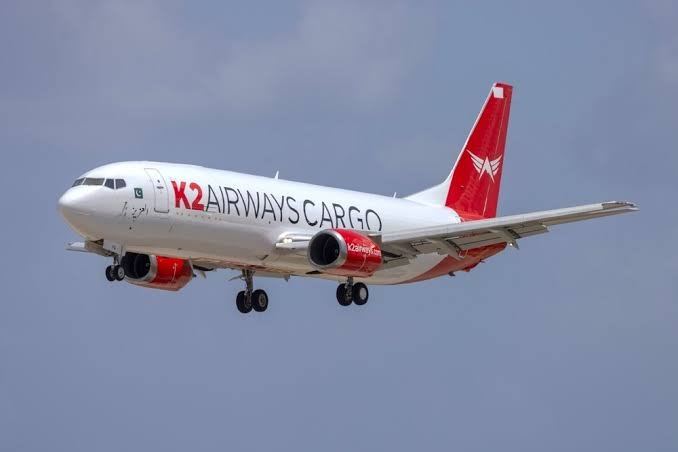
KARACHI, Pakistan – Pakistan’s military and civil aviation authorities are conducting extensive search and rescue operations for a Boeing cargo plane that disappeared off the country’s southern coast on Tuesday evening with five crew members on board.
Prime Minister Shehbaz Sharif confirmed the K2 Airways aircraft crashed into the Arabian Sea whilst flying from Sharjah in the United Arab Emirates to Karachi.
The Pakistan Airports Authority (PAA) reported that the aircraft was observed on radar “rapidly descending and with rapid heading change” at 21:21 Pakistan time, approximately 155 nautical miles west of Karachi. Communication contact was lost shortly afterwards.
The plane had reported a “navigational system issue” before radar showed it rapidly descending on Tuesday evening, according to the PAA’s statement on X.
Preliminary data from the aircraft indicated a loss of altitude, followed by a climb, and then a second sudden and dramatic loss of altitude, according to Flightradar24.com, a global flight-tracking service.
The prime minister expressed deep sorrow over the incident and offered condolences to the families of the five crew members. He directed Pakistan’s civil aviation authorities, navy and air force to intensify search and rescue operations using all available resources.
A source familiar with the matter said both navy and merchant vessels are participating in efforts to locate the missing plane, with support from military aircraft.
K2 Airways is a private cargo airline in Pakistan that operates scheduled and charter flights domestically and internationally.
The aircraft, manufactured in 1999, previously flew as a passenger plane for Aeroflot and Garuda Indonesia before being converted to a cargo configuration in 2012, according to Airfleets.net.
Pakistan’s aviation sector has experienced several major deadly plane crashes in the past decade, including incidents in Karachi. The European Union barred Pakistan’s national carrier from its airspace for four years over safety and licensing concerns, but lifted the ban in 2024.

