



High above the shelves and silent study spaces of the Sasol Library at the University of the Free State (UFS), a quiet conservation success story is unfolding. A pair of barn owls have been nesting in the library’s roof space – raising chicks, hunting on campus grounds, and becoming an unexpected symbol of ecological balance and cross-departmental collaboration.
More than just a charming tale of urban wildlife, their presence is also prompting reflection on the evolving purpose of academic spaces.
Prof Vasu Reddy, Deputy Vice-Chancellor: Research and Internationalization, whose portfolio includes libraries, sees the owls as part of something much deeper. “If we consider Shakespeare’s play, All’s Well That Ends Well, then the presence of the owls in the Sasol Library confirms another meaning of that play.”
“Love,” Prof Reddy says, “is not always considered noble, but is something persistent, and our library is not just a building, but a living ecosystem where precious documents, people, and even animals can interact, shape, and nurture our lives.”
The owls had been observed roosting at the library since 2016, but their fate took a turn in 2023 when a distressed owl was spotted outside the building. Tanya Scherman from the Centre for Teaching and Learning was the first to respond. “It appeared that the owl had been poisoned, most likely secondary poisoning from a contaminated rodent,” she explains. That moment became the catalyst for a grassroots conservation initiative – one that brought together concerned staff, students, and wildlife researchers.
“I phoned around trying to find more knowledgeable people who could help,” says Scherman. “I consulted with a local vet, the Owl Rescue Centre in Pretoria, and Prof Francois Deacon from our Faculty of Natural and Agricultural Sciences. I wanted to know how we could keep the owls safe on campus.”
Prof Deacon, who lectures in the Department of Animal Sciences, immediately saw the potential. “As someone passionate about urban wildlife conservation, I saw a great opportunity – not just to support the owls, but to involve students in hands-on learning,” he says. “These projects offer rare chances to study natural animal behaviour in real time, outside the confines of a lab.”
Together with his postgraduate students, Ruan Higgs and Kaitlyn Taylor, the team assessed the owls’ behaviour and advised on the design of a suitable nesting structure. They also installed a motion-triggered, infrared field camera to monitor the owls’ activity safely and without disruption.
But first, the nesting box had to be built. That part of the project became unexpectedly personal. “I worked with my dad to build it,” says Scherman. “He’s an avid animal lover too, and we spent a weekend sawing, sanding, and assembling the box using a blueprint we found online.” With the help of Prof Deacon’s team, the completed structure was carried up into the roof space and secured on a ledge that the owls already favoured. “It was such a special moment to share with my family,” she adds.
A window into wildlife on campus
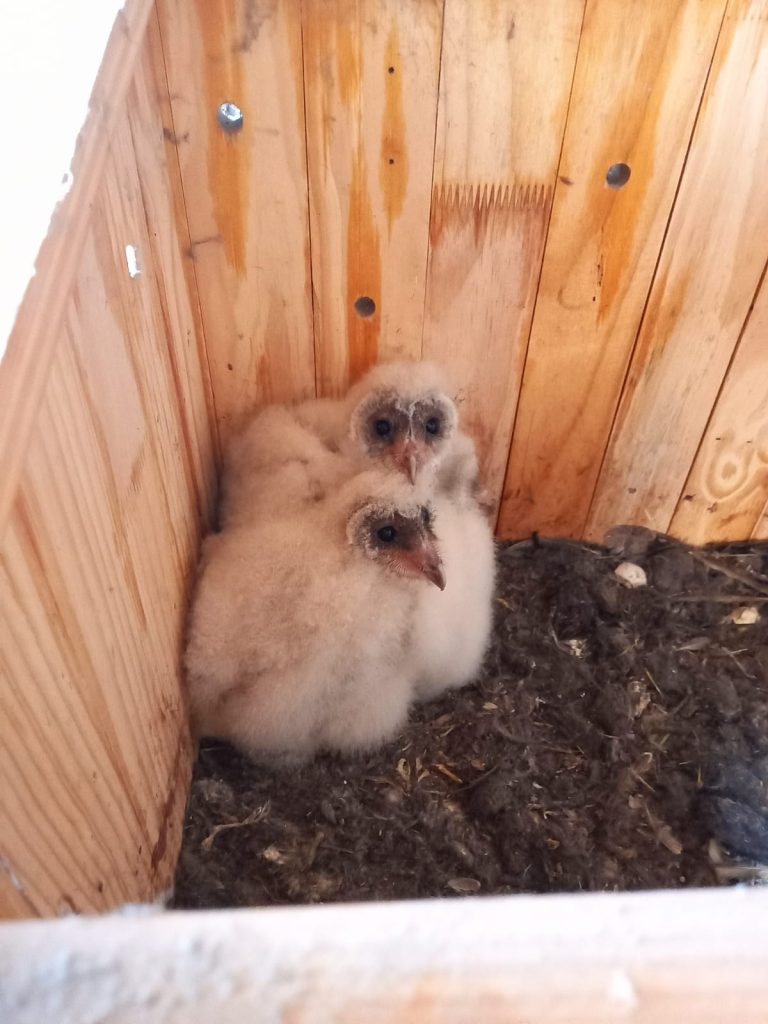
Scherman and Deacon’s efforts have already yielded encouraging results. In 2023, a breeding pair successfully raised two owlets. “This year we found six eggs,” Scherman shares. “Of those, we are currently able to see three owlets.”
For Deacon and his students, the camera has opened a window into the birds’ world. “It captures feeding events, chick development, and parental behavior,” he explains. “This kind of passive monitoring is invaluable – it provides long-term data without human interference.” The footage has already formed the basis of student research into owl diet, chick growth, and even nesting material preferences – insights that could guide future conservation projects both at the UFS and beyond.
“These owls are teaching tools,” he says. “They bring textbooks to life for students studying ecology, animal behaviour, and sustainable land use.” He adds that the project also demonstrates how scientific knowledge can directly benefit local ecosystems. “It shows that biodiversity and human development can coexist with the right approach. Even a university library can become a habitat.”
Barn owls also play a practical ecological role on campus. “A single owl pair can eat hundreds of rodents in a breeding season, reducing the need for poisons and pesticides,” says Deacon. And it’s not just rodents. “We found remains of small birds and insects in their regurgitated pellets,” Scherman notes, “which shows just how active and adaptive they are in an urban environment.”
Still, their survival is not guaranteed. Urban owls face risks ranging from road traffic to poisoning. “If you ever find an injured owl or have concerns, don’t try to help it yourself,” Scherman advises. “Rather contact Deacon or me. We’re here to assist.”
“Awareness builds respect,” Deacon adds. “When people know that these owls are quietly raising a family above their heads, it shifts how they interact with the space. We ask people to avoid making loud noises or using flash photography near the nesting site. Simple behaviours, such as keeping windows closed at night near the roost, go a long way towards protecting them.”
A library as a living ecosystem
As the project gained momentum, so did its symbolic weight across campus. Reddy reflects on how a seemingly disruptive moment became something much more valuable:
“It is clear that what may be seen as a disruptive incident with an owl swooping into our library space is also a pedagogical and deeply conservation touchdown.”
Changing perceptions, protecting heritage
The project also touched on a deeper cultural significance. Owls are often misunderstood, linked to myths or fear in some communities. “It’s understandable,” Scherman says, “with their eerie calls, white faces, and ghost-like flight. But they are also messengers, protectors, and symbols of wisdom in many traditions.”
She believes education is key to changing these perceptions: “Let us embrace the opportunity to coexist respectfully with nature and wildlife. The presence of owls among us is a living testament to the rich biodiversity that thrives even in urban spaces.”
For Scherman, the project was far more than a conservation effort. It was a passion project rooted in her own family history. “My grandparents also had a special connection to owls, so this felt very close to home,” she says. “Observing their habits and individuality made me feel like their caretaker. When we saw the baby owlets, I naturally felt like I was being promoted to an owl-granny!”
Deacon adds that librarian Hesma van Tonder even joined one of their giraffe capture excursions. “That kind of connection – between research and real-life adventure – is what makes conservation come alive.”
Looking ahead, he hopes that this project will inspire more cross-campus initiatives. “We’re exploring green corridors, rooftop biodiversity zones, and opportunities to conserve other species such as bats and pollinators,” he says. “It’s only the beginning. Hopefully, other departments such as Zoology and Botany can also come on board in the future.”



You must be logged in to post a comment.