

FREE STATE – I remember when I was a little girl, playing with other children in my neighbourhood beside a stream where the water was clean and the riverbed was clear.
You could hear it before you saw it – the soft, happy sound of water running over stones. Clean water bubbled and rushed along as if the river itself were laughing.
We would take off our shoes, chase the water and collect the smooth, beautiful stones lying beneath the surface. The water was so clear that we could see our feet.
We made paper boats and raced them against each other, running along the riverbank to see which one would reach the finish first. We shouted and laughed, our feet splashing through the water as we followed our little boats downstream.
As children we had no idea where that water was going. We did not understand that our small stream was part of a much larger system. We did not know that the water flowing past our playground would eventually become someone else’s downstream water – potentially even part of the water source on which communities depend.
Water flows in a sequence
A stream flows into a larger river. The river flows into a dam. That dam may feed a water treatment plant, where water is processed before being supplied to households.
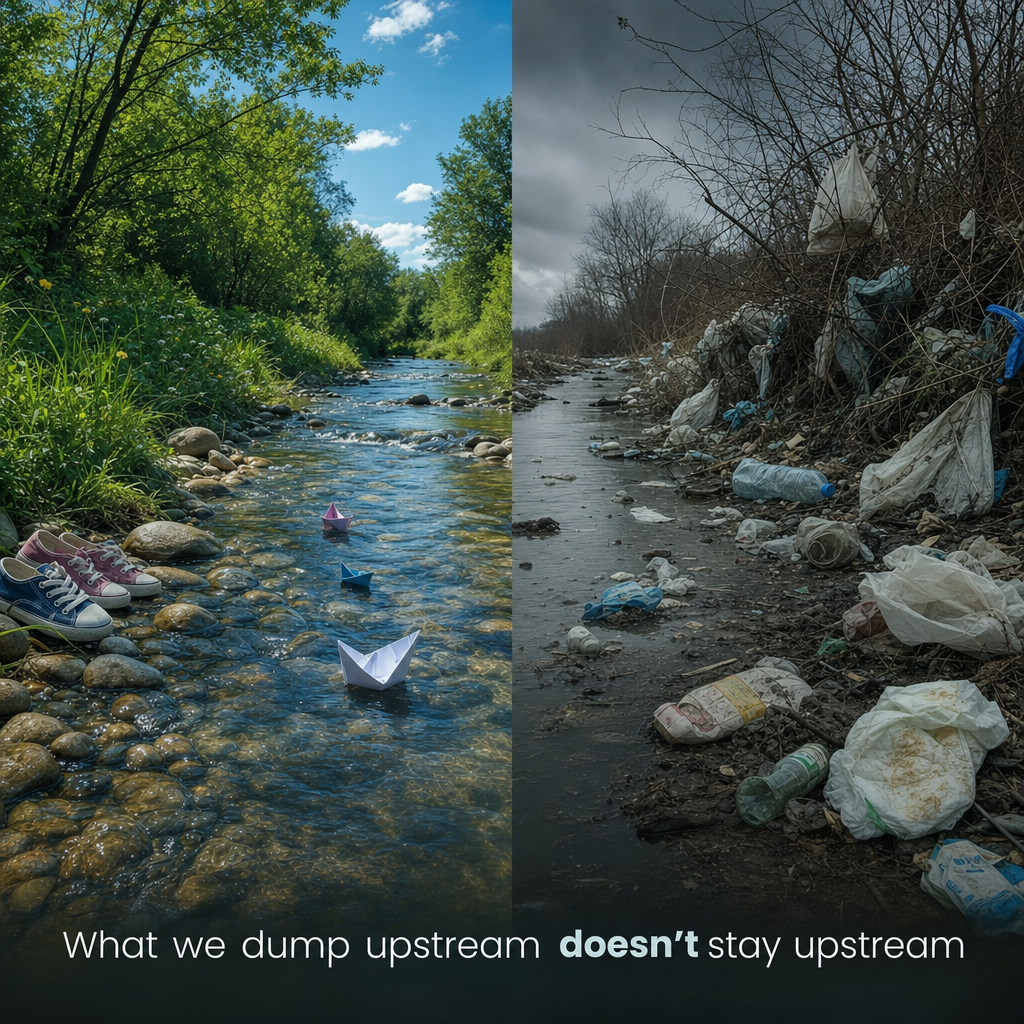
To us, it was simply a stream, it was our playground, with its own music.
Today, everything has changed. Before I can even reach that stream, I have to pass an illegal dumping site. But this is not necessarily the result of people choosing pollution over responsibility. In many cases, it is the result of desperation.
When waste collection services are not provided, what alternative do residents have?
The vibrant sounds of the stream have been replaced by silence. There are no paper boats. The water struggles to flow as plastic bags become entangled in bushes, while nappies, bottles and household rubbish litter the riverbank.
And I understand why. In many communities, municipal waste collection is inconsistent. In some areas, it does not happen at all. Bins overflow for weeks. There are no properly managed drop-off points, no alternative disposal facilities and, sometimes, little or no communication from the municipality.
When municipalities make promises but fail to deliver
When municipalities make promises but fail to deliver, residents are left with a very real problem: what do they do with the waste accumulating in their homes?
Some eventually take it to the nearest open space, vacant plot or stream.
That does not make illegal dumping right. But it does force us to confront a more uncomfortable question: what happens when people are expected to behave responsibly while the basic systems that make responsible behaviour possible have collapsed?
Waste collection is not a luxury. It is a basic municipal service.
When that service fails, the consequences do not stop at overflowing bins.
The pollution we create upstream eventually becomes somebody else’s problem downstream.
They reach our rivers, and what we dump upstream does not stay upstream. In other words, we dump at the top and drink at the bottom.
As our rivers and streams become increasingly polluted, treating that water becomes more difficult and potentially more expensive. The environmental cost is significant, but so too is the financial burden placed on already struggling municipalities and, ultimately, communities.
Much of this could be prevented through something as basic as reliable refuse removal.
We cannot continue treating waste management as an afterthought.
If we want cleaner rivers, we must start with the basics. Municipalities must restore consistent refuse collection. Where conventional collection is difficult, properly managed communal bins, transfer stations and safe disposal sites must be provided.
Residents, too, have a responsibility not to dump waste into waterways or open spaces. Our streams are not dustbins. Riverbanks are not landfills. And residents should not have to choose between keeping waste in their homes and dumping it in the environment because there is nowhere else to take it.
Residents have a responsibility
The Department of Water and Sanitation, as the custodian of South Africa’s water resources, annually spearheads the Clear Rivers Campaign during Mandela Month to raise awareness about protecting water resources through community clean-up initiatives. It is important to note that the campaign is not confined to July. Protecting our water resources requires sustained action throughout the year.
But campaigns alone will not solve the problem. We need functioning municipalities, reliable waste collection, accessible disposal facilities and communities that understand the consequences of pollution.
We also need to remember that a river is more than water flowing between two banks. It is part of a connected system on which people, ecosystems, agriculture and communities downstream depend.
I can still picture that clear riverbed from my childhood, and the sound of water rushing over the stones is etched in my memory. As children we set off those little paper boats that would race downstream while we ran alongside them, laughing.
I hope the next little girl who approaches that stream hears the water before she sees the rubbish.
Because protecting the upstream is how we protect everyone downstream.
By Keneilwe Morwagae
Communications Intern, Department of Water and Sanitation, Free State
ALSO READ: Environmental crisis at Goldfields waste sites poses serious health risks




You must be logged in to post a comment.