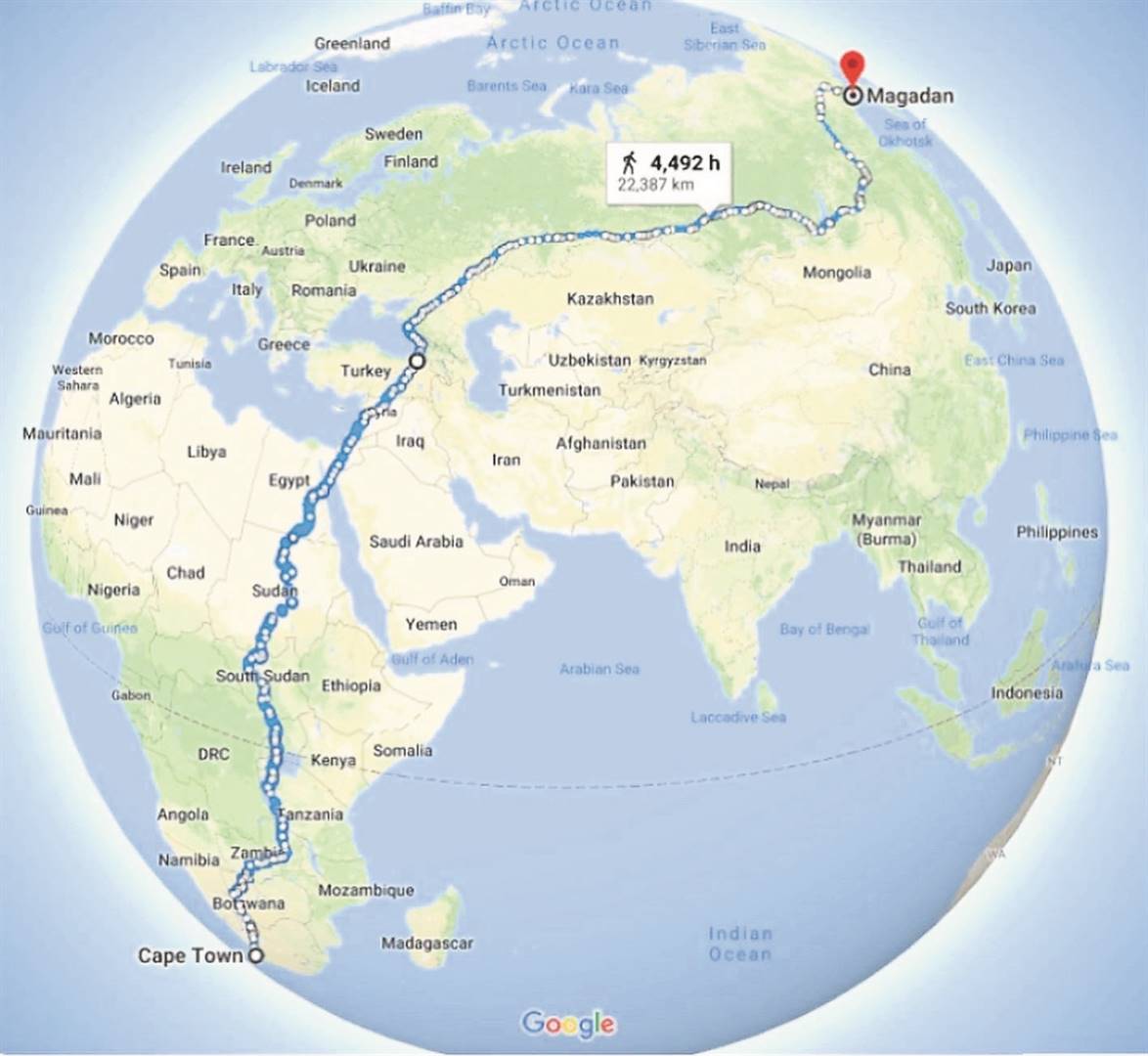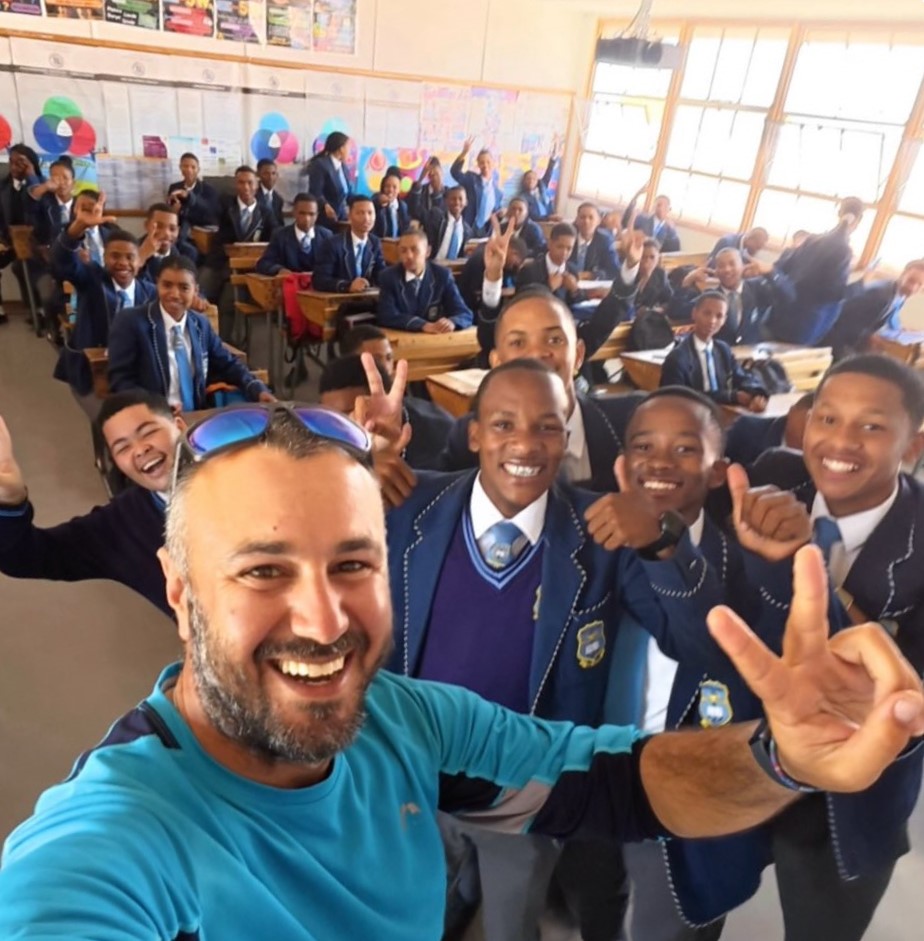

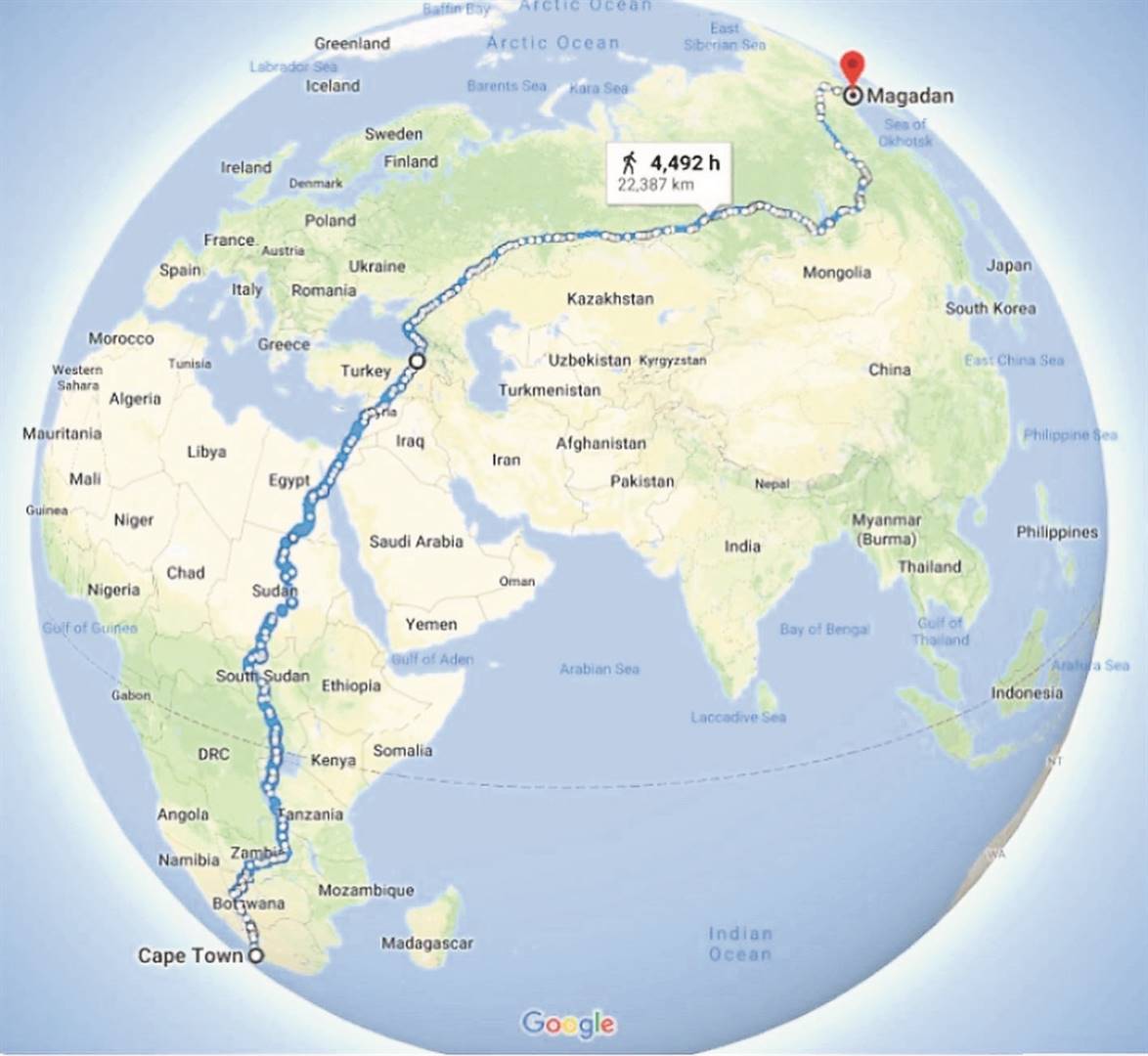
Walking his “solar breatharian journey” from Cape Town to Magadan in the far northeastern part of Russia, Elitom El-amin is currently on foot somewhere in the Northern Cape – presumably in the Prieska area.
El-amin, born in 1969 in Pittsburgh in America and raised in Ohio, is internationally renowned as the expert of prolonged fasting.
Also the author of several books and with a following on his YouTube channel and Facebook page where his philosophy is preached on a regular basis, he is seen by his followers as an inspiration to get more attuned to their natural capacities and obtain better lives through peace and harmony.
According to his website, he started on the path of fasting in 2000 for health reasons, going from overweight with high blood pressure to thriving health and energy levels within a few months only. In a video interview in 2019, El-amin said he experienced drastic health improvements after he started eating less, exercising more, fasting and meditating, and discovering the energy channels in his body.
Since then, El-amin kept growing his capacities to mastery through longer periods of time without consuming food or water.
Apparently, breatharianism has been around in some form or another for as long as 400 years, and breatharians claim to believe in eating food or drinking water as minimally as possible. It is said in extreme cases they abstain from food and water altogether.
On 10 December, El-amin departed on foot for the first part of his journey of more than 22 300 km – it is said he aims to reach Magadan by 2028. For a few hundred kilometres he was joined by two of his students, Beata Worwa and Chris Garrelts, both from America.
“Travelling expends consciousness,” says Worwa, adding that El-amin believes the body is capable of certain physical adjustments.
From Wellington they followed a part of the Forgotten Highway, taking them through Ceres, Sutherland, Fraserburg, and Loxton. This is the longest heritage route in South Africa, and was the first to connect the Cape in the south with the northern inland region. It follows the two-way traffic roads of ancient travelers and was used by, amongst others, the !Xam, Tswana, missionaries, and explorers to travel into Central Africa.
“Elitom is a very fast walker,” says Worwa, who has been his student for over three years and a breatharian since 2016.
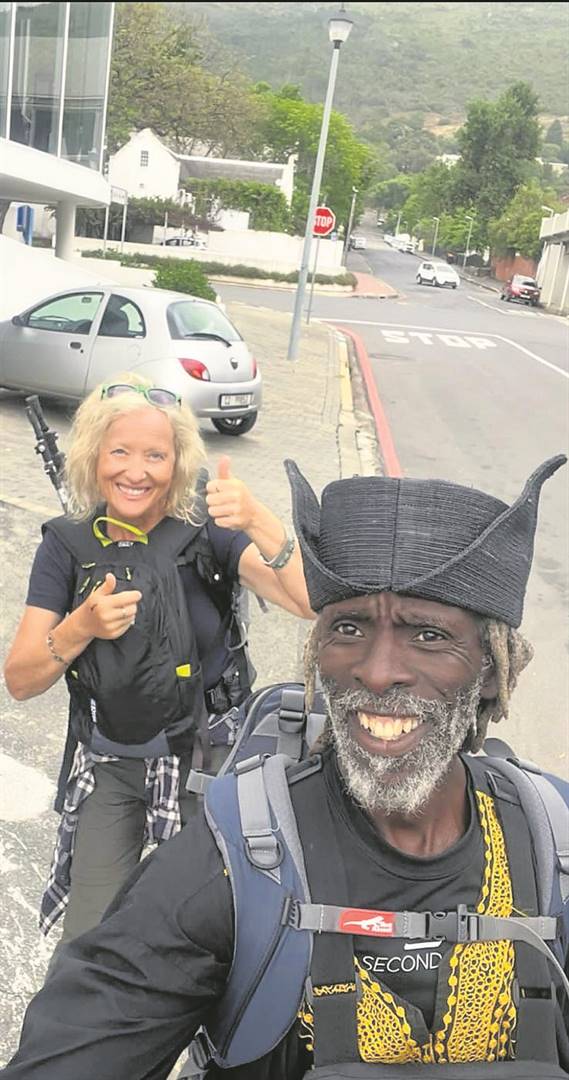
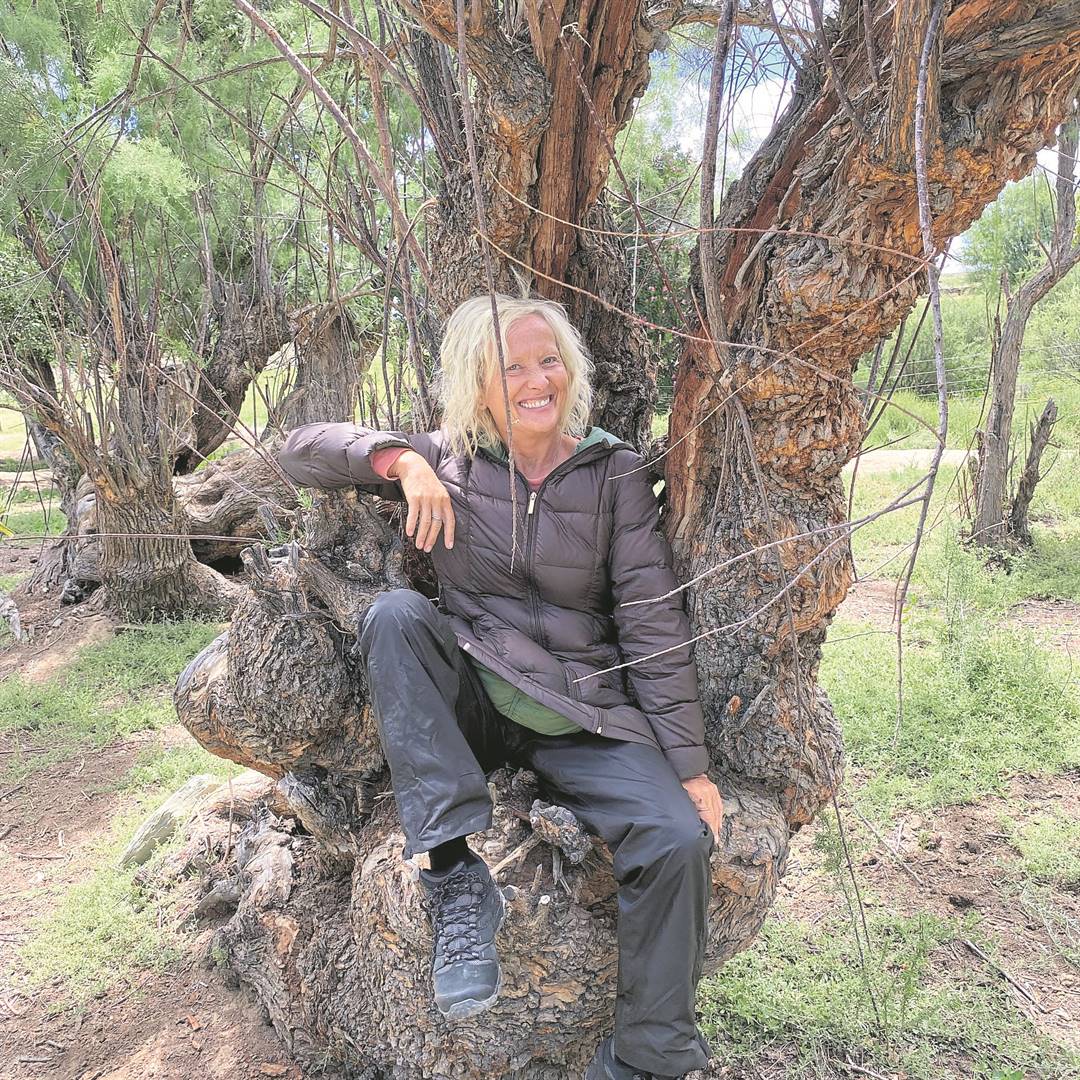
Worwa says she went through a spontaneous awakening to breatharianism when her body decided to operate without food, and only on water for 54 days.
“I met Elitom only two years after that to establish an understanding of the science behind my body’s reaction.”
Prior to that, Worwa says, she healed her body from several illnesses which was all done through the lifestyle she developed that leaded her to the breatharian’s initiation.
She says El-amin prefers to walk on his own, and is heading for the Botswana border.
Soon after leaving Cape Town, Worwa says they were robbed in Wellington.
“After that we made better choices and acted more carefully.”
Along the way they sometimes slept under the stars – “the first time in my life”. Worwa describes South Africa as “dangerously beautiful, with beautiful people, and the weather was great”.
After experiencing foot problems, Worwa met a family on a farm in the Fraserburg area. She describes this farm and its surrounding area as peaceful with a loving atmosphere.
Here Worwa saw an opportunity “to implement a holistic lifestyle and expand the ideology of The Walk by creating a stable spot for retreats on the continent of our Motherland, where The Walk started.
“We are not physically walking with Eli now, but we are a team and are still participating in the walk, just in different ways,” she says.
Garrelts, in the meantime, departed for Mexico.
“Women need to get together. There is healing in sharing stories, and in learning emotions,” Worwa says.
“Women need to rise up, raising a new generation of strong women.”
Oberholzer was previously involved at a rehabilitation centre in Fraserburg which closed down during the Covid-19-pandemic, and also at a recovery centre for after substance abusers were rehabilitated.
On meeting Worwa, Oberholzer realised that Worwa’s visualised healing centre is ideal and possible. Although Worwa will soon leave for her home in America, she will return “and bring women from the USA” to experience healing on a farm in the Northern Cape.
Follow El-amin’s journey on the Facebook page Elitom El-amin.