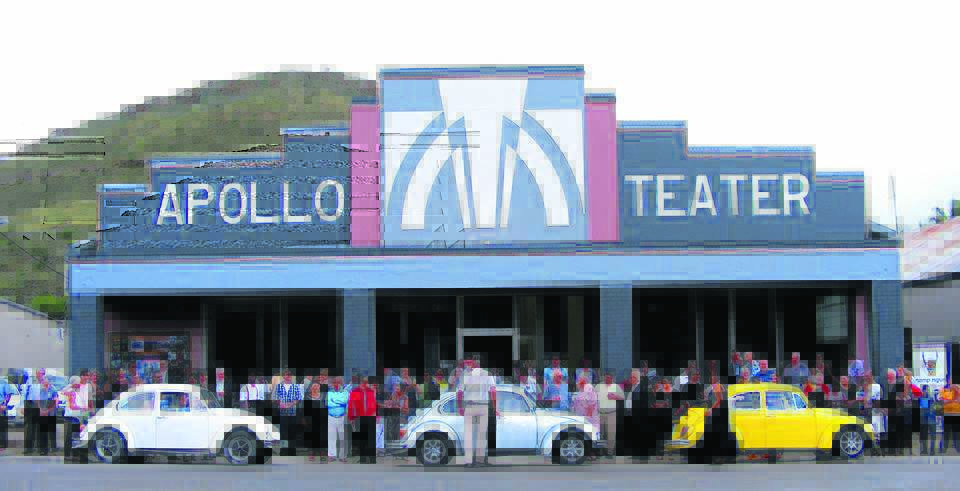

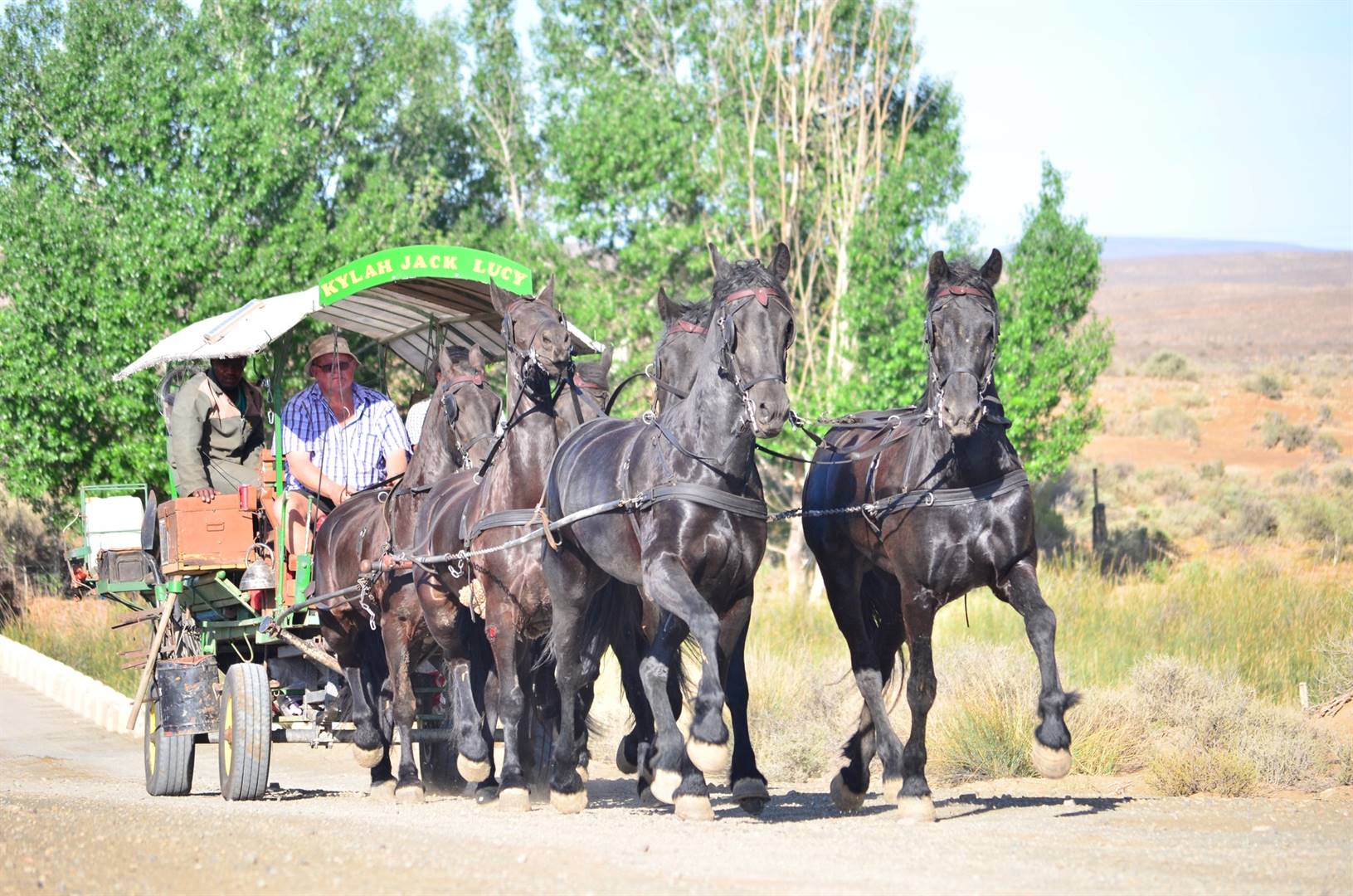
The possibilities of the longest heritage route in South Africa are as wide as the horizons along the Forgotten Highway, which stretches for approximately 1 000 km from Ceres in the south to Kuruman in the north.
“How do you understand a 640 km road through the Karoo that is far too short?”
This is the rhetorical question posed by Piet Coetzer who recently launched and completed an expedition of the Forgotten Highway Heritage Route.
Coetzer and his companions covered this distance over the course of 14 days at the walking and trotting pace of six horses pulling a wagon on gravel roads.
This expedition came to an end on Sunday, 6 November, in Griquatown in the Northern Cape.
By the time church services had ended, Coetzer’s wagon with six horses of the Vreugde Vlaamperd stud, accompanied by Kobie Herselman’s 1933 Chevrolet Eagle Roadster with his horses under the vehicle’s gleaming hood, had already attracted the attention of churchgoers on their way home.


On the route from the Dutch Reformed Church to the old age home where the elderly made the acquaintance of horses Minister, Kimon, Tom, Karnet, Kristal and Klara in the rig, through the neighbourhood, back into the main street and up to the showground, residents in vehicles, children on bicycles and others on foot followed the wagon.
The warm and enthusiastic welcome in Griquatown was typical of the reception experienced during the whole trip.
As Coetzer says, “if I can say one thing about the hospitality we experienced, I must say it was overwhelming; almost too much.”
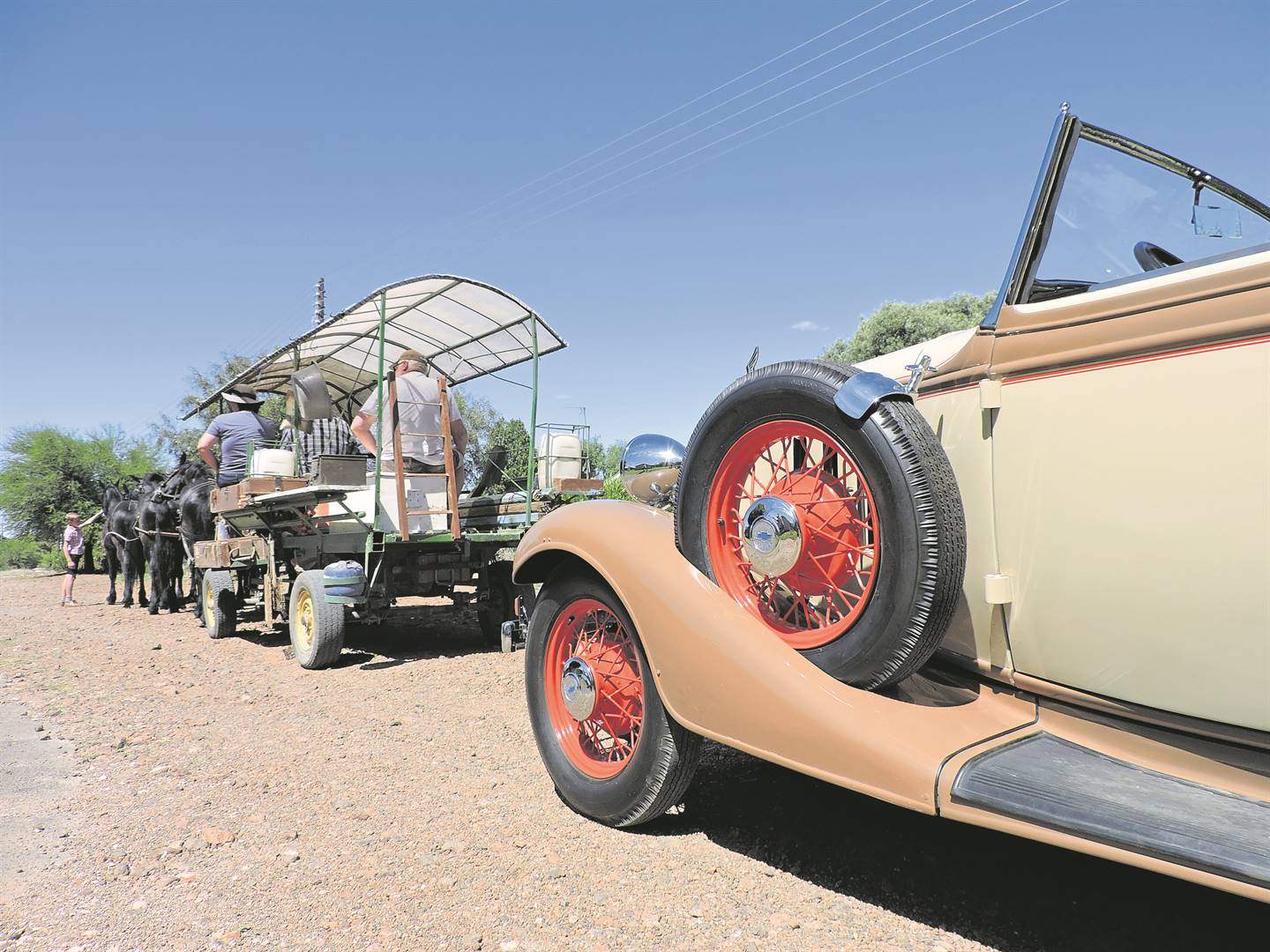 The 1933 Chevrolet of Kobie Herselman accompanied the wagon pulled by six horses through the streets of Griquatown.
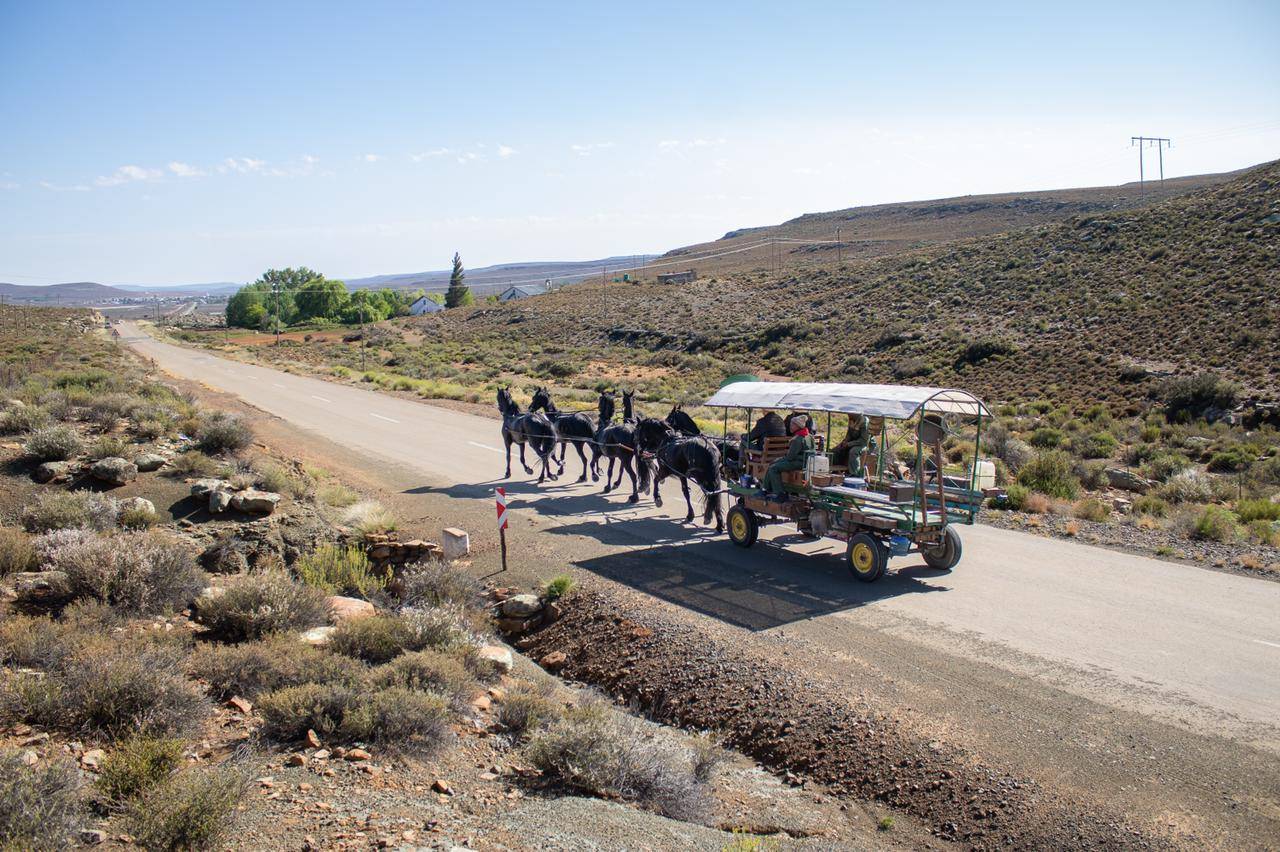 On the way to Sutherland on Saturday, 22 October.
‘Not the first, and not the last’
Last year, Coetzer, from Senekal, and his team completed a part of the Forgotten Highway – approximately 700 km from Hopetown to Ceres – with the same wagon and six horses from the stud on their own initiative.
As far as possible, they followed the horse-drawn carriage route used by the Gibson Brothers of the Red Star Line during the Diamond Rush to and from Kimberley in the 1870s.
Coetzer has previously traveled to other towns with the same wagon and horses and, according to him, he is still not done. For 2023 he is planning to complete a 1 000 km route with the wagon and horses.
It was his 2021 expedition that caught the attention of Prof. Doreen Atkinson of the Karoo Development Foundation (KDF).
Atkinson, a KDF trustee and involved in various studies, is particularly interested in small town development, history, tourism, and architecture of the Karoo.
“For KDF, it was amazing that Piet and his expedition enjoyed such prominence.” Their expedition was followed by numerous people from all over the world on Facebook and a WhatsApp group.
Atkinson says KDF works very hard behind the scenes, and what Coetzer and his expedition have accomplished, is immense. Atkinson contacted Coetzer, plans were made and KDF funded this year’s expedition.
Encounters, then and now
The Forgotten Highway was the first route that connected the Cape in the south with the northern inland region.
It is described as the longest heritage route in South Africa and stretches over approximately 1 000 km from Tulbagh and Ceres in the south to Kuruman in the north, with numerous side-paths.
It follows the two-way traffic roads of ancient travelers and was used by the !Xam, KhoeKhoe, Tswana, missionaries and explorers to travel into Central Africa.
The route stretches through numerous regions, including the Ceres-Karoo, Roggeveld, Nuweveld, Bo-Karoo, Griqualand-West, Ghaap and into the Kalahari.
Parts of it overlap with footpaths used by the !Xam and other hunter-gatherer groups, as well as the KhoeKhoe herders with their sheep and cattle, Tswana farmers and later Xhosa groups who entered the Karoo in the late eighteenth century.
From the late 1700s, the pioneers, hunters, fugitives, traders, discoverers such as William Burchell, ivory hunters and missionaries who traveled in small numbers were followed by a stream of nomadic farmers.
The San, Korana, Xhosa (at Prieska and Carnarvon), the Griqua at Griquatown and the Thlaping at Kuruman met these newcomers in various ways.
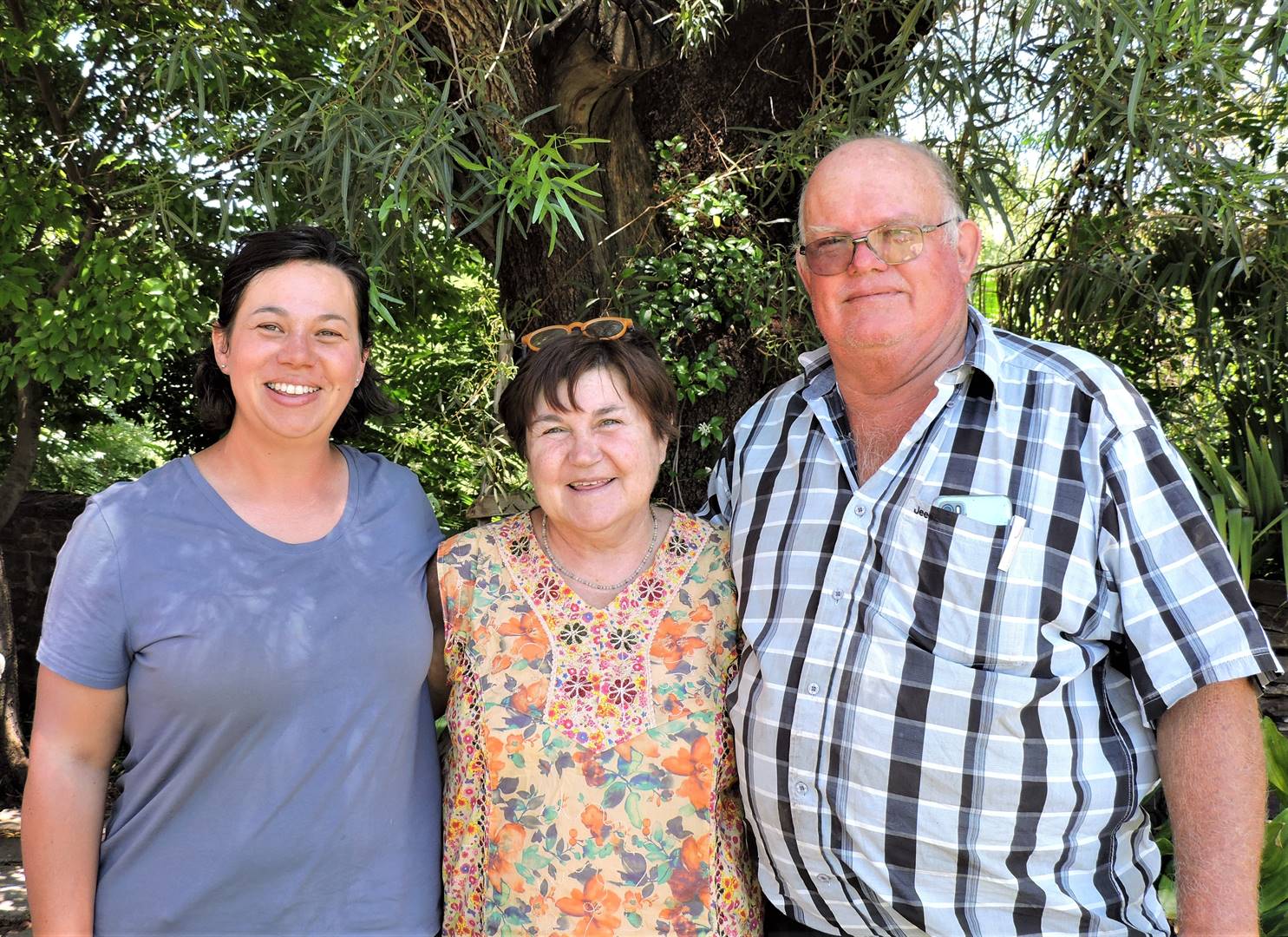
The main theme of the route is “encounters”, says Atkinson. These encounters included and ranged from trade, military display, conflict to spiritual competition, and those involved had to move out of their comfort zone to meet others from a different cultural background.
During the just-concluded expedition, Atkinson visited some of the towns through which the route stretches, as well as surrounding towns such as Williston, Victoria-West and Vosburg. At some towns, workshops were offered on the background, nature and potential of the Heritage Route.
Along the way, more evidence was gathered on the route’s side-paths.
“We are already collecting more information, getting snippets and photos, finding ruins. There is still so much information that needs to be assembled.”
Atkinson says the enthusiasm and interest in the towns have been great.
The Heritage Route is ideal for tourism businesses, teachers, church and community leaders, researchers, municipal councillors, and officials.
She foresees that the concept will take at least another five years to fully develop.
“Everyone has something to add, and as soon as you connect things, for example missionary history, you immediately have a subtheme.”
Atkinson believes there is no competition in this concept, saying it is about cooperation instead.
As in the era of the Forgotten Highway, we are all out of our comfort zone in modern-day South Africa, and we are constantly busy with encounters, she says.
“We have a lot in this country to be thankful for. The Truth and Reconciliation Commission, the Zondo Commission, the looting in KwaZulu-Natal that was stopped by ordinary people…
“Even the government, which fails us again and again, teaches us to think for ourselves.
“The horizons are endless; you can start anything, even a knitting club.
“We live in an interesting period of tremendous openness,” she says.
Charming Karoo
Adri Smit, a director and founder of Ons Karoo en Kontrei, experienced the expedition in her own vehicle.
Our Karoo and Kontrei is described as a “one-stop online guide to explore the Karoo and the surrounding countryside”.
Smit and Atkinson have previously worked together on various projects and concepts.
“The dynamics of the expedition group, regardless of personal differences, was incredible. We could read each other; gave each other enough space; and worked very well together.
Amongst others, Smit was constantly on the look-out for experiences and information during the expedition to expand and supplement the online guide.
Waldo and Ansie Bosse from Newcastle in KwaZulu-Natal were part of the whole expedition and joined in their well-equipped vehicle.
Bosse, a farmer, endurance rider and horseman, heard about the expedition on a horse group. He offered logistical assistance, and his vehicle towed the wagon with, among other things, horse feed.
He and his wife experienced the Karoo as a very special place with its beauty, vast spaces, and hospitality.
Bosse is full of praise for Smit, who organized interesting trips and visits during the expedition and says that this added so much more value to the whole experience.
Several other individuals and groups also accompanied the expedition for a while or for a few days.
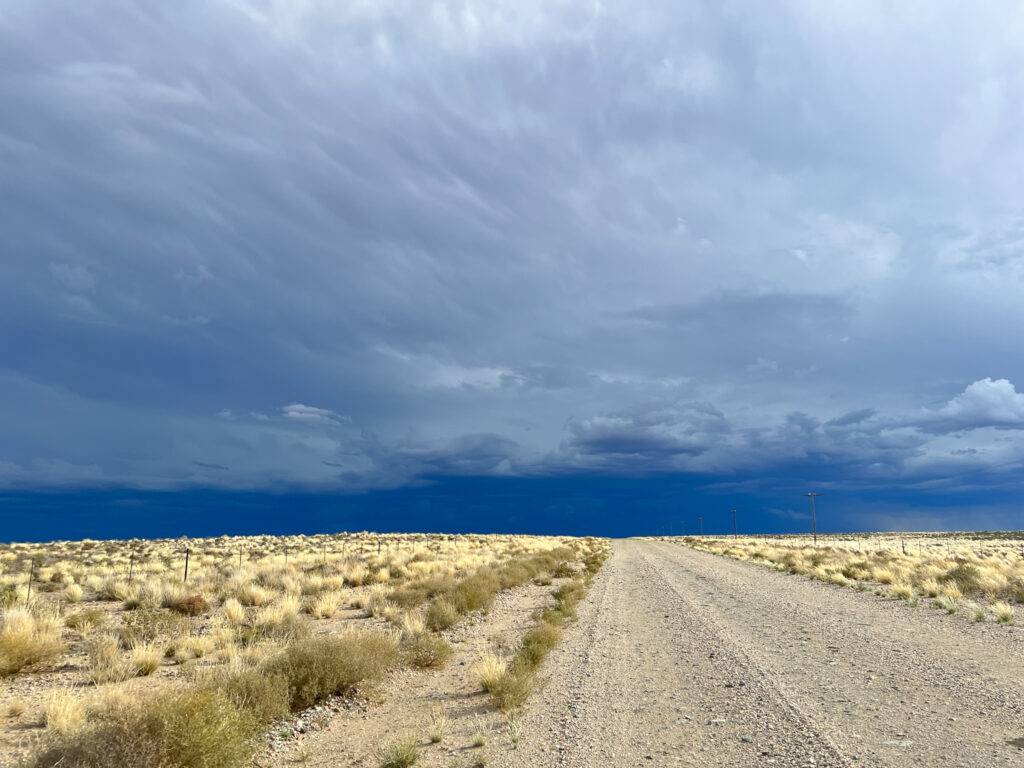 “… we travelled under dark clouds full of promise”, according to an entry on a social media platform.
 Churchgoers in Griquatown were met with a view of these six horses and wagon when they exit the building on Sunday morning, 6 November.
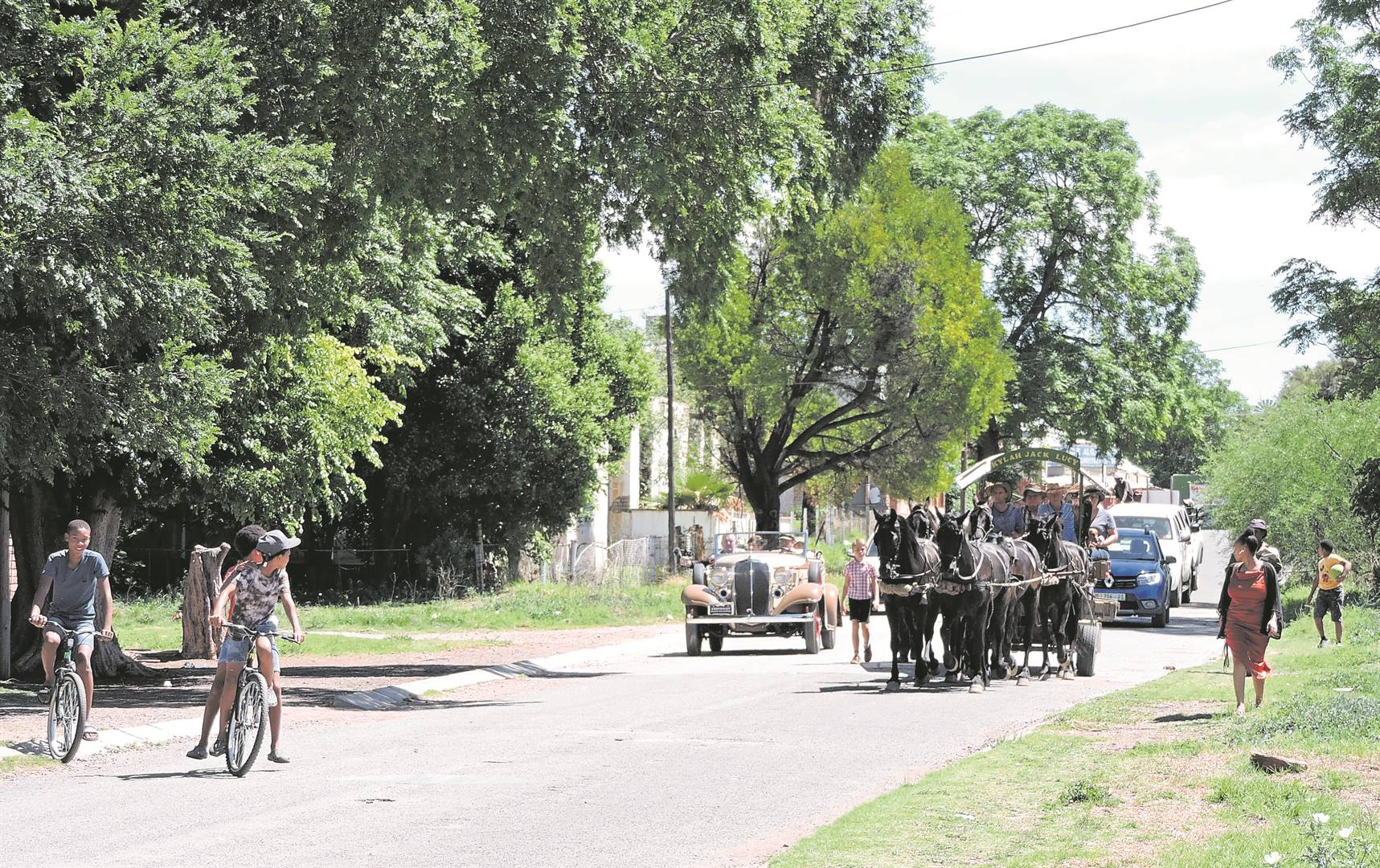 By the time churchgoers came out of church on Sunday, 6 November, the wagon with six horses, accompanied by the 1933 Chevrolet Eagle Roadster of Kobie Herselman, had already attracted the attention of the residents.
‘Clouds full of promises’
“The street is closed, because the horses and wagons are blocking it,” is written on the website vreugdepaaie.co.za on the official launch of the expedition on Saturday morning 22 October in front of the N.P. van Wyk Louw Museum in Sutherland.
Earlier the morning, more than 30 people saw the expedition off at Rogge Cloof, where they spent the night. On the way to Sutherland more horsemen and wagons joined the convoy.
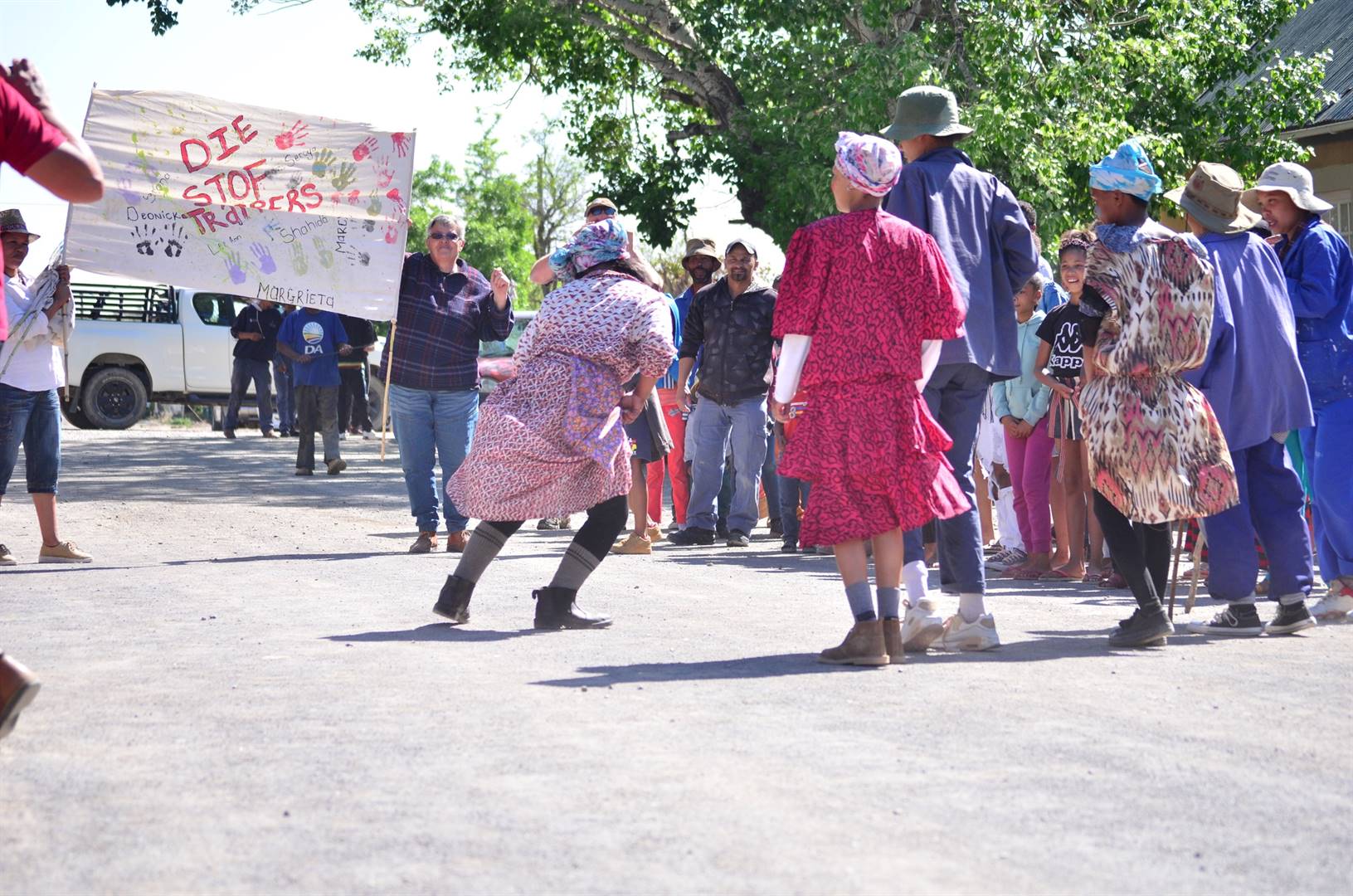
In Sutherland, Die Stoftrappers put on a show, roosterkoek was enjoyed and the Sutherland on Foot tour was completed.
This was the start of the expedition where there was an early rise and an early departure every morning, to take a break later during the morning and prepare breakfast.
Entries on the website and the Facebook page Ons Karoo en Kontrei, as well as quips on the WhatsApp group reflect the atmosphere that prevailed:
“We had nice rain at night which makes the road soft and nice during the day.”
“… travelled under dark clouds full of promises.”
“A lot of time for talking and for being quiet.”
“This guy (Piet) not only drives horses, but people too. He says, ‘It doesn’t help if you get up at five and you don’t wake up until nine.’”
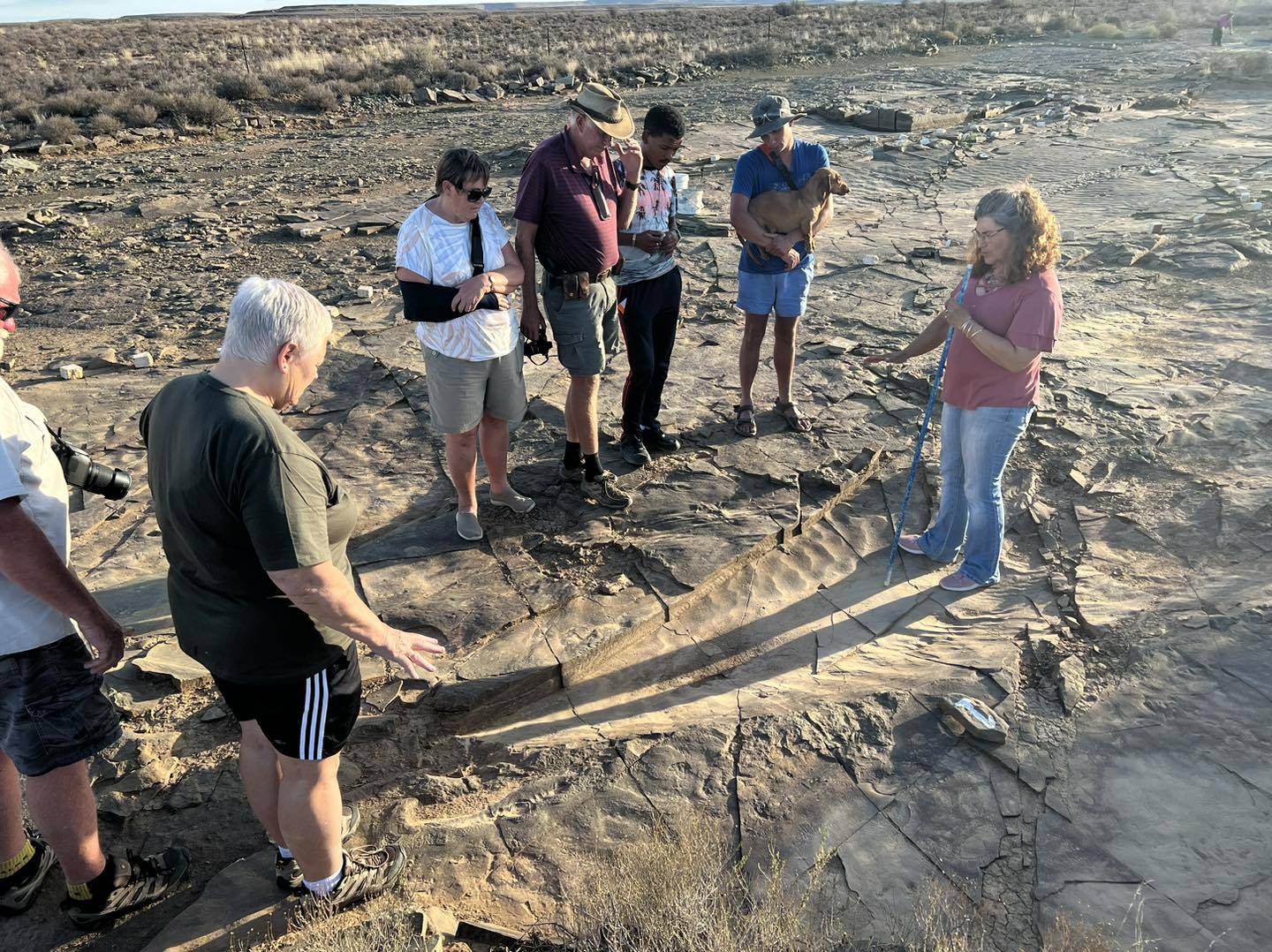
A further extract from entries and events is as follows:
Monday 24 October: A guard of honor of children awaits the expedition at Fraserburg. Marinda Oberholzer from Karoo Fossil Tours offers a tour where “stones are read”.
Wednesday 26 October: At Loxton the “wind was blowing wildly”, but Delta the sheepdog and Esté Matthew of the Endangered Wildlife Trust’s working methods could still be observed. Among other things, Matthew monitors the movement of the rare riverine rabbit and determines “how many of them are hopping around”.
With Delta’s keen sense of smell, he smells out the droppings of the rabbits that are collected for DNA samples. The riverine rabbit was first observed in the Victoria West and Loxton area in 1901 and was first reported in Uniondale as recently as 2018.
Thursday 27 October: Also in the Loxton area, the “most beautiful sheep shearing store in the district” was visited. The group also observed the pregnancy scan of ewes.
Friday 28 October: At Pampoenpoort, outside Carnarvon, the milking of goats was observed. From the goat’s milk, “delicious goat butter” is made.
Saturday 29 October: Beyerskloof has a “majestic cemetery where the oldest grave dates back to 1820”.
Monday 31 October: Between Carnarvon and Vosburg is Karelsgraf where a person by the name of Karel was trampled to death by an elephant. The date on the stone is 1750.
Tuesday 1 November: Coetzer wrote: “We leave at 06:00 from the South Pole. It’s freezing cold, I’m wearing a jacket, a big coat and long trousers, gloves, as well as a blanket over my legs. It starts to rain, and we pull the tarpaulin over the wagon. As soon as we are done, it stopped raining.”
Saturday 5 November: At Niekerkshoop, the expedition arrives with their horse-drawn wagon in the middle of the school’s athletics meeting where they received a great welcome.
After the expedition, messages and well wishes from as far away as Pietermaritzburg and Cape Town were received on the WhatsApp group:
“Well done. The expedition opened our eyes to what happened and what was done years ago. The horses and oxen opened up SA, tamed it, and started civilizations.”
“Piet, you are a legend. In years to come people will still talk about you and your horses.”
- For more information about the Forgotten Highway, send an email to doreen@karoofoundation.co.za; or
- Visit the webpages karoofoundation.co.za or onskaroo.org.za; or
- Visit Ons Karoo and Kontrei, as well as Karoo Development Foundation on Facebook.