

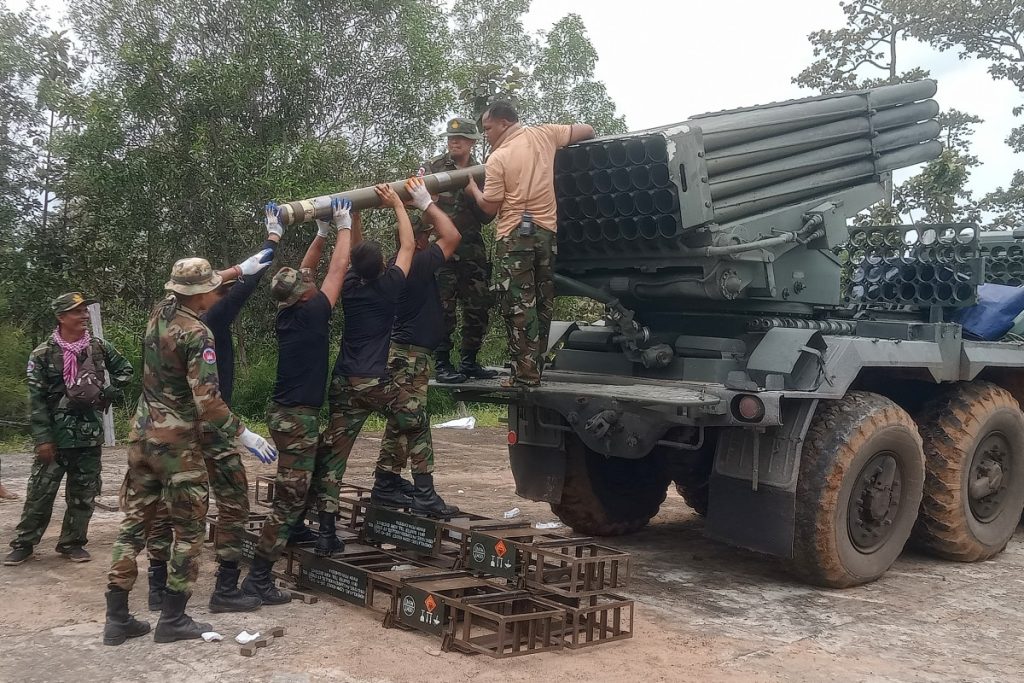
Thailand launched devastating air strikes on Cambodian military targets Thursday as Cambodia responded with rockets and artillery fire, killing at least 11 civilians in a dramatic escalation of the long-running border dispute between the Southeast Asian neighbors.
The Thai Ministry of Public Health confirmed that at least 11 civilians lost their lives, with most fatalities occurring in a rocket strike near a petrol station in Sisaket province. Footage from the scene revealed smoke billowing from a convenience store attached to the petrol station, where provincial officials reported most victims were students.
Six Thai F-16 fighter jets deployed from Ubon Ratchathani province struck two “Cambodian military targets on the ground,” according to Thai military deputy spokesperson Ritcha Suksuwanon. The air strikes marked a significant escalation in the decades-old territorial dispute.
The Emerald Triangle: Decades of dispute
The neighbors remain locked in a bitter dispute over the Emerald Triangle, a strategically important area where Thailand, Cambodia, and Laos borders converge. This region, home to several ancient temples, has been the source of tensions for decades, with bloody military clashes occurring more than 15 years ago and again in May when a Cambodian soldier was killed.
According to Thai military sources, the clashes began around 07:35 (00:35 GMT) when soldiers guarding Ta Muen temple detected a Cambodian drone overhead. At approximately 08:20, Cambodian forces opened fire toward the eastern side of the temple, located about 200 meters from the Thai base.
International diplomatic response
Cambodian defense ministry spokeswoman Maly Socheata stated that Thai troops launched an “armed assault on Cambodian forces,” claiming Cambodia exercised its “legitimate right to self-defense” in accordance with international law.
Thailand’s government spokesman accused Cambodia of being “inhumane, brutal and war-hungry,” with the foreign ministry announcing the closure of all border crossings and evacuation of nearby residents.
China, a close ally of Cambodia, expressed being “deeply concerned” about the clashes and called for dialogue while urging its citizens in Cambodia to avoid the Thai frontier.
Malaysian Prime Minister Anwar Ibrahim, whose country currently chairs ASEAN, called on both sides to “stand down” and begin negotiations.
Cambodian Prime Minister Hun Manet requested an urgent UN Security Council meeting to address what his foreign ministry labeled “unprovoked military aggression.”
Diplomatic crisis deepens
Thailand’s embassy in Phnom Penh issued urgent warnings for Thai nationals to leave Cambodia “as soon as possible” unless they had pressing reasons to remain. The violence erupted just hours after Thailand expelled the Cambodian ambassador and recalled its own envoy following injuries to five Thai military patrol members from a landmine.
Thursday morning saw Cambodia announce a downgrading of ties to “the lowest level,” withdrawing all but one diplomat and expelling Thai equivalents from Phnom Penh.
Domestic political implications
The border conflict has triggered a domestic political crisis in Thailand, where Prime Minister Paetongtarn Shinawatra faces suspension pending an ethics investigation. A leaked diplomatic call between Paetongtarn and Hun Sen, Cambodia’s former longtime ruler and current Prime Minister Hun Manet’s father, sparked the judicial investigation.
The escalation poses significant challenges for ASEAN unity, with both Thailand and Cambodia being key members of the regional bloc. Recent weeks have witnessed tit-for-tat actions, including Thailand’s border crossing restrictions and Cambodia’s import halts.
The conflict threatens regional economic cooperation and security, with potential spillover effects on trade routes and diplomatic relations throughout Southeast Asia.
Currently all border crossings between Thailand and Cambodia remain closed.
Thailand’s acting Prime Minister Phumtham Wechayachai emphasised that “the situation requires careful handling” and stressed adherence to international law while protecting sovereignty.




You must be logged in to post a comment.