There are dishes that feed you, and then there are dishes that carry an entire world inside them. The Durban bean bunny chow is firmly in the second category. It is hot, it is messy, it is entirely unapologetic about both of those things — and tucked inside that hollowed-out loaf of soft white bread is a history more layered than the curry itself.
Long before food trucks made street food fashionable and chefs began deconstructing everything in sight, the bunny chow was already doing something radical: turning a loaf of bread into a bowl, a political act into a meal, and a moment of exclusion into one of the most beloved culinary traditions the African continent has ever produced.
The word “bunny” is widely believed to be a corruption of “bania” — a term for the Gujarati merchant caste whose families ran many of Durban’s shops and canteens in the early 20th century. “Chow” is Indian slang for food, plain and simple. Put them together and you have a name that carries an entire community’s fingerprints.
Most food historians place the bunny chow’s birth in the 1940s, though its roots stretch further back. During apartheid, Indian and Black South Africans were barred from sitting inside restaurants designated for white patrons. Rather than turn customers away empty-handed, vendors began ladling hot curry into hollowed bread loaves, passing them through side windows and back doors. No crockery required, no seat needed, no dignity surrendered. The bread was the bowl, the lid, and the solution all at once.
Other origin stories swirl around the dish like steam off a pot. Some say indentured Indian labourers on the 19th-century sugarcane plantations outside Durban carried their midday meals in hollowed bread because it was cheap, portable, and required no utensils. Others suggest that restaurant owners would stuff leftover curry into bread at the end of service to feed those who could not afford a full plate. History, as it so often does when food is involved, offers several truths at once.
What is beyond debate is the result. The bean bunny chow — the vegetarian original — has outlasted the laws that gave it its unusual shape. Today it is eaten with cheerful abandon across Durban’s streets, at family tables, on the beachfront, and in restaurants that have spent decades trying to pin down exactly what makes it so irresistible. The answer, of course, is everything.
Classic Durban bean bunny chow
Serves 4
You will need:
For the bean curry
- 2 x 400 g cans sugar or burred beans, drained and rinsed
- 3 medium potatoes, peeled and cut into 2 cm cubes
- 3 Tbsp sunflower or canola oil
- 1 large onion, finely chopped
- 3 garlic cloves, minced
- 1 Tbsp fresh ginger, cut into thin matchstick strips
- 1–3 green chillies, finely sliced (adjust to taste)
- 1 whole star anise
- 1 tsp cumin seeds
- 1 stick cinnamon
- 3 Tbsp Durban masala (or a good-quality curry powder)
- 1 tsp turmeric
- 1 x 400 g can chopped tomatoes
- 250 ml water
- Salt to taste
- Fresh coriander, to finish
For the bread
- 2 medium unsliced white bread loaves, cut in half crossways (to make 4 half bunnies)
To serve
- Carrot and cucumber salad or atchar
- Sliced green chilli (optional)
Method
- Heat the oil in a heavy-based pot over medium heat. Add the cumin seeds and allow to sizzle for about 30 seconds until they begin to pop.
- Add the onion and cook, stirring regularly, for eight to 10 minutes until soft and lightly golden. Add the garlic, ginger and green chilli, and cook for a further two minutes.
- Stir in the Durban masala, turmeric, cinnamon stick and star anise. Cook the spices gently in the oil for one to two minutes, stirring constantly, until deeply fragrant. Do not rush this step — the spices need time to bloom.
- Add the canned tomatoes. Stir well, scraping up any spice caught on the base of the pot. Simmer uncovered for 10 minutes until the tomatoes break down into a rich, thick base.
- Add the potato cubes and pour in the water. Season generously with salt. Cover and cook on medium-low heat for 15 minutes, or until the potatoes are just tender but still holding their shape.
- Add the drained beans and stir gently to combine. Simmer uncovered for a further 10 minutes, stirring occasionally, until the gravy thickens and coats the back of a spoon. Taste and adjust salt. Remove the cinnamon stick and star anise.
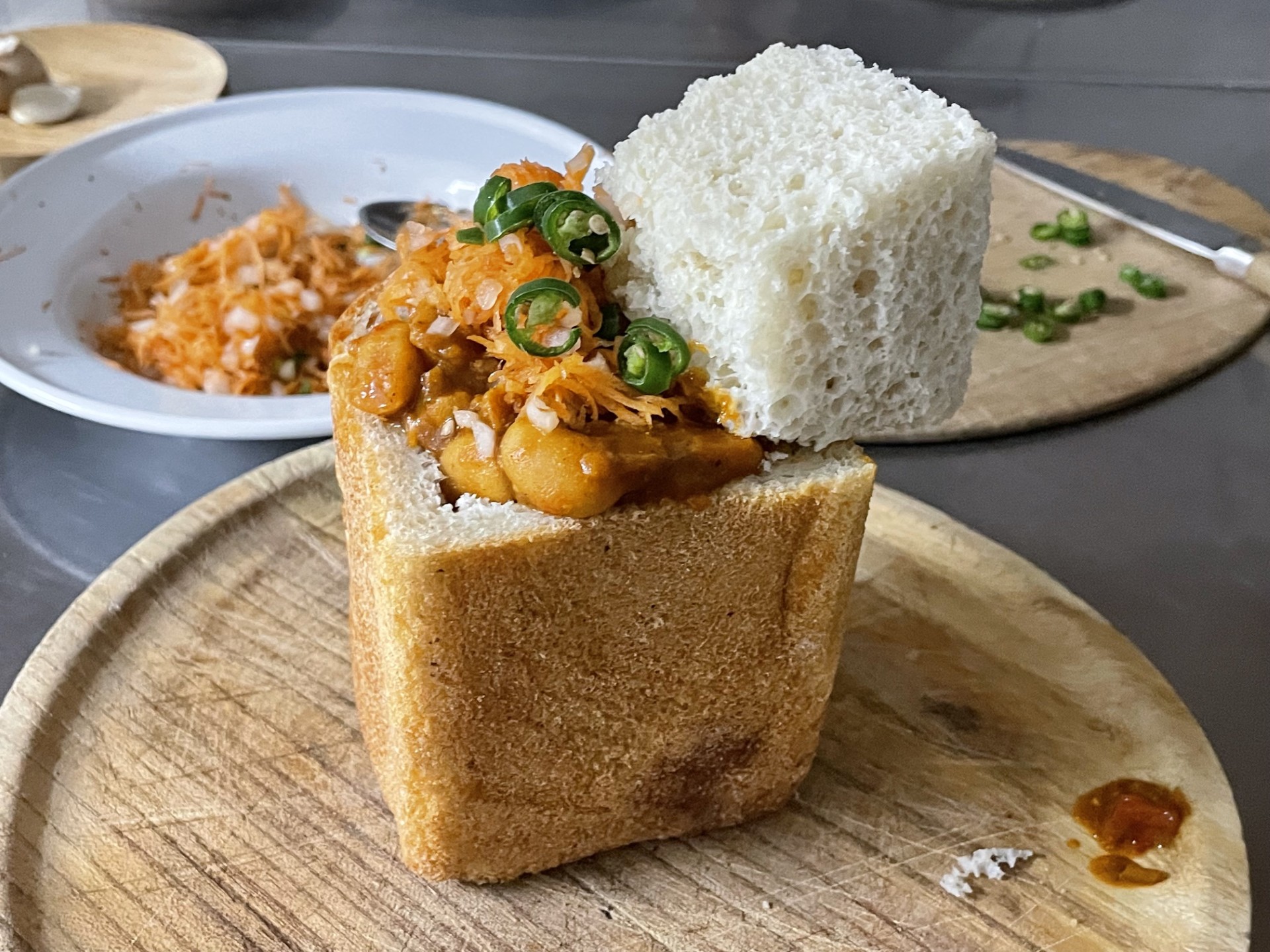
- While the curry finishes, prepare the bread. Using your fingers, carefully hollow out each half loaf, pulling the soft centre out cleanly and leaving the crust intact as a sturdy bowl. Set the removed bread aside — this is the “waiter” or “virgin,” and it gets placed on top of the filled bunny as the lid.
- Ladle the hot bean curry generously into each hollowed loaf, allowing it to soak into the walls of the bread. Place the bread “lid” back on top. Scatter fresh coriander over the top and serve immediately with carrot and cucumber salad or a spoonful of atchar on the side.
The bunny chow is, at its heart, a meal that was never meant to be eaten politely. It spills. It soaks. It stains. And when you finally tear into that curry-drenched bread wall at the end, you will understand exactly why Durban has never once felt the need to apologise for it.
For those however who prefer a more refined manner of eating, use the bean curry as a filler in a warm roti or on a bed of rice.
ALSO READ: MIDWEEK MEALS | One-pan spaghetti meatballs