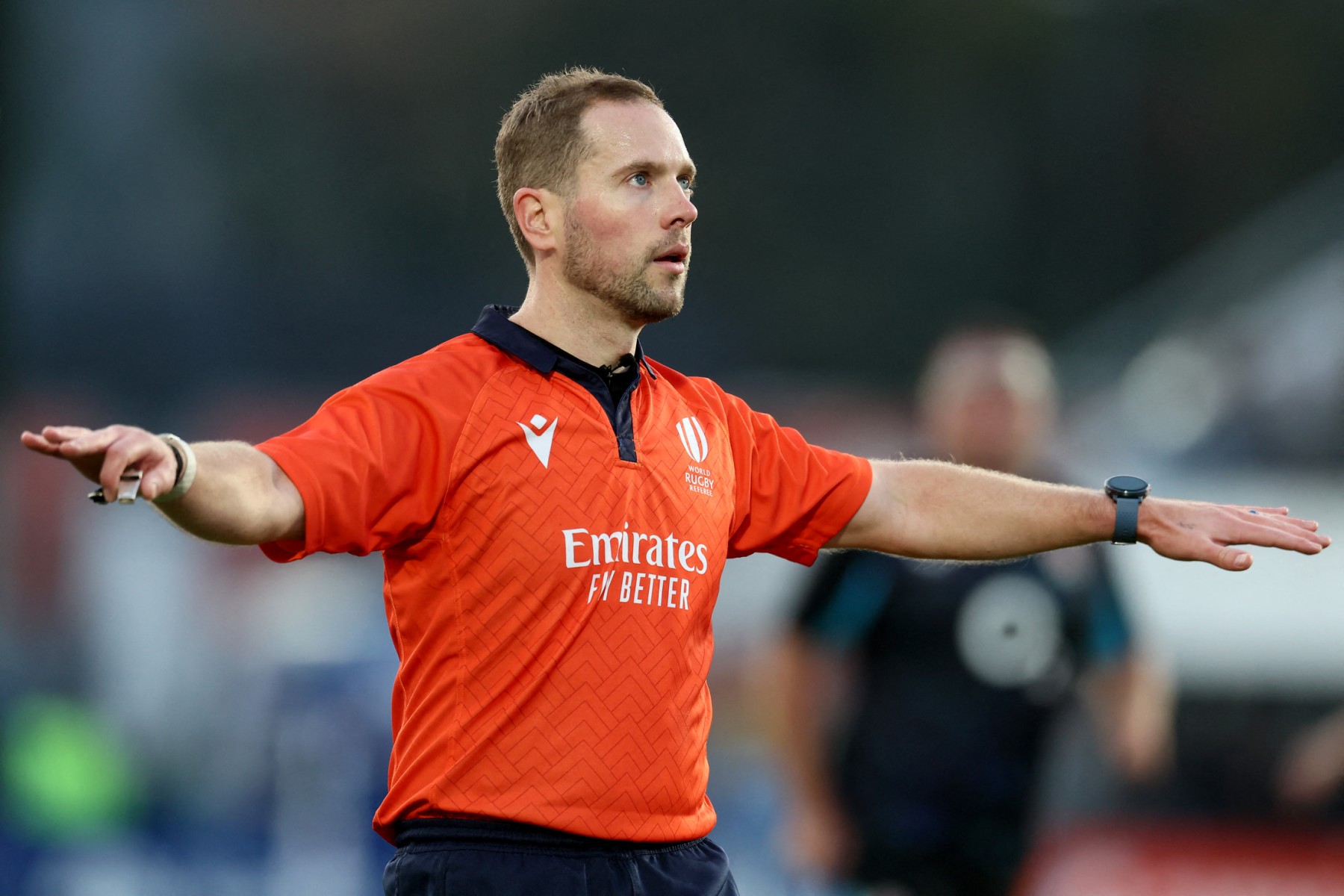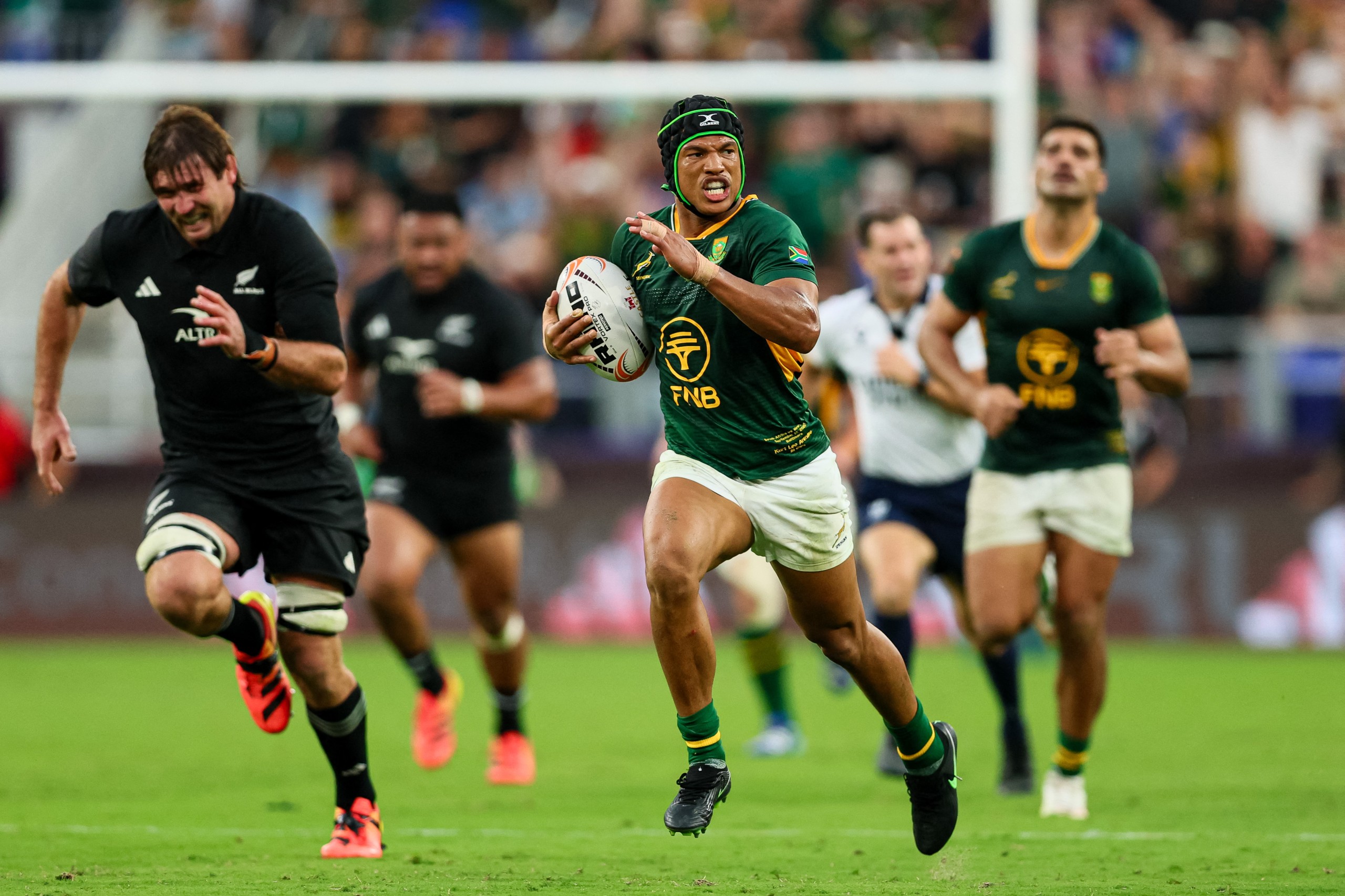
Refereeing will once again dominate pre-match conversation when the Springboks and All Blacks renew hostilities in Saturday’s second Test at Cape Town Stadium, with former Springbok coach Nick Mallett and lock legend Victor Matfield questioning several crucial decisions made by England referee Matt Carley during last weekend’s 33-16 All Blacks victory at Ellis Park.
The pair, speaking on SuperSport’s Final Whistle Presents Side Entry, dissected multiple contentious incidents from Saturday’s opener, particularly focusing on offside calls, scrum penalties, and a late yellow card that they believe significantly influenced the contest’s outcome.
Also Read: Reinach’s tribute to ton-up Pieter-Steph: ‘I’d rather play with him than against him’
And with Georgian referee Nika Amashukeli handed the whistle for Saturday’s Cape Town clash, the pressure is firmly on officials to deliver consistency and accuracy when the series resumes.
Not looking for excuses, but…
Mallett was careful to frame his analysis within the context of South Africa’s overall performance, acknowledging the Springboks made their own mistakes that contributed to defeat. But his examination of Carley’s decision-making revealed genuine frustration with several calls that went against the hosts.
“First of all, we’ve got to say we’re not looking for excuses. We lost this game,” Mallett began diplomatically. “But when you get a game that goes against you, and you’re making your own mistakes, often you also get calls that go against you.”
The most contentious incident came in the second half when Fabian Holland charged down Grant Williams’ box kick, creating the try that put New Zealand into the lead. Mallett believed Holland was offside, and pointed to an earlier, nearly identical incident involving Eben Etzebeth that he felt should have been ruled the same way.
“Right at the beginning of the game, Etzebeth charged the ball down. There’s the offside line; he’s well ahead of the offside line,” Mallett explained, illustrating his point with video footage.
“There’s a player, an All Black player, on the ground part of the ruck… The ref says that’s not offside, play on, and he scores a try. At the beginning, there’s Etzebeth; I thought he was offside, but I also thought that Holland was offside too.”
The scrum penalty that left Matfield baffled
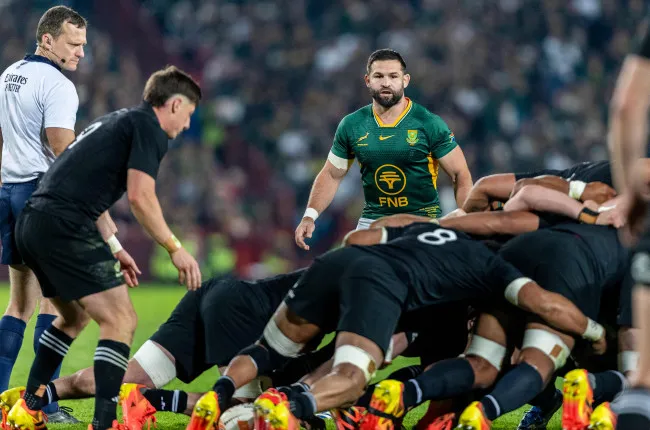
Perhaps the most baffling decision for the analysts came at a crucial scrum five metres from the All Blacks’ line, where South Africa had dominated throughout and won five consecutive scrum penalties. The Springboks opted for their third consecutive scrum from a penalty, piling enormous pressure on New Zealand’s pack.
Then Carley penalised South Africa. For walking around.
Matfield was incredulous, highlighting what he saw as New Zealand’s angled scrummaging that forced the Springbok movement Carley penalised.
“Look at the angle of the loosehead of New Zealand. If you get that angle, how can you not walk around because that prop just went on the angle?” Matfield argued, his frustration evident.
“Wilco Louw was straight. We can see it, the pressure is there, and the All Blacks step left and then, of course, the Boks will follow. What I can’t understand is that we’ve dominated the scrums, we’ve got five scrum penalties in a row, and we are going forward.”
Matfield speculated that Carley may have simply grown tired of awarding scrum penalties and decided to penalise South Africa to move the game along.
“It’s a very, very big call. Five-metre scrum under the posts. Admittedly, we took three scrums, didn’t we? We got two penalties. We went back to a scrum. Perhaps this referee just said, ‘We’re not going to have the scrum all the time,’” Matfield suggested.
Van Staden yellow card also questioned
The pair also examined Marco van Staden’s late yellow card, with Mallett arguing the penalty itself was incorrect because Damian McKenzie failed to roll away from the tackle on Jesse Kriel.
“Jesse Kriel is tackled by Damian McKenzie, who should roll away,” Mallett noted. “Jesse Kriel tries to place the ball, but the tackler is lying on the completely wrong side of the tackle. He’s not allowed to be there.
“Remember, stealers can’t steal if the tackler is still there. Marco van Staden is not there, but he’s behind the last man’s feet.”
Again, the implication: Carley missed McKenzie’s failure to roll away and instead penalised Van Staden, compounding the error by issuing a yellow card that left South Africa a man down during a crucial period.
Saturday’s pressure: All eyes on Amashukeli
Georgian referee Nika Amashukeli will take charge of Saturday’s second Test, and he’ll be acutely aware that every decision will be scrutinised, analysed, and debated by millions watching around the world.
Mallett and Matfield’s dissection of Carley’s performance has ensured refereeing remains front and centre heading into Cape Town. Amashukeli will be under enormous pressure to deliver consistency, accuracy, and fairness to both sides.
In a series as tight and fiercely contested as this, the referee’s performance could determine not just individual Test outcomes, but the entire Greatest Rivalry series winner. Saturday will reveal whether Amashukeli can handle that pressure.