

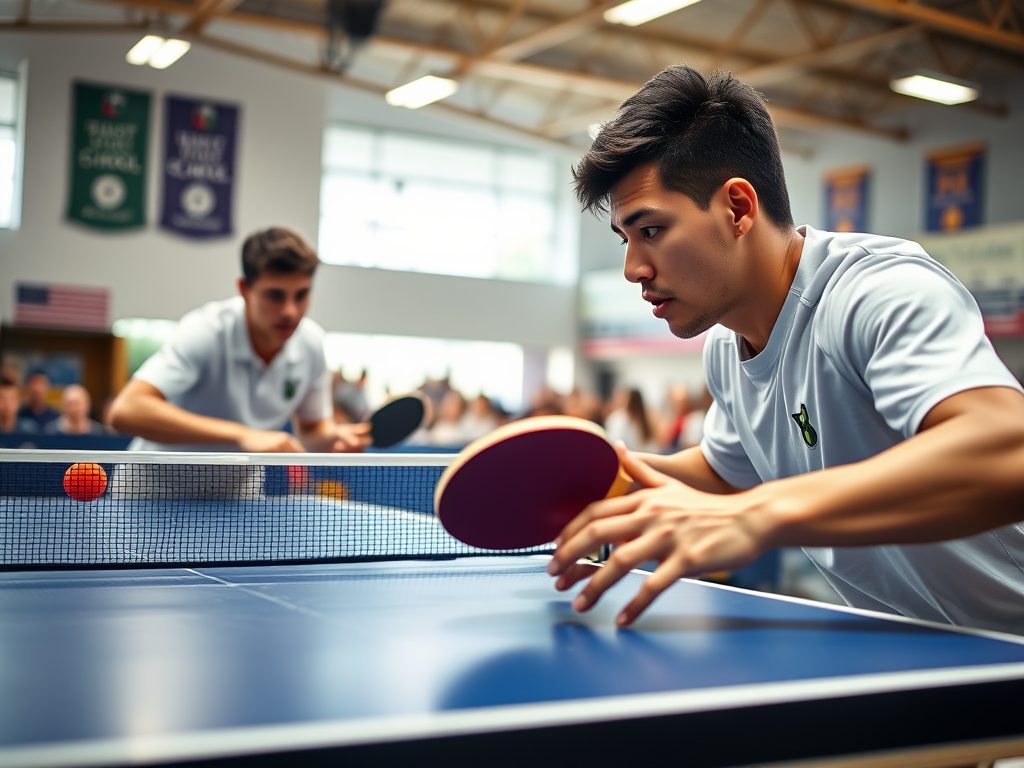
KARIEGA – Table tennis is steadily gaining ground in Kariega and Despatch, with local coach Julian Horne working to expand participation at both high school and primary school level despite limited resources.
Horne said the high schools league is now in its third year. , established in 2010, remains the only club in the region. “We would like to see more clubs forming through developing the sport at schools level,” he said.
ALSO READ: Decaying sports infrastructure sparks concerns in Kariega, Despatch
To start a programme from scratch, Horne explained that schools do not require top-tier competition equipment, but certain basics are essential. “For a school to start from scratch, a table or two, nets and entry level competition standard bats and multiple training balls,” he said.
He emphasised that tables must be suitable for indoor use. “The table does not have to be competition standard but must be indoor; outdoor has a much thinner topsheet which is not suitable for training and competition.”
For a basic start-up, Horne estimates that a table, nets, at least six bats and a set of 100 training balls would cost approximately R12 000. The number of bats required would depend on how many learners wish to participate.
Beyond physical fitness, Horne has observed several developmental benefits among learners who play the sport. “Students who play table tennis show improvements in concentration, problem solving and positive reaction, energy improvement as well as mobility,” he said. “Hand and eye co-ordination naturally improves with repetition.”
The programme has already produced notable achievements. One learner from Strelitzia High School represented the metro at senior level at the national tournament. A learner from Uitenhage High School was selected to represent the metro at the Steve Biko Games last year. In addition, three Masters (50+ category) players represented the metro at nationals.
Horne also highlighted the speed and technical demands of the sport. “Table Tennis is seen as one of the fastest sports in the world, reaction is milli-seconds, so speed combined with technique and thinking is vital,” he said.
Looking ahead, Horne hopes to establish a primary schools league in the area. “If Kariega and Despatch can at least have two schools competing in the primary schools league I would be happy for a start,” he said.
However, challenges remain. Access to a central venue for coaching would be “really an advantage for students”, according to Horne. Transport is another persistent difficulty.
He added that Kariega has experienced table tennis players whose guidance could benefit developing learners. As players improve their equipment needs become more specialised depending on individual playing styles.
In August and September last year, Horne hosted a three-week coaching programme in conjunction with the Department of Sport, Recreation, Arts and Culture, which attracted more than 30 learners. “It was just a basic coaching session,” he said.
With growing interest and early competitive success, Horne believes that continued community support and school-level development will be key to expanding table tennis in the region.


