Former Vlakplaas commander Eugene de Kock has accused the National Prosecuting Authority of protecting apartheid-era generals and politicians by deliberately failing to prosecute those who ordered some of the regime’s most notorious crimes.
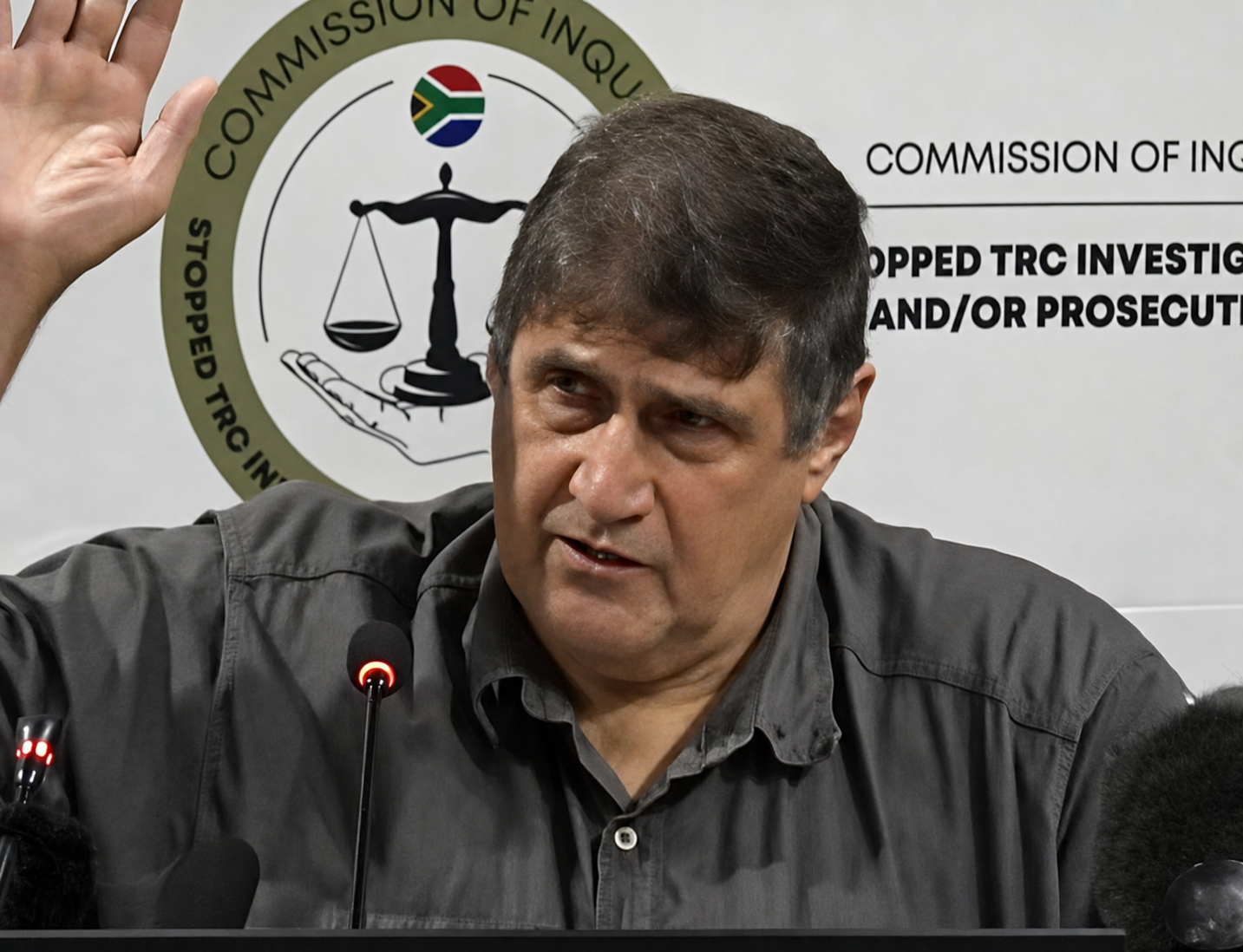
The man known as “Prime Evil” testified before the Khampepe Commission on Monday, claiming he was used as a scapegoat while those at the top of the chain of command escaped justice.
De Kock told the commission that prosecutors never once approached him for statements or evidence about major apartheid crimes, despite his willingness to cooperate. He said he could have immediately identified the generals who gave him orders and explained how instructions moved down the chain of command.
“None served a day in a South African prison – except me,” he said.
The commission is investigating whether attempts were made to prevent or delay the prosecution of apartheid-era crimes linked to the Truth and Reconciliation Commission.
Could have exposed the generals
De Kock said prosecuting the generals above him would have exposed the politicians who ultimately gave the orders. He described himself as a crucial link between operatives who carried out crimes and the senior police commanders who issued instructions.
He listed several major cases where he could have provided evidence but was never asked: the Motherwell bombing that killed four people, the murders of the Cradock Four activists, and the killings of Sweet Sambo, Goodwill Sikhakhane and Jappie Maponya.
The former commander named specific political figures he claims were involved in ordering operations. He alleged that former law and order minister Louis le Grange approved the bombing of the ANC’s London office.
He also claimed that former minister Adriaan Vlok visited Vlakplaas twice to congratulate him after the Cosatu House and Khotso House bombings.
Orders ‘came from very high’
In explosive testimony, De Kock said Brigadier Willem Schoon told him the instruction to bomb Cosatu House came “from very high”. When he asked how high, Schoon allegedly said the order came directly from then-president PW Botha.
These remain allegations presented in testimony and are not findings established by the commission.
De Kock also described an alleged poisoning operation targeting prisoners, which he attributed to then-colonel Johan van der Merwe. He said poisoned food could cause paralysis or death, and that cremation was allegedly used to prevent autopsies from revealing the poisoning.
He described his own trial and sentencing as a “kangaroo court”, alleging the process helped prevent him from implicating senior generals and politicians.
De Klerk ‘has blood of children on his hands’
In a scathing attack on former president FW de Klerk, De Kock said his Nobel Peace Prize should be revoked because he had “the blood of children on his hands”.
He alleged that De Klerk ordered General George Meiring to carry out an October 1993 South African Defence Force raid on an alleged Azanian People’s Liberation Army safe house in Mthatha. The raid killed five people, including 12-year-old twins Wandile and Samora Mpendulo.
“De Klerk is up to his elbows in the blood of children, and his Nobel Prize should be revoked,” De Kock told the commission.
De Klerk shared the 1993 Nobel Peace Prize with Nelson Mandela for their work to end apartheid and lay the foundations for a democratic South Africa. De Klerk died in 2021.
The commission heard that De Kock had detailed knowledge of command structures, operational relationships, covert liaison arrangements, intelligence sources and how target selection worked.
He said he could explain how instructions moved through the chain of command but was never given the opportunity by prosecutors.
De Kock served time for apartheid-era crimes after being convicted in the 1990s. He was granted parole in 2015 but remains under correctional supervision.
The Khampepe Commission was established in May 2025 after pressure from victims’ families who argued that the state had failed to pursue justice for apartheid crimes despite findings from the TRC.
ALSO READ: Ramaphosa grants Khampepe commission extension to probe apartheid-era crime cover-ups