
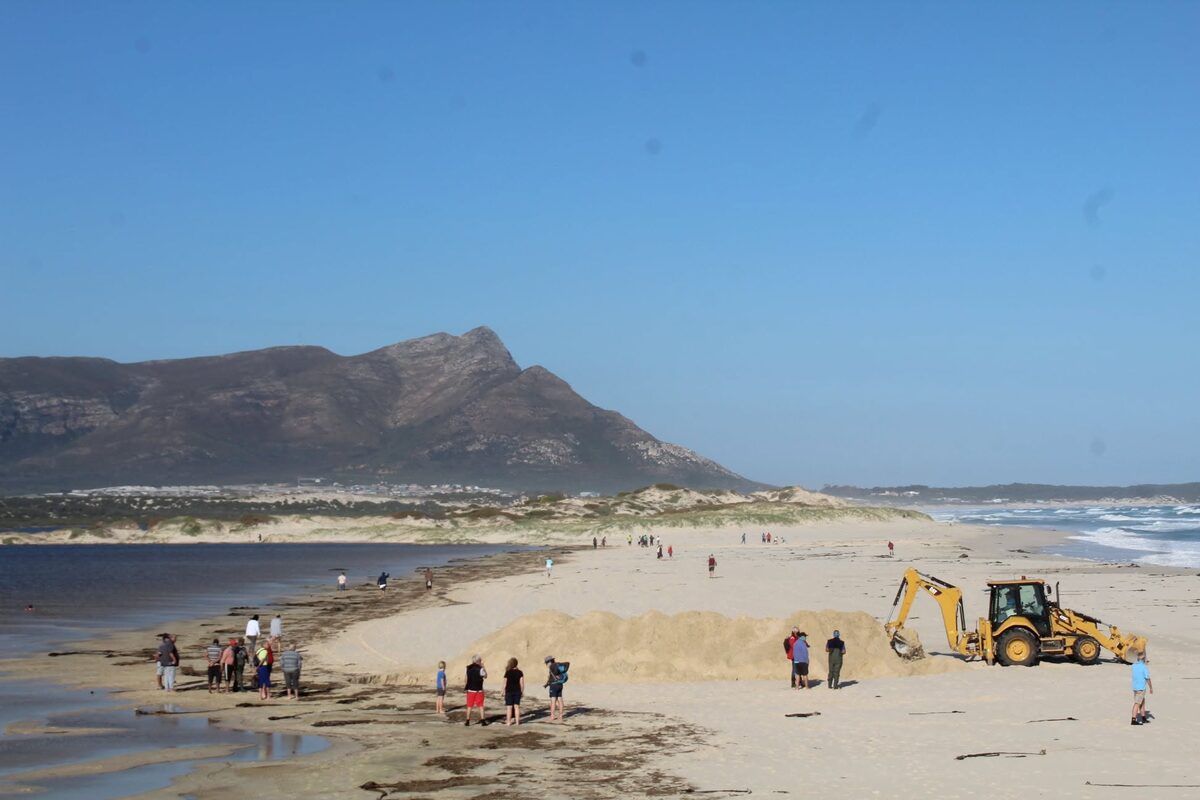
After the Bot River Estuary mouth was artificially opened last month, many residents wondered why this was done especially given the low rainfall in the Overberg and dams that are running increasingly low.
An environmental expert shed light on the matter. The Bot River Estuary mouth was artificially opened on Friday, 14 August, as CapeNature acted to protect the estuarine system’s ecological health under the approved Estuary Management Plan and Mouth Maintenance Management Plan.
“The decision followed a Breaching Committee meeting held to assess prevailing conditions. While the water level stood at approximately 2,4 m – just below the 2,5 m trigger – other critical factors weighed heavily in the decision. Salinity had dropped to around 9, below the 10 threshold, raising the risk of fish mortality should further freshwater enter the system without an opportunity for exchange with the marine environment,” said the acting Municipal Manager of the Overstrand Muninicipality, Edward Jantjies.
The Klein Estuary at Grotto Beach, Hermanus, was also open at the time, and the need for marine species to move between the Klein and Bot estuaries was a further factor in the decision.
CapeNature’s Pierre de Villiers, Senior Manager for Marine and Coasts Operations, explained that restoring connectivity between the estuary and the sea – allowing the movement of fish and other aquatic species – was central to the decision. He said a favourable weather window during the week provided suitable conditions to undertake the opening and that the berm would be breached at its lowest point, opposite the historic channel.
Why the Estuary Mouth matters
The Bot-Kleinmond Estuarine System is one of the most ecologically significant estuaries on South Africa’s coastline. In January 2017, it was designated a Ramsar Wetland of International Importance – a recognition reserved for the world’s most valuable wetland habitats.
A total of 41 fish species from 24 families have been recorded in the system. Of these, roughly 40% are found only in southern African waters, and approximately 71% are either partially or completely dependent on the estuary to survive. The system has been awarded a functional importance score of 90 out of 100 for its nursery role, and it accounts for approximately 12% of all estuarine fish nursery habitat along the 900-kilometre stretch of coastline between False Bay and Port Alfred.
One of the most fascinating aspects of the estuary is the way different fish species use it as a bridge between the ocean and inland waters.
Marine nursery species – including dusky kob, white steenbras, leervis, Cape moony, flathead mullet, freshwater mullet and Cape stumpnose – spend the early stages of their lives in the estuary. These fish are born at sea and their larvae and juveniles enter the estuary through the open mouth, using its sheltered, nutrient-rich waters as a nursery for at least their first year. Without an open mouth, these young fish cannot enter, and the estuary’s nursery function collapses. When they are ready, they return to the ocean to complete their life cycles – but only if the mouth is open to let them out.
Catadromous eels do the reverse. The African mottled eel, the Madagascan mottled eel, and the longfin eel are born in the ocean, enter the estuary as juveniles, and migrate upstream into freshwater rivers and streams where they live for years – sometimes decades – before returning to the sea to spawn. The estuary mouth is the gateway for this entire migration. When it stays closed, eels cannot enter from the ocean or return to it, and their life cycle is broken.
A fish found nowhere else on earth
The estuary is also home to the Bot River klipfish (Clinus spatulatus), a small, live-bearing fish found only in the Bot and Kleinmond estuary systems and nowhere else in the world. Classified as endangered, this species is an obligate estuarine resident – it cannot survive in a purely freshwater or purely marine environment. Its survival is entirely dependent on the estuary remaining in a healthy, brackish condition.
What happens when the mouth stays closed
If the mouth remains closed for too long, the estuary gradually turns into a freshwater lake. Salinity drops steadily and when it falls below critical thresholds, fish begin to die. In the most severe cases on record, salinity fell as low as three parts per thousand, triggering mass fish mortality events. Estuarine invertebrate communities – the food source for wading birds – collapse and are replaced by freshwater species. Reeds such as Phragmites australis encroach into the shallows, trapping sediment and reducing water depth further.
The estuary loses its character as a brackish nursery and becomes something else entirely: a freshwater body that cannot support the marine-dependent species that once thrived there.