


Gaza’s civil defence agency has confirmed that five journalists were amongst at least 20 people killed on Monday when Israeli strikes targeted a hospital in the south of the territory, with Israeli Prime Minister Benjamin Netanyahu expressing regret over what he termed a “tragic mishap”.
Reuters, the Associated Press and Al Jazeera have all issued statements mourning their slain contributors, whilst the Israeli military has announced it will investigate the incident.
The ongoing conflict in Gaza has proved to be one of the deadliest for journalists, with approximately 200 media workers killed over the course of the nearly two-year Israeli assault, according to media watchdog organisations.
Hospital strike details
Civil defence spokesman Mahmud Bassal confirmed “the toll thus far is 20 martyrs, including five journalists and one member of the civil defence”, following strikes on Khan Yunis’s Nasser Hospital—a large medical complex that has been targeted several times by Israel since the commencement of hostilities.
In a statement, the Israeli military acknowledged its troops had “carried out a strike in the area of Nasser Hospital”.
“The Chief of the General Staff has instructed that an initial enquiry be conducted as soon as possible,” the statement read, adding that it “regrets any harm to uninvolved individuals and does not target journalists as such”.
Mr Bassal reported that an Israeli explosive drone struck a building at the hospital, followed by an air strike as the wounded were being evacuated.
Prime Minister’s response
Netanyahu issued a statement on Monday evening stating that his country “deeply regrets the tragic mishap that occurred today at the Nasser Hospital”.
“Israel values the work of journalists, medical staff, and all civilians,” he added.
Reuters reported that video journalist Hussam al-Masri—a contractor working for the agency—was operating a live feed at the hospital, “which suddenly shut down at the moment of the initial strike”.
Media organisations ‘devastated’
A Reuters spokesperson confirmed the agency was “devastated” to learn of Mr Masri’s death “and injuries to another of our contractors, Hatem Khaled” in the strikes.
“We are urgently seeking more information and have asked authorities in Gaza and Israel to help us obtain urgent medical assistance for Hatem,” the statement continued.
A spokesperson for Qatar-based television network Al Jazeera confirmed that one of its photojournalists and cameramen, Mohammad Salama, was also killed in the attack.
“Al Jazeera Media Network condemns, in the strongest possible terms, this horrific crime committed by the Israeli occupation forces, who have directly targeted and assassinated journalists as part of a systematic campaign to silence the truth,” the broadcaster stated.
The Associated Press confirmed it was “shocked and saddened” to learn of the death of Mariam Dagga, 33, a visual journalist who had worked as a freelancer for the agency since the start of the conflict.
The Palestinian Journalists Syndicate identified two other victims as Moaz Abu Taha and Ahmad Abu Aziz.
Later on Monday, a sixth journalist, Hassan Douhan, was killed by Israeli fire in the Al-Mawasi area of Khan Yunis, according to the Palestinian Journalists Syndicate and Nasser Hospital.
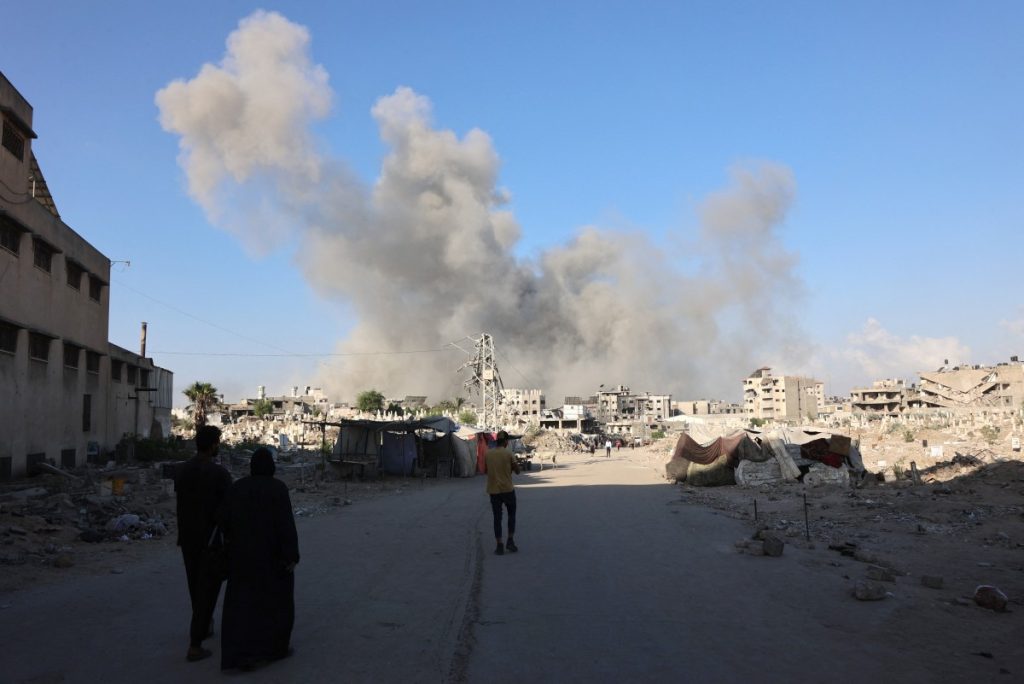
Aftermath scenes
Media restrictions in Gaza and difficulties in accessing many areas mean AFP is unable to independently verify the casualty figures and details provided by the civil defence agency or the Israeli military.
AFP footage from the immediate aftermath of the attack showed smoke filling the air and debris from the blast scattered outside the hospital.
Palestinians rushed to assist the victims, carrying bloodied corpses and severed body parts into the medical complex. One body could be seen dangling from the top floor of the targeted building as a man screamed below.
A woman wearing medical scrubs and a white coat was amongst the injured, carried into the hospital on a stretcher with a heavily bandaged leg and blood covering her clothing.
Nasser Hospital remains one of the last remaining health facilities in the Gaza Strip that is at least partially functioning.
Later in the day, a crowd carried the bodies of some of the slain journalists at a funeral in Khan Yunis, with the deceased wrapped in white burial shrouds and their press flak jackets placed on top.
“We will not cease walking this path, and the coverage will continue, God willing,” said Mr Masri’s brother Mahmoud.
International condemnation
The strike has been condemned by a range of voices, including the United Nations, media outlets, rights groups and the Israel-based Foreign Press Association.
Earlier this month, four Al Jazeera staff and two freelancers were killed in an Israeli air strike outside Al-Shifa hospital in Gaza City, prompting widespread condemnation.
The Israeli military alleged that Anas al-Sharif—a prominent Al Jazeera correspondent killed in the strike—headed a Hamas “terrorist cell” and was “responsible for advancing rocket attacks” against Israelis.
The war in Gaza was sparked by Hamas’s October 2023 attack on Israel, which resulted in the deaths of 1 219 people, mostly civilians, according to an AFP tally based on official figures.
Israel’s retaliatory offensive has killed at least 62 744 Palestinians, most of them civilians, according to figures from the health ministry in Hamas-run Gaza that the United Nations considers reliable.
ALSO READ: Gaza slips towards famine



You must be logged in to post a comment.