

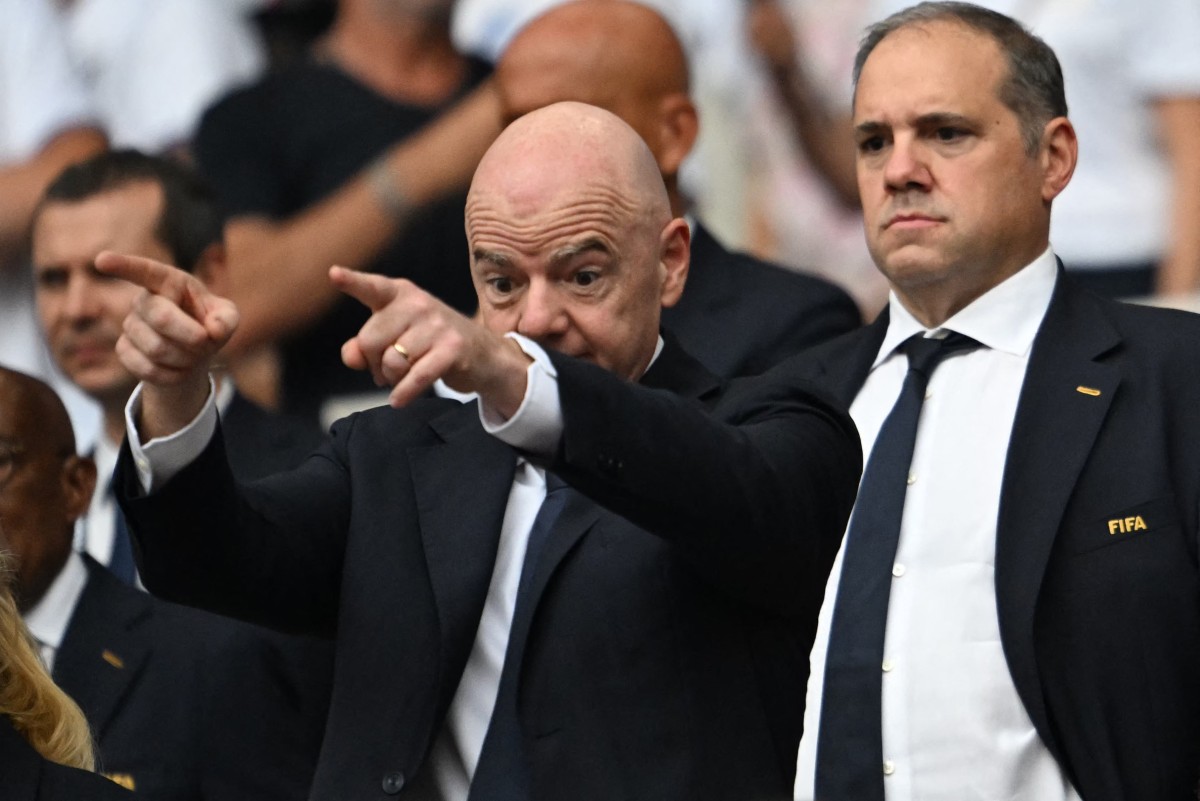
The gloves are off. FIFA has vowed to press ahead with its controversial private investment plan despite a nuclear threat from UEFA to boycott the World Cup if the world governing body doesn’t back down.
In a defiant statement released Friday, FIFA insisted it would proceed with an “open and democratic” consultation on the proposal that has triggered the biggest civil war football has witnessed in decades. The world body claims all 211 member associations deserve a chance to consider the plan, brushing aside warnings from Europe, North America, Asia, and Africa that this crosses a line too dangerous to contemplate.
“Nobody is selling football,” FIFA declared. “This is not something FIFA would ever entertain.”
But UEFA isn’t buying it. Europe’s governing body has drawn a line in the sand, declaring that none of its national teams would participate in any FIFA competition “for so long as these proposals remain alive.” That includes the World Cup, football’s crown jewel and FIFA’s golden goose.
The battle lines couldn’t be clearer. FIFA insists it’s offering a democratic consultation. UEFA calls it “governance by intimidation.” One side sees a golden opportunity to turbocharge global development. The other sees football’s soul being auctioned to the highest bidder.
Welcome to the biggest power struggle world football has ever witnessed.
The plan that broke football
FIFA announced Tuesday it could raise up to $4.2 billion based on a valuation of $20 billion for the FIFA Forward Enterprise (FFE), the proposed commercial subsidiary that would run events including the World Cup and Club World Cup.
Private investors would be allowed to acquire minority stakes in the company, whilst FIFA retains majority control. In return, each of FIFA’s 211 member associations would receive a one-off payment of $20 million in early 2027, with funding allocations for the 2027-2030 cycle increasing from $8 million to $20 million.
On paper, it’s a windfall. Twenty million dollars could transform football development in smaller nations. Increased funding could build infrastructure, develop coaching programmes, and professionalise administrations that currently run on shoestring budgets.
But the opposition isn’t arguing about the money. They’re arguing about the principle, and what happens when private investors hold significant stakes in football’s most valuable asset.
UEFA’s nuclear option
UEFA didn’t just criticise the proposal. It detonated a bomb.
“The World Cup cannot be treated as an investment product… No part of it should ever be surrendered to private investors. The World Cup is not for sale,” Europe’s statement thundered.
Then came the threat that left jaws on floors across the football world: European national teams would boycott FIFA competitions for as long as the proposal remains alive.
Imagine a World Cup without Germany, France, Spain, Italy, England, Portugal, the Netherlands, Belgium, Croatia. Imagine the commercial catastrophe, the credibility crisis, the existential threat to the tournament’s legitimacy.
UEFA isn’t bluffing. President Aleksander Čeferin, who already boycotted the recent World Cup final to show his displeasure with FIFA, made clear there’s no place in world football for private investment models.
“Football’s future cannot be dictated by the expectations of those whose first duty is to maximise financial return,” Čeferin declared. “Nor can the interests of national associations, leagues, clubs, players and supporters become subordinate to investor returns. Football cannot mortgage its future for financial gain.”
UEFA went further, describing the proposal as “a failure of leadership” and accusing FIFA of “governance by intimidation.”
“It is both irresponsible and indefensible that a proposal of such significance for football was conceived in secret and brought to the brink of approval without any meaningful consultation with those entrusted with stewarding the game,” UEFA’s statement charged.
“National associations around the world are now presented with an ultimatum, accept the irreversible capture of football’s greatest competitions or bear the consequences. Some things are simply too important to sell. The FIFA World Cup belongs to football. It always will. And so long as Europe has a voice, it will never be for sale.”
The global revolt
Europe isn’t alone in its opposition.
CONCACAF members, including the three co-hosts of the recent World Cup, unanimously rejected the proposal Thursday. All 41 member associations voted against it, expressing “deep concerns about the lack of due process surrounding the proposal, the artificially short deadline imposed, and the absence of any review or approval by the relevant FIFA governance bodies.”
The Asian Football Confederation (AFC) expressed concern that FIFA made the proposal public before all 211 member associations were fully consulted. The Confederation of African Football (CAF) urged its members to review the divisive plan carefully.
Even the European Union waded in, praising UEFA for “defending the integrity of the game.” Glenn Micallef, European commissioner for sports, posted on social media: “Proud to see Europe’s football associations leading on governance, standing firm on their principles.”
FIFA doubles down
Despite the global revolt, FIFA insists it will proceed with consultation.
The world body acknowledged hearing feedback from UEFA and CONCACAF but said its planned consultation process had been “disrupted by incorrect media reports.” It claimed to respect the feedback and concern whilst reaffirming commitment to an “open and democratic consultation.”
“We will proceed with this consultation process to ensure that each member association has the ability to express its vote based on facts,” FIFA’s statement declared.
President Gianni Infantino described the initiative Wednesday as a “golden opportunity to turbocharge the development of the game globally,” seemingly undeterred by the firestorm his proposal has ignited.
The fundamental question
Strip away the rhetoric, the threats, and the posturing, and one fundamental question remains: Should private investors be allowed to own stakes in the World Cup’s commercial operations?
FIFA argues it’s not selling football, just creating a sustainable funding model that channels billions into development whilst retaining majority control. The $20 million windfall for each member association would be transformative for smaller nations that struggle financially.
Opponents argue that once private investors hold minority stakes, their influence becomes inevitable. Quarterly earnings expectations, pressure for returns, commercial considerations overriding sporting ones, these become the new reality. The World Cup risks becoming an investment product optimised for financial returns rather than a sporting competition held in trust for the global community.
The stakes couldn’t be higher
UEFA called the World Cup “one of football’s greatest sporting legacies” and vowed it would “never be for sale” so long as Europe has a voice.
That’s the line in the sand. Private investors can pursue other opportunities, but the World Cup remains off limits. Compromise isn’t on the table. Negotiation isn’t happening. This is binary: withdraw the proposal or face the consequences.
FIFA’s response will determine whether world football navigates this crisis through dialogue or descends into civil war.
Nobody is selling football? UEFA says prove it. Withdraw the proposal, or watch Europe walk away from the World Cup.
The ball is in FIFA’s court. And the whole world is watching.

