


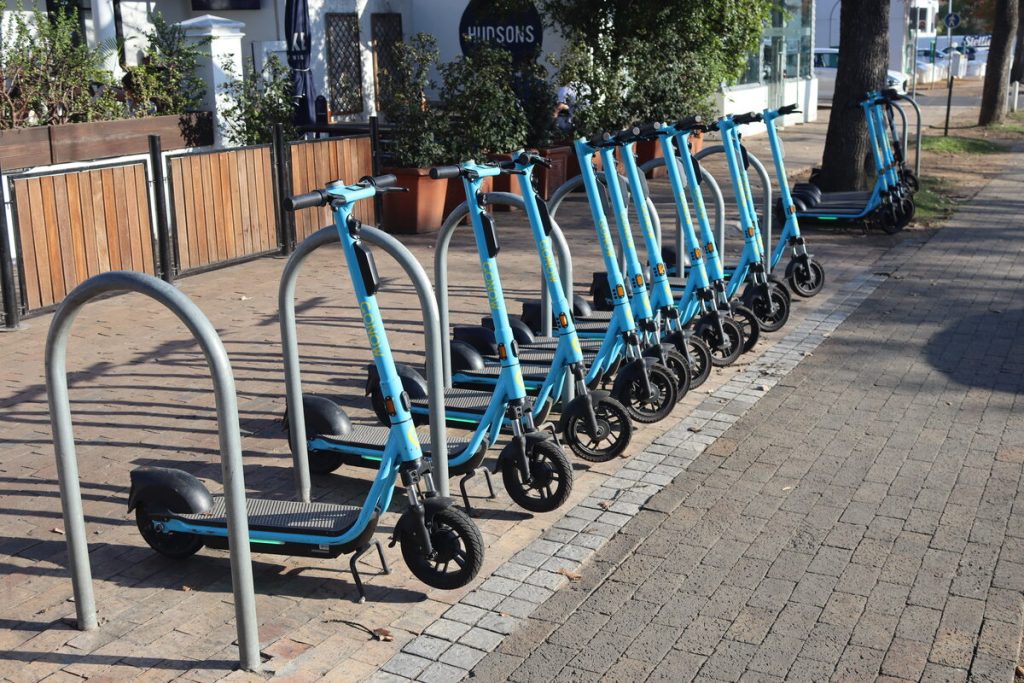
The legalities of using electronic scooters on public roads may be in limbo, but it seems users of GoNow scooters in Stellenbosch have no qualms about zipping around town on the blue vehicles.
Despite Stellenbosch Municipality issuing a notice the local micro-mobility transport provider as of 1 March, GoNow’s e-scooters are still in used in and around town. Among the users are groups of underage children, which was originally one of the reasons the municipality suspended GoNow’s services in town.
Legal grey area persists
After serving GoNow with a notice to suspend its operations in town, the municipality said the national traffic and transport legislation (National Road Traffic Act 93 of 1996) and regulations (National Road Traffic Regulations, 2000) made the use of e-scooters illegal.
The municipality also cited two unrelated accidents involving minors as reasons for the suspension.
ALSO READ: GoNow in die wiele gery
GoNow co-founder Jacob Levitan explained that these two children, aged 12 and 14 respectively, had circumvented GoNow’s age restriction of 16 years by using the credentials of their older siblings.
However, despite the company’s promise of various safety features like user verification and age controls, underage children can still regularly be on GoNow e-scooters in Stellenbosch’s CBD.
Stellenbosch Municipality has sought legal advice about the scooters.
“The municipality is attending to this through our legal services and we are waiting for a meeting to address the legal opinion that has now been obtained to discuss the way forward,” said municipal spokesperson Stuart Grobbelaar.
At the time of the issuing of the notice, Levitan urged the municipality not to halt operations summarily, but rather to “constructively engage” and create “a clear interim framework for micro-mobility in Stellenbosch”.
No straight answer
Levitan, who is also the CEO of GoNow, said the company has opted not halt its Stellenbosch operations despite the municipality’s “semi-formal suspension letter”.
According to Levitan its now seems Stellenbosch Municipality is “moving away from shutting down the service, towards embracing being the first South African town with e-scooters as a mobility option, given the imminent amendment”.
“We have recently discovered that the legal framework for GoNow is more positive than the municipality originally thought. The National Road Traffic Act (NRTA, Act 93 of 1996) does not explicitly exclude e-bikes or e-scooters from the definition of a motor vehicle. This ambiguity was addressed in the NRT Amendment Act (Act 8 of 2024), enacted by Parliament on 10 December 2024,” Levitan explained.
“The definition of a motor vehicle was amended to exclude various vehicles, including power-assisted pedal cycles (e-bikes) and vehicles with a maximum design speed of 45 km/h classified as environmentally friendly vehicles (which includes e-scooters). The implementation date and regulations of the NRT Amendment Act 8 of 2024 have not yet been published, but it is only a matter of time. The legality of the scooters, which the municipality was questioning, is therefore (nearly) moot.”
After the initial media reports ridership was down and the company temporarily switched off the ID verification feature as costly to run.
However, Levitan reiterated that the company is firmly committed to the 16-and-over age limit and the verification will soon be switched back on.
Beyond Stellenbosch
Despite the ongoing local dispute GoNow continues to expand its footprint and has quickly become a fan favourite among students of the North-West University (NWU), where it launched operations in late last month.
But Louis Jacobs, a spokesperson for the NWU, said the university has not approved the use of e-scooters on its premises. “GoNow has approached the NWU and they were informed that should the NWU at any time consider allowing any company to make their product available to our students, such a process will have to follow the NWU’s financial policy, which includes a competitive procurement process,” Jacobs said.
“This company will have to prepare and submit a comprehensive operational plan to the university.”
NWU has received documentation from GoNow which is currently being reviewed.
Jacobs added that NWU recognises the potential benefits of introducing e-scooters, in terms of environmental sustainability, reducing carbon emissions and providing an alternative, convenient mode of transport for students and staff.
“The university is therefore supportive of exploring innovative and sustainable mobility solutions, but will have to ensure full compliance with the university’s governance, legal and procurement requirements, as well as implementing appropriate measures to address safety, liability, and operational risks ,” he said.
Local reports indicate students, high school learners and security guards have taken to the micro-transport mode.
Creating the legislation
Stellenbosch residents and road users aren’t the only critics of e-scooters. The City of Cape Town has set a deadline for safer e-scooter use on Sea Point Promenade. This follows public complaints about the use of motorised scooters on the popular walkway.
In a statement, the City explained that various safety measures will be put in place to improve pedestrian safety while providing clear rules for the responsible use of electric mobility devices.
The City aims to publish a management protocol and install relevant signage by the end the month, while rental operators have until the end of September to comply with the new safety measures. These measures include: a maximum speed of 8 km/h in shared pedestrian areas; one rider per device; and appropriate age, supervision and safety requirements .
ALSO READ: City to tighten e-scooter and e-bike controls on Sea Point Promenade
But Stellenbosch Municipality noted that GoNow users in town are not limited to a specific, designated recreational area like the promenade.
“The Sea Point Promenade was agreed on as the only space where this could be allowed in the City – as it is zoned as public open space – with no impact on roads, pavements, and vehicular traffic,” Grobbelaar said.
“We are moving ahead with our plan as communicated. Legal opinion [has been] received and the process is now around how this impacts the work of various municipal departments and what is the best way forward.”
Levitan said GoNow foresees a positive future for the micro-mobility industry in South Africa. “We remain fully committed to working with local authorities and operating within the legal framework. In the meantime, GoNow is showing lawmakers what those laws should look like,” he said.


You must be logged in to post a comment.