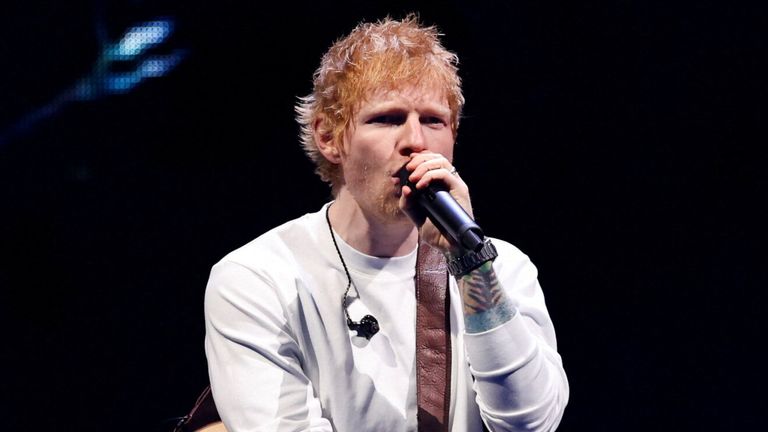
All remaining supporting acts have withdrawn from Ed Sheeran’s Loop Tour in solidarity with rapper Macklemore, after the rapper was removed over his pro-Palestinian comments.
Finneas, Lukas Graham, Aaron Rowe and Irish folk band Beoga all announced their departures on Tuesday, leaving Sheeran without his scheduled opening acts. The controversy over political expression at his concerts continues to escalate.
The walkouts came hours after Sheeran publicly addressed Macklemore’s removal, insisting that the decision was made by tour promoter Messina Touring Group and the venues hosting the concerts, rather than by him personally.
“Macklemore coming off tour was the promoter’s decision, it was not mine,” Sheeran said in a statement posted on Instagram.
The British singer said he had spent the previous week attempting to resolve the dispute and “build a bridge” between Macklemore, the promoter and venues. But, he said, the venues’ and promoter’s decision was ultimately final.
Macklemore controversy
The controversy began after Macklemore used his support slot at New Jersey’s MetLife Stadium earlier this month to publicly support Palestinians.
During his performance, he called for a “Free Palestine” and introduced his protest song “Hind’s Hall”. The song was in commemoration of Hind Rajab, a five-year-old Palestinian girl who was killed by Israeli military fire in Gaza City in 2024.
Macklemore also addressed Jewish members of the audience, saying that criticism of Israel should not be understood as criticism of Jewish people.
Subsequently, the Grammy Award winner said he had been removed from the remaining North American dates after several stadium owners objected to his presence.
He specifically accused New England Patriots Stadium owner Robert Kraft of rallying other stadium owners against him and presenting Sheeran’s team with an ultimatum: keep Macklemore on the tour or risk losing access to venues.
Messina Touring Group confirmed that multiple venues had told the promoter they would not allow concerts to proceed with Macklemore on the bill.
A total of seven United States venues objected to Macklemore’s addittion on the remainder of the tour. These include Gillette Stadium, Lincoln Financial Field, Mercedes-Benz Stadium, Lucas Oil Stadium, Bank of America Stadium, AT&T Stadium and Raymond James Stadium.
Kraft defended the decision, saying Macklemore’s recent performances, material shared from the stage and what Kraft described as a broader history of antisemitic rhetoric and imagery had crossed the line for Gillette Stadium.
He added that the decision was not intended to diminish Palestinian suffering or prevent advocacy for Palestinians, while arguing that criticism of Israel should not obscure the actions of Hamas.
Macklemore rejected allegations that his advocacy was antisemitic and argued that criticism of Israel’s actions should not be equated with hostility towards Jewish people.
Pink backlash
Macklemore’s comments initially drew criticism from three-time Grammy winner and singer Pink.
She shared a post criticising Macklemore’s remarks which prompted backlash from people who interpreted the post as opposition to Palestinian advocacy. She later clarified her position, saying that social-media posts and memes could not adequately capture the complexity of the conflict.
Pink said she supports the rights and future of Palestinians while also condemning Hamas. She explained that her own Jewish identity and concerns about the safety of Jewish people informed her response.
Against that increasingly polarised backdrop, Sheeran attempted to distance himself from the political dispute.
The singer said he has personal views about the Israel-Palestine conflict and is “appalled” by the suffering caused by it, but has deliberately chosen not to publicly express those views during his concerts.
Sheeran said his shows are intended to be places where people from different backgrounds can come together rather than political forums.
“I am not complicit,” he said, while also expressing respect for Macklemore’s decision to stand up for what he believes. He argued that there could be “multiple approaches to the same end: peace”. His own approach, he explained, being to use his platform as a place of safety, dialogue and diplomacy.
His explanation, however, has been followed by a remarkable chain reaction.
Supporting acts drop out of tour
Grammy-award winner and Billie Eilish collaborator, Finneas was due to join Sheeran for the South American leg of the tour.
However, following the latter’s statement and backing of the decision to drop Macklemore, he said: “Artists must not be silenced when they speak up for the oppressed”. He announced his subsequent withdrawal from the tour.
Aaron Rowe, who was due to replace Macklemore on upcoming US dates, also pulled out. The Irish musician said his decision was influenced by his country’s history of genocide, forced famine and occupation.
Beoga, who had been performing with Sheeran during his shows, also withdrew, describing its members as Irish Artists for Palestine activists.
Lukas Graham, another replacement for Macklemore, said it was difficult to continue after what had happened, arguing that money should not determine who gets to speak or which suffering can be acknowledged.
The result is that Sheeran now faces his upcoming shows without the supporting acts that had been scheduled to accompany him.
A dispute bigger than performers
The dispute has therefore developed beyond a disagreement between two performers.
It has become a wider confrontation involving artists, promoters, stadium owners and competing views about the limits of political expression on commercial entertainment platforms.
For Sheeran, the issue is one of maintaining concerts as inclusive and broadly apolitical spaces.
For Macklemore and the artists who have subsequently withdrawn, the issue is whether artists should be expected to remain silent when using their platforms to speak about an ongoing humanitarian crisis.
The controversy is particularly notable given Sheeran’s own history of political and humanitarian engagement.
Sheeren’s political stance and history
Although he has generally avoided presenting himself as a political activist, Sheeren has publicly engaged in political activism in previous years.
In 2016, the four-time Grammy winner supported Britain remaining in the European Union.
Then in subsequent years, he would back labour politicians, support LGBTQ+ rights, participate in refugee-related initiatives and perform at a fundraising concert for Ukraine following Russia’s invasion.
His current position is therefore less that he has never expressed political views and more that he does not believe his concert platform should become a political forum. That distinction is now being tested as the fallout from the Macklemore dispute threatens to reshape the remainder of his tour.
With all four remaining support acts withdrawing, the immediate question is no longer simply whether Macklemore should have been allowed to speak from Sheeran’s stage.
It is whether Sheeran can maintain his stated vision of the tour as a neutral space when the artists sharing that stage have concluded that neutrality itself has become part of the political debate.