

Busamed Paardevlei Private Hospital in Somerset West has established itself as a leading cardiology facility, transforming healthcare accessibility for the community through world-class care.
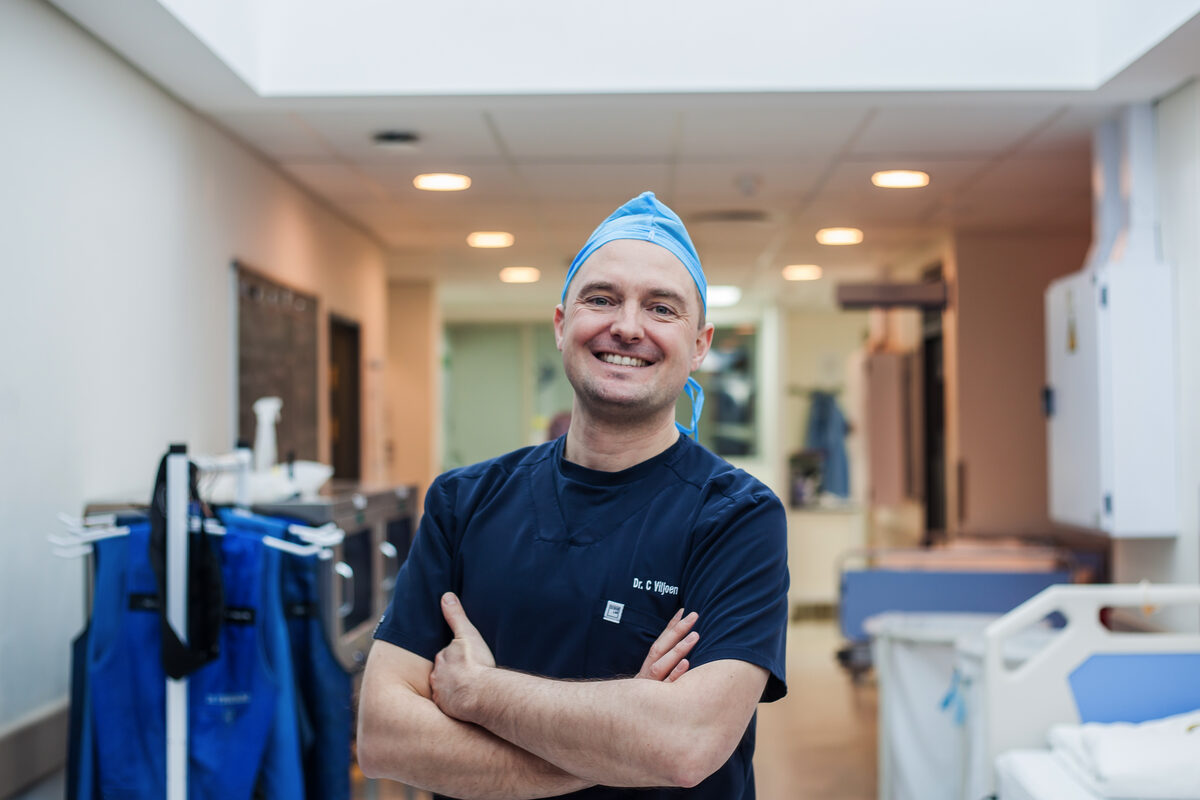
The facility’s latest milestone is the introduction of a specialised electrophysiological service headed by cardiologist and electrophysiologist Dr Charle Viljoen.
“I’m excited to establish an electrophysiology service at Busamed,” the 42-year-old medical specialist, who is bringing cutting-edge, full spectrum cardiac care to the basin, enthusiastically shared.
He completed his medical training at the University of Pretoria before pursuing his postgraduate studies at the University of Cape Town. His specialised training encompassed internal medicine, cardiology and electrophysiology.
The Pretoria-born physician, now proudly identifying as a Capetonian, and a recent addition to the Cape Winelands community, brings five years’ experience as a cardiologist to his new role. His expertise has been further enhanced through recent specialised training in electrophysiology, positioning him to offer advanced cardiac-rhythm management services to Busamed patients.
Asked what gets his blood pumping for the specialised field of cardiology, Viljoen fondly recalled: “My fascination with the heart actually began when I was just seven years old. We went on a hunting trip, and afterwards an impala’s heart was shown me.
“I was absolutely captivated watching how the valves could open and close when we poured water through it with a hosepipe. From that moment I knew I wanted to work with the heart one day.”
His childhood wonder evolved into a deeper scientific passion at medical school and eventually living his dream. “From early medical-student days I was captivated by electrocardiograms (ECGs). The notion that the heart’s electrical impulses could produce patterns on paper, and that these patterns could help to diagnose arrhythmias truly amazed me.”

This fascination naturally led him towards electrophysiology, the specialist field that focuses on the heart’s electrical system. “I genuinely come to work every day feeling fascinated by what I do.”
Viljoen successfully conducted his first cases at the hospital on Tuesday 26 August, performing a pioneer procedure called pulsed field ablation, a revolutionary advancement in catheter ablation therapy for atrial fibrillation (irregular heartbeats).
Explaining this cardiological phenomenon Viljoen emphasises the importance of understanding electrophysiology itself. “The heart is essentially a pump that supplies blood to the entire body. For this pump to function effectively it needs not only its own blood supply, but also its own electrical system.
Atrial fibrillation
“Electrophysiology focuses on ensuring the heart’s electrical system operates correctly. Every heartbeat begins with an electrical impulse that travels from the upper down to the lower chambers, synchronising the entire cardiac cycle. When this electrical system malfunctions various interventions become necessary.
“If the heartbeat is too slow we can implant a pacemaker. If it’s too fast we investigate the source of the problem. Sometimes this requires implanting a device that can shock the heart back into rhythm, or we may need to ablate – essentially eliminate – abnormal electrical pathways or problematic areas.
“Pulsed field ablation specifically targets atrial fibrillation, the most common arrhythmia affecting the general population. Atrial fibrillation poses serious health risks for two primary reasons; it’s a leading cause of stroke and contributes significantly to heart failure. Traditional treatment approaches include blood thinners and medications, but when these prove insufficient ablation offers an alternative solution.
“What makes pulsed field ablation revolutionary is that we don’t burn or freeze the problematic veins. Instead, we deliver precise shock waves at very high frequencies to the affected areas.
“This innovative approach offers distinct advantages; not only do we successfully isolate the triggers causing the arrhythmia but we also protect the surrounding tissues. The procedure is performed with ultrasound, X-ray, and 3D-mapping guidance, ensuring maximum precision and safety.”
Explaining how the procedure differs from a traditional catheter ablation, Viljoen said traditionally atrial fibrillation was treated by either burning the lesions around the pulmonary veins or freezing the pulmonary veins.
However, the problem with thermal methods is that even though the complication rate is very low, there is risk of thermal damage to adjacent structures.
“And in that way pulsed field ablation is considered to be safer because it protects the oesophagus and nerves, which are in the vicinity, and would be at least as effective as these other methods.”
Pulsed field ablation

Dr Viljoen highlighted that “pulsed field ablation is an exciting new development for cardiology, because it offers a new tool to the toolbox in treating arrhythmias”.
According to Dr Viljoen currently patients with atrial fibrillation are the primary candidates for this procedure. While the technology is being developed for other arrhythmias, traditional radiofrequency ablation is still used for those conditions.
Asked what patients can expect, Viljoen explained the procedure requires hospital admission and is performed under general anesthesia. It begins with an echocardiogram to ensure there are no blood clots or structural abnormalities that could make the procedure dangerous.
The cardiologist then places specialised catheters in the left atrium to create a 3D map and monitor electrical activity. The pulse field energy is delivered to the four pulmonary veins to electrically isolate them.
As part of the recovery process patients remain in hospital overnight for monitoring of heart rhythm and blood pressure. Most experience no pain after the procedure and can typically return home the next day. Normal activities can usually be resumed within about a week.
Dr Viljoen added that success rates significantly depend on early intervention. “The sooner patients receive treatment, the better the outcomes.”
The availability of the state-of-the-art technology transforms healthcare access for Helderberg residents locally, he reckons.
“This represents a significant advancement for the Helderberg community. We’re delivering world-class, cutting-edge cardiac technology that matches international standards.
“Our patients can now access the most advanced electrophysiology treatments locally, without needing to travel.”


You must be logged in to post a comment.