

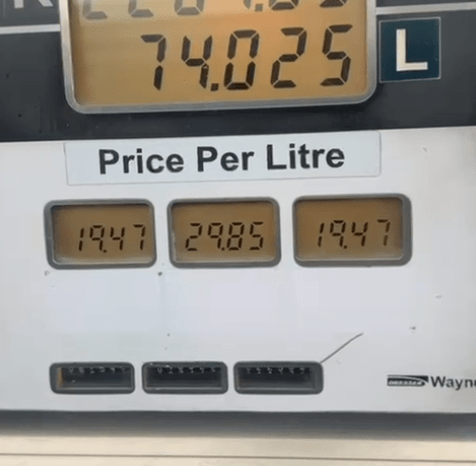
Many consumers were left hot under the collar this past weekend when wanting to fill up their vehicles with diesel, only to find that at various filling stations across the country, the price of diesel had already shot up to almost R30 a litre.
This past weekend motorists from across the country descended en-masse upon fuel stations in what seemed to be panic-buying due to the expected massive fuel increase on the cards for April.
One post on social media that went viral showed a video allegedly taken at a filling station in Phoenix, Durban, clearly showing the raised diesel price. Consumers are in an outcry over this as they say that the official fuel price rise has not yet been announced.
Social media users have been vocal over the past few days about some filling stations having already increased their diesel prices by several rand per litre, even though the fuel prices for April have not yet been officially adjusted.
Words like “dishonest”, “shock” and “deception” have been flying around in Facebook posts.
How fuel price regulation works
The confusion stems from a fundamental difference in how petrol and diesel prices are regulated in South Africa.
The Central Energy Fund (CEF) issues basic fuel prices every weekday based on international prices and its own formula to determine local prices. However, these figures are only an indication of what the prices should be on that day, and not a daily price adjustment.
In South Africa, petrol prices are only adjusted once a month and then those prices remain in effect for the entire month. This is why there are currently only estimates of April’s fuel prices being given. At the moment, South Africans are still paying March prices, because the final prices for April have not yet been set.
Why diesel prices can change mid-month
Filling stations are allowed to adjust their diesel prices during the course of the month, unlike petrol prices. This makes it completely legal for filling stations to raise the price of diesel in March already, before the traditional date of the first Wednesday of each month.
Petrol is mainly sold to ordinary motorists by filling stations and therefore the state sets the retail prices. This is to create a uniform national price system, limit excessive pricing and keep profit margins predictable.
The department of mineral resources and petroleum energy’s policy is that the deregulation of petrol prices would be problematic because it would make the playing field unequal. Not all wholesalers have equal access to import and storage infrastructure. This would leave remote filling stations vulnerable if price competition takes over.
ALSO READ: Oil price shock sends shockwaves through global markets
Diesel, however, is regarded as a commercial and wholesale fuel. It is used by trucks, farms, the mining industry and other wholesalers. Prices are often negotiated and discounts are common.
The department therefore publishes its diesel prices only as a guideline for wholesalers, not as mandatory selling prices.
Petrol prices are regulated to protect consumers, while diesel prices are handled differently because of diesel’s greater role in the business economy.
April fuel price shock on the cards
Due to the war in the Middle East, especially the crisis surrounding the Strait of Hormuz which is a crucial shipping passage for fuel, petrol is expected to rise as high as R5 per litre, and diesel a staggering R8.
And to add insult to injury the fuel levy, the Road Accident Fund (RAF) levy and the carbon tax, will also be increased on 1 April, as announced in this year’s budget speech:
- The fuel levy on petrol will increase by 9c to R4,10 per litre and diesel’s by 8c to R3,93 per litre.
- The RAF levy will be 7c per litre more and will amount to R2,25.
- The carbon tax will increase for petrol by 5c to 19c per litre and for diesel by 6c to 23c per litre.


