

CAPE TOWN – Cape Peninsula University of Technology (CPUT) management has decided to shut all campuses, including student residences, following escalating protests and violence linked to student concerns over registration fees, accommodation costs and the university’s financial recovery plan.
The decision comes after the old CPUT Education Building was set alight on the Bellville campus yesterday.
The protests began earlier this month after students raised concerns about CPUT’s draft 2027 Financial Recovery Plan, which they claimed would require students to pay up to R7 000 to register for the new academic year.
The CPUT Student Representative Council (SRC) has rejected the proposed registration fee and has also called for residence fees to be reduced where they exceed the National Student Financial Aid Scheme (NSFAS) funding cap.
Students have further demanded an independent forensic investigation into the university’s finances.
The unrest followed a mass meeting at CPUT’s District Six campus on Monday, 10 August, where students discussed their grievances over registration fees. A planned campus shutdown followed on Tuesday, 11 August.
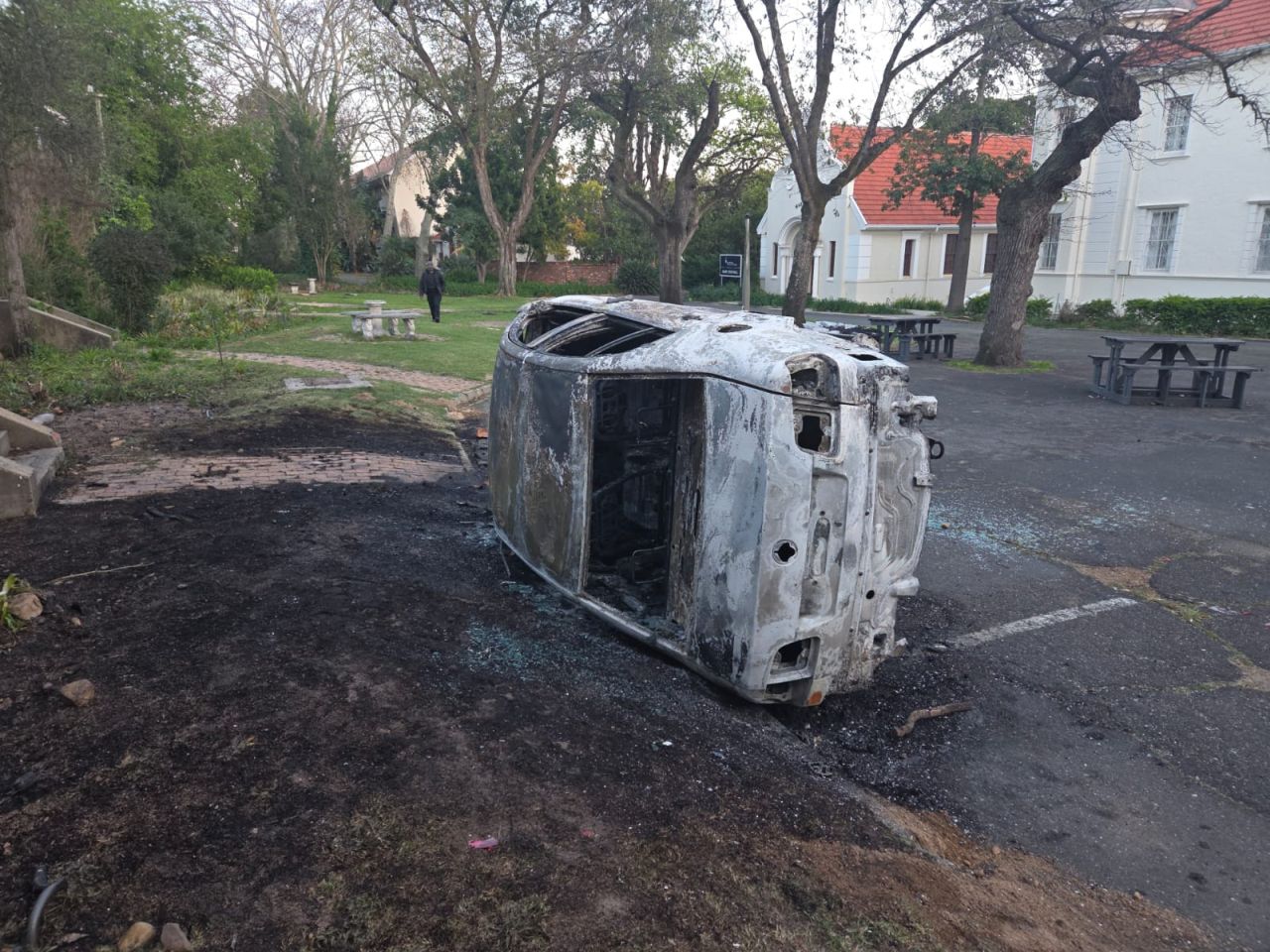
On Wednesday, 12 August, a security vehicle was set alight at the Wellington campus.
The protests have since escalated, with the old CPUT Education Building in Bellville set alight yesterday.
Building set alight
City of Cape Town Fire and Rescue Service spokesperson Jermaine Carelse said an emergency call was received at 23:40.
According to Carelse, firefighters from Bellville, Belhar, Goodwood and Milnerton fire stations responded to the scene, supported by an Incident Management Team (IMT) Type 5.
He said the fire, which caused severe damage to the building, was extinguished by 03:00.
The matter has since been handed over to the South African Police Service.
The university confirmed that the ongoing protests have also resulted in two people, a female security guard and a female student, being rushed to hospital.
The security officer spent several days in ICU with critical injuries but has since been discharged.
Crisis alert
Lauren Kansley, CPUT spokesperson, said the university is currently at its “highest crisis alert level” and that the decision was taken to “avoid a potential loss of life”.
“CPUT Management have continuously implored the student leadership to return to the negotiating table so that we stop the violence and disruption and avoid losing more academic teaching time,” she said.
Kansley reiterated that management remains open to “meaningful and constructive engagement”.
“However we feel the evacuation is a necessary step to de-escalate the violence.”
Kansley previously confirmed that the university’s council had decided to withdraw the draft Financial Recovery Plan to allow for further consultation.
Withheld certificates
The protests are taking place against the backdrop of a growing student debt crisis across South Africa’s post-school education and training system.
According to figures presented to Parliament’s Portfolio Committee on Higher Education in May, outstanding student debt across the sector stands at about R59 billion, with R29 billion owed by NSFAS-funded students.
The financial pressure has also left thousands of students without their qualification certificates.
The Department of Higher Education and Training (DHET) indicated that about 165 000 qualification certificates were being withheld because of outstanding student debt.
CPUT has reportedly recorded the highest student debt among South African universities, at approximately R4.2 billion.
The university also has 16 196 withheld qualification certificates, according to statistics provided by Universities South Africa (USAF).
Portfolio Committee chair Tebogo Letsie said withholding certificates could make it even more difficult for graduates to find employment and repay their debts.
A CPUT student, who spoke to Nova News on condition of anonymity, said she owed the university about R100 000.
“The debt is not just a number on a university statement. It is affecting my ability to move forward with my life.
“Finding employment is already difficult, but not having access to my qualification certificate makes it even harder. I also cannot apply to study further because I do not have access to my academic transcript,” she explained.
The student said she feel “trapped”.
“I need a job to pay the debt, but the debt prevents me from accessing the documents that could help me find better opportunities. There needs to be a solution that allows graduates to work, study further and become financially independent.”
ALSO READ: Protest action at CPUT continues to escalate

