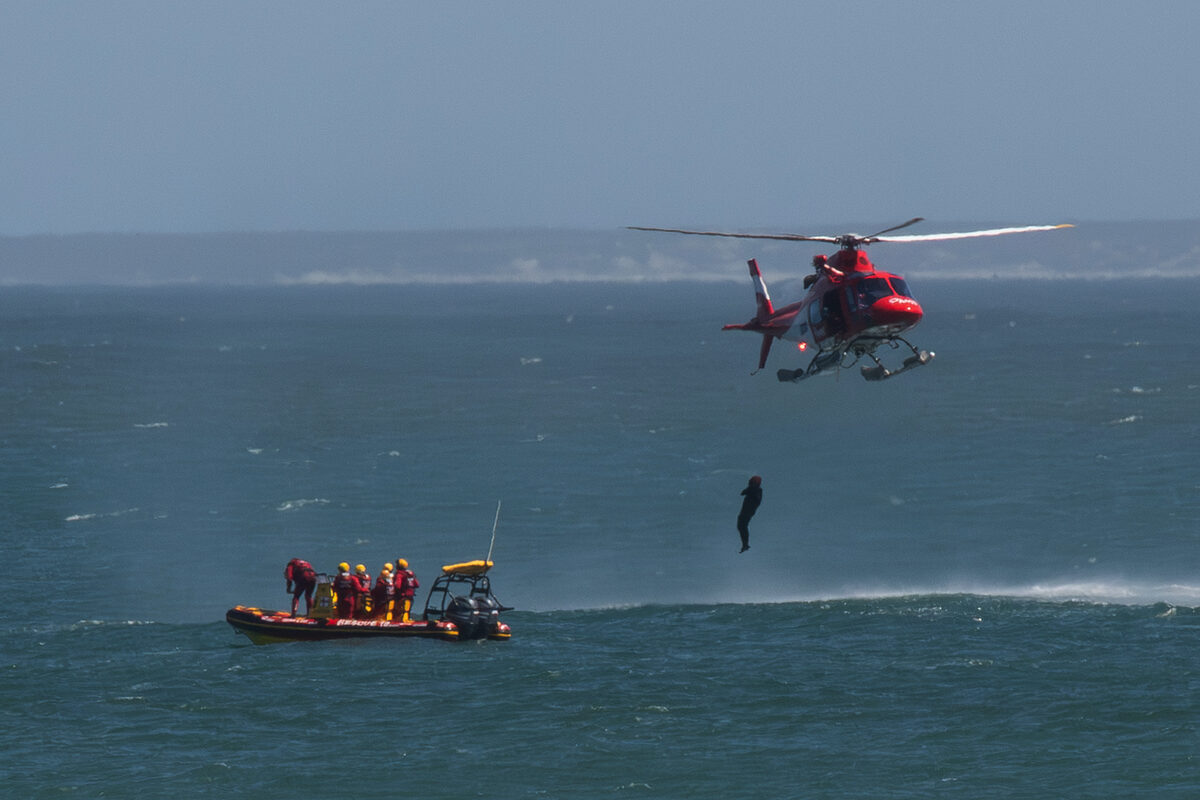
A Vredehoek film director and cinematographer’s love for the ocean as well as long-standing fascination with the life-saving work of the National Sea Rescue Institute (NSRI) have come together in a powerful new awareness project.
Inspired by both the beauty and danger of the ocean, Kabeer Shaik has turned his lens towards an innovative safety initiative, the NSRI’s beach-safety camera system.
The result is a compelling awareness film that not only highlights this vital technology but also outlines the importance of beach safety and the tireless efforts of NSRI volunteers, who work tirelessly to keep beachgoers safe.
Shaik visited the NSRI’s Volunteer Support Centre in Blouberg earlier this year where he was introduced to the Emergency Operations Centre (EOC) and the Beach Safety Camera Project.
Andrew Ingram, NSRI communications manager, said the camera project was initiated in 2020, and is the first of its kind in the country.
Camera project
“It is a network of strategically placed, high-definition PTZ (pan-tilt-zoom) cameras that support rescue operations and beach safety.”
He said in Cape Town these cameras are active at Strand and Blouberg Beach.
“The idea was that from a high angle we can get a completely different view as to what lifeguards see. We can work with lifeguards and first responders in spotting dangers and rip currents. This helps with prevention to move them out of danger or get them help as fast as possible.”
WATCH
The film
The 1-minute film, which can be viewed on the NSRI’s YouTube channel, was filmed at Strand Beach.
It features actress Shiefaa Hendriks in a portrayal that merges realism and symbolism.
Shaik said: “The team used rich golden-hour light and a cinematic approach to create an emotional and immersive experience.
“The biggest challenge was the weather. We needed a calm sea and high tide in late afternoon to match the story’s emotional tone. After weeks of postponements, we got the perfect window in April and gathered an incredible team to make it happen.”
She said the film is based on a real-life rescue event.
“The film is pegged to a real-life rescue that occurred over a year ago. It is of a young boy who was caught in a rip current before lifeguards were on duty and one of the camera operators spotted him having trouble in the water. The camera operator coordinated a rescue and the boy was saved.”
Shaik said the film is his way of paying homage to the incredible work done by the NSRI. “This is a way for me to give back to the NSRI. I want to create awareness of what the NSRI does and the behind-the-scenes work that no-one notices.”
According to Ingram, there are 11 cameras nationwide.
Expansion
He said the initiative has also been expanded to beaches in Plettenberg Bay.
“Some of the cameras in Plettenberg Bay have a flashing light and a loud audio siren as well as the possibility of our operation-centre volunteers talking to people on the beach through a speaker system.”
Ingram noted that the cameras have shown positive results since their introduction.
“We have videos on our YouTube channel of camera operators spotting people in difficulty and lifeguards rescuing them. Two small crafts overturning and getting them rescued.
“We can see when flairs are being fired. Previously our first responders would spend ages searching for someone in difficult situations. Our volunteer operator or our emergency operation centre can see what is happening immediately.”
Rely on donations
Ingram said expanding the initiative needed donations.
He said the cameras can cost between R100 000 and R200 000 to set up based on internet connectivity among other things.
“Because the cameras are located close to the ocean we are using good components and cameras. All the kits are high quality equipment.”
Ingram expressed gratitude to Shaik for his remarkable portrayal of the work carried out by the volunteers.
“The film beautifully shows the tension of a camera operator who is behind the screen, but who plays an integral part of the rescue although she is not in the water. He created a magnificent piece that talks to the passion of NSRI volunteers.”
Shaik said he was grateful to everyone who helped make the film a reality.
“I would like to thank the volunteers from the NSRI who helped us with this. Also, the film-production crew and suppliers who came forward to make this happen. A special thank you to Jessica Schipper, the producer, who made the whole thing possible. I couldn’t have done it without her.”
To view the film visit: https://youtu.be/6kA8ZeHLHFc?si=j8LgATFaGCD1tMZz