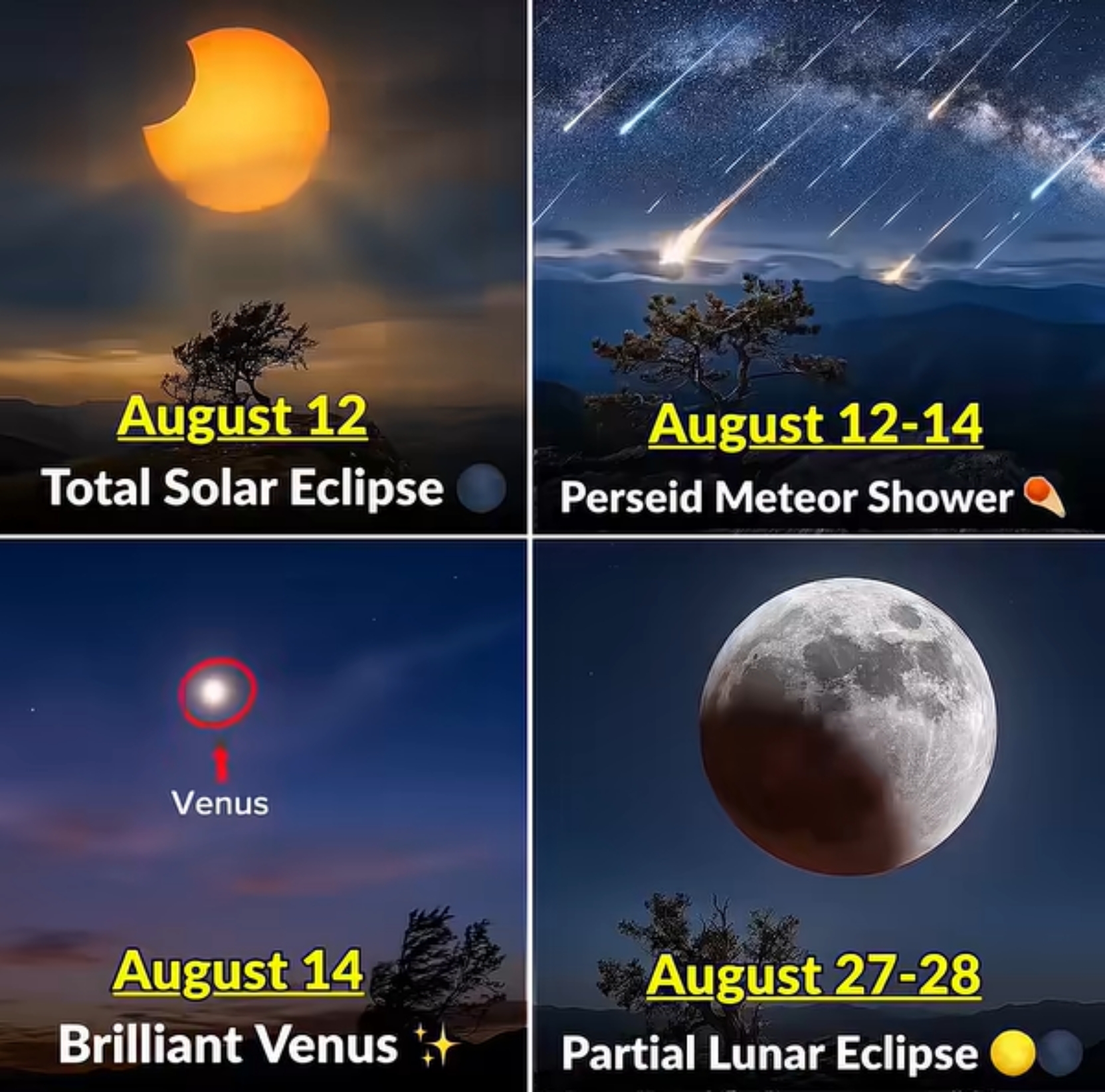
Skywatchers are in for an exceptional month, with August 2026 bringing a series of remarkable celestial events that will delight amateur astronomers and seasoned stargazers alike. From a total solar eclipse and the annual Perseid meteor shower to a rare six-planet alignment and a dramatic “Blood Moon”, there will be plenty of reasons to look up.
Total Solar Eclipse – 12 August
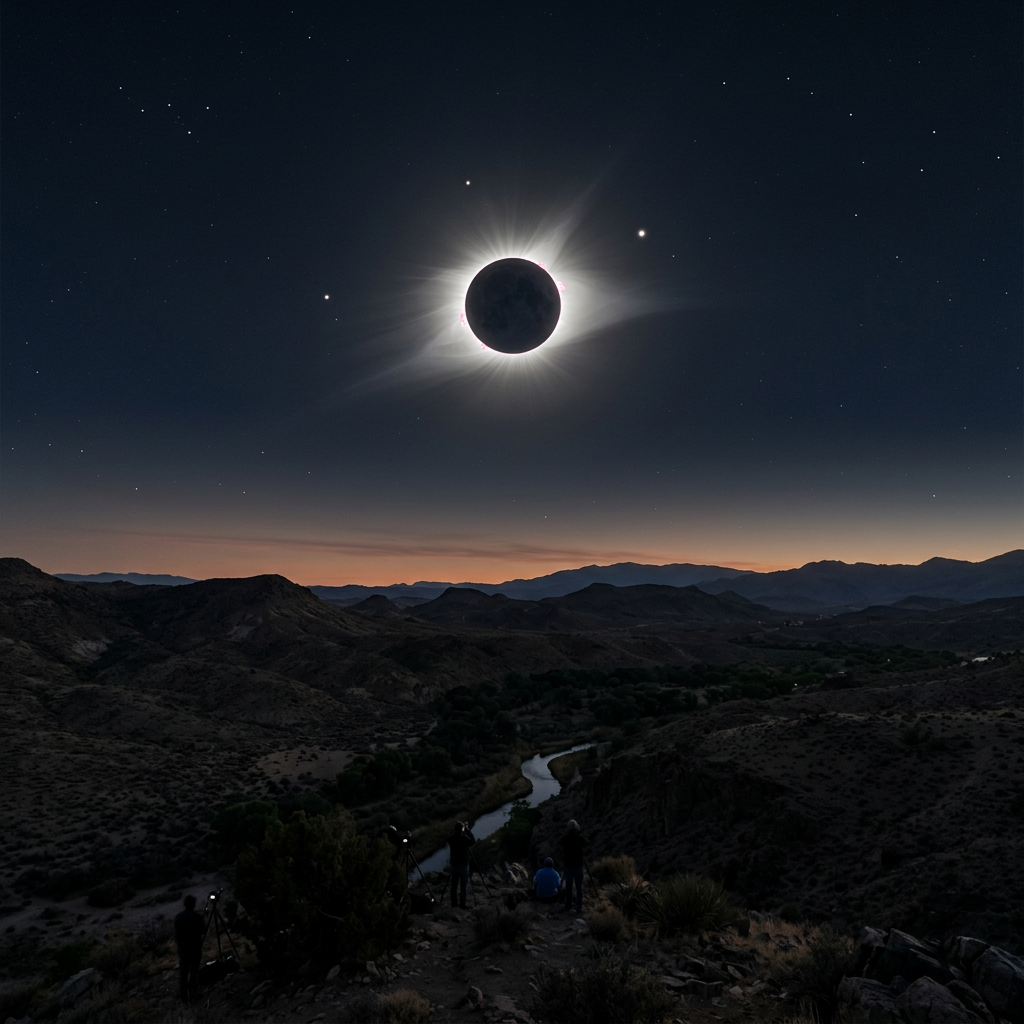
The month’s headline event is a Total Solar Eclipse on Wednesday, 12 August. The Moon’s shadow will sweep across parts of Greenland, Iceland, northern Russia, the Atlantic Ocean and northern Spain.
The eclipse reaches its maximum at 15:46 UTC, with observers in northern Spain enjoying the rare spectacle of totality near sunset. This timing may produce the famous Diamond Ring effect, when a brilliant point of sunlight appears around the edge of the Moon just before or after totality.
People outside the eclipse path will be able to see a partial eclipse in some regions.
Anyone planning to observe the eclipse should use only certified solar eclipse glasses or approved solar filters, as looking directly at the Sun without proper protection can cause permanent eye damage.
Perseid Meteor Shower peaks
The popular Perseid Meteor Shower reaches its peak during the night of 12–13 August, with maximum activity expected at around 03:00 UTC on 13 August.
Regarded as one of the finest meteor showers of the year, the Perseids can produce up to 100 meteors an hour under ideal dark-sky conditions. Fast-moving meteors, bright fireballs and long glowing trails are expected, making this one of the best opportunities for skywatching in 2026.
The best viewing conditions are after midnight and before dawn, away from city lights.
Rare six-planet alignment
Early risers will also have the chance to witness a rare six-planet alignment on the morning of 13 August.
About 30 to 60 minutes before sunrise, observers looking towards the eastern horizon may see Mercury, Jupiter, Mars, Saturn, Uranus and Neptune stretching across the morning sky.
Mercury, Jupiter, Mars and Saturn should be visible to the naked eye under clear conditions, while Uranus and Neptune will require binoculars or a small telescope.
Deep partial lunar eclipse
The month concludes with a spectacular deep partial lunar eclipse on 28 August.
The eclipse begins with the Moon entering Earth’s penumbral shadow at 17:34 UTC, followed by the partial eclipse at 18:35 UTC. Maximum eclipse occurs at 20:12 UTC, when nearly 93% of the Moon will be immersed in Earth’s dark umbral shadow.
As sunlight filters through Earth’s atmosphere, much of the Moon is expected to take on a striking copper-red hue, creating the appearance of a Blood Moon. The partial eclipse ends at 21:49 UTC, with the penumbral phase concluding at 22:50 UTC.
Unlike a solar eclipse, a lunar eclipse is completely safe to observe with the naked eye and requires no special equipment.
With four major astronomical events packed into a single month, August promises to be one of the most exciting periods of the year for anyone with an interest in the night sky. Whether watching meteors streak overhead, planets line up before dawn or the Moon turn shades of red, clear skies could reward observers with unforgettable celestial views.
August 2026 features a rare total solar eclipse, the peak of the Perseid meteor shower, and a deep partial lunar eclipse.
Major Eclipses
- August 12: A total solar eclipse occurs, with totality visible across northern Russia, Greenland, Iceland, and northern Spain, and partial phases visible in parts of Europe and North America
- August 27–28: A partial lunar eclipse covers roughly 93% of the Moon in Earth’s shadow, visible across the Americas, Europe, and Africa
Meteor Showers & Planetary Highlights
- August 12–13: The Perseid meteor shower peaks under optimal dark skies coinciding with a new moon, producing up to 50–100 meteors per hour.
- August 14–16: Venus reaches greatest eastern elongation, shining bright in the western evening sky.
- August 15: A close pre-dawn conjunction pairs Jupiter and Mercury just above the eastern horizon
ALSO READ: ‘Blood Moon’ rises during total lunar eclipse