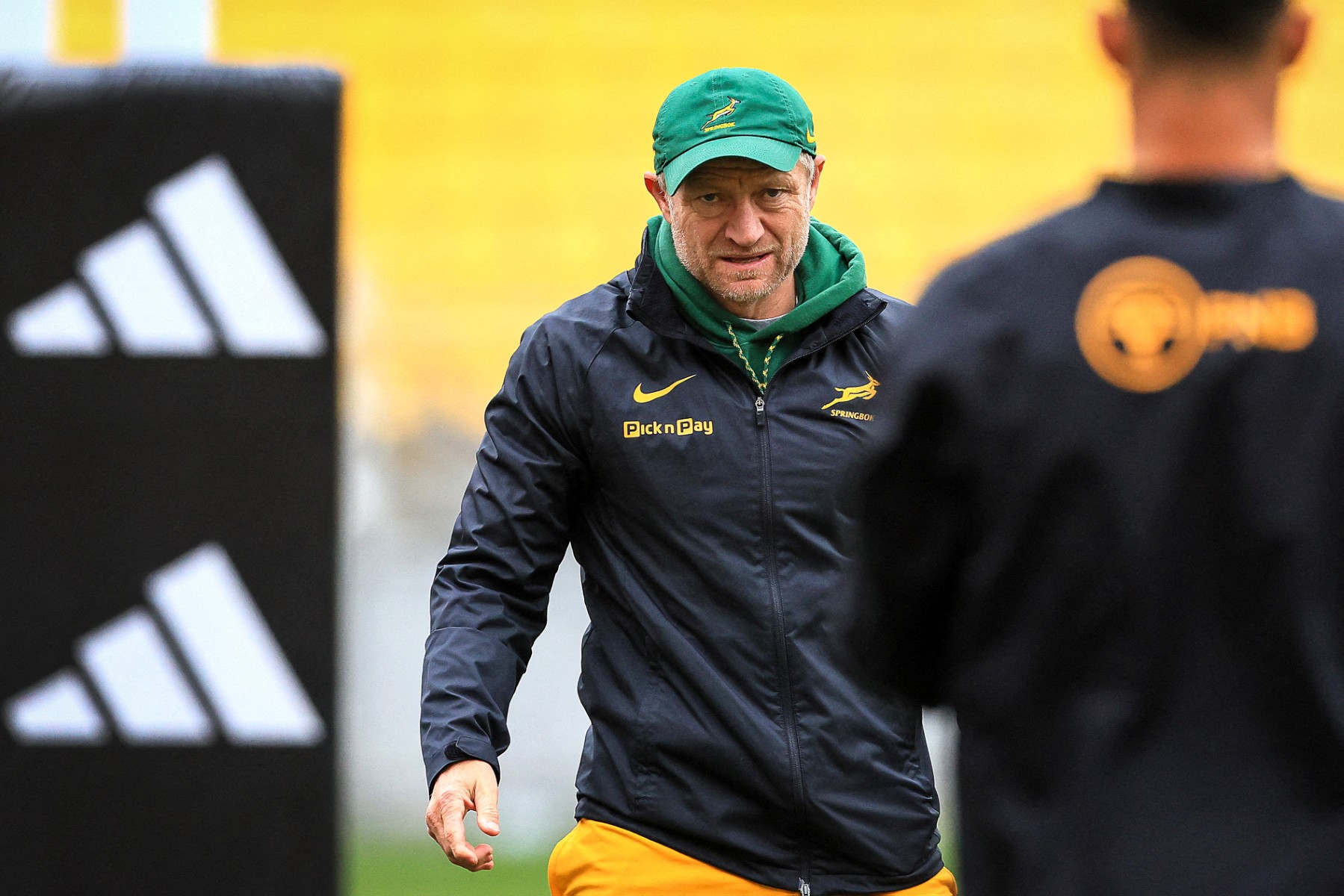
The contract is signed, the headlines written, the future mapped out, but Tony Brown isn’t going anywhere just yet. The Springbok attack coach has drawn a line in the sand, making it emphatically clear that his heart, mind, and tactical genius remain 100% committed to South Africa until the final whistle blows at the 2027 Rugby World Cup.
Speaking following confirmation of his move to New Zealand Rugby in 2028, Brown shut down any suggestion that his focus might be divided between present and future employers. This is a man on a mission, and that mission wears green and gold.
“My contract with New Zealand Rugby only begins in 2028, so there is still a long road ahead before that comes into play,” Brown declared to KickOff.com. “Right now, I am fully committed to the Springboks. What we are building and trying to achieve as a team over the next two years is my only focus.”
No distractions, no divided loyalties
Brown’s appointment to the All Blacks coaching setup, was announced on 7 June 2026. The New Zealander, who joined the Springboks in 2024 and has since revolutionised their attacking game, will return home after the 2027 World Cup in Australia to take up a two-year contract with NZR.
For some, the announcement might have raised questions about split loyalties or distraction. But those who know Brown, and those who’ve worked alongside him in the Springbok setup, understand that’s simply not how he operates.
SA Rugby CEO Rian Oberholzer was quick to praise Brown’s professionalism and transparency, qualities that have defined his tenure in South African rugby.
“We are grateful to Tony for his commitment, loyalty, and honesty throughout his time with us,” said Oberholzer. “He has made a tremendous contribution to the Springboks and to SA Rugby as a whole since joining us, and we have no doubt that he will continue to give everything he has to help the team maintain the high standards we set for ourselves on the field.”
Erasmus welcomes the clarity
Springbok head coach Rassie Erasmus, never one to shy away from strategic planning or candid communication, welcomed the early announcement. For Erasmus, knowing where his coaching staff stands allows him to plan effectively without the distraction of contract negotiations looming over a World Cup year.
“Tony has made a remarkable difference, both on and off the field, and he has always been upfront with us about wanting to be closer to his family and about the All Blacks holding a special place in his heart, and we are genuinely delighted for him,” Erasmus said.
“We’ve made the mistake in the past of negotiating contracts in a Rugby World Cup year, and this clarity will allow us all to go full steam ahead with our preparations for this and next season.”
That transparency, has strengthened rather than weakened the Springbok camp. There’s no speculation, no rumours, no uncertainty. Just a clear timeline and a shared understanding that until late 2027, Brown is a Springbok through and through.
The Brown blueprint: transforming Bok attack
Brown’s impact on South African rugby cannot be overstated. When he joined the coaching staff in 2024, opinions were divided. Could a New Zealander steeped in the All Blacks’ tradition of free-flowing rugby truly mesh with the Springboks’ renowned forward-oriented, physically dominant style?
The answer has been a resounding yes.
Brown hasn’t tried to turn the Springboks into a clone of the All Blacks. Instead, he’s unlocked the attacking potential that already existed within South African rugby, integrating creative play seamlessly with the team’s traditional strengths , set-piece dominance, suffocating defence, and territorial control.
Under his guidance, the Springboks have become a multi-layered beast. They can still maul you into submission, scrum you backwards, and kick you into corners. But now they can also carve you open with slick handling, identify space with surgical precision, and counter-attack with devastating efficiency.
“The evolution of the South African game is how we combine our attack, defence, set piece and kicking game, and try to put teams under massive pressure,” Brown explained earlier this year. “No other team can look at the Boks and say ‘if we shut them down here, we’re going to win the Test’. We’ve got so many layers to our game now.”
That evolution has made the Springboks perhaps the most complete rugby side on the planet. Brown’s fingerprints are all over it, in the late support lines from forwards, the increased comfort of backs in attacking situations, and the team’s ability to strike from anywhere on the pitch.
Building towards 2027
Brown’s departure will undoubtedly be a loss when it eventually comes. But for now, South African rugby fans can rest assured that one of the game’s finest attacking minds is entirely focused on delivering another World Cup trophy.
The partnership between Brown and Erasmus, described by some as “mad chemistry”, continues to evolve. Erasmus constantly challenges his coaches to innovate, to push boundaries, to think differently. Brown thrives in that environment, bringing fresh ideas while respecting the foundations that have made South African rugby a global powerhouse.
Over the next 18 months, as the Springboks prepare for their assault on a historic third consecutive World Cup title, Brown’s attacking innovations will be crucial. The blueprint is in place, the players are buying in, and the results speak for themselves.
Come 2028, New Zealand Rugby will inherit a coach at the peak of his powers. But until then, Tony Brown belongs to South Africa, and he’s determined to make every moment count.