

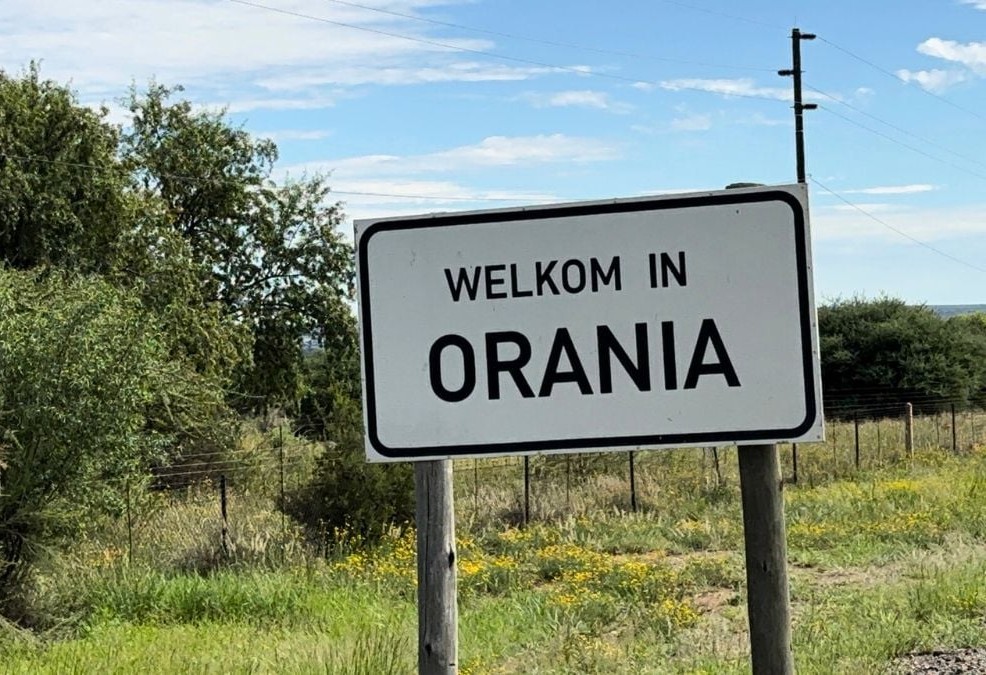
ORANIA – A new generation is flocking to Orania, South Africa’s controversial whites-only Afrikaner enclave, as the isolated Northern Cape town celebrates its 35th anniversary.
The small town, founded in 1991 and home to just over 3 000 residents, is experiencing an influx of young people from the country’s white minority, attracted by a new training college and the promise of preserving their cultural identity.
At Stokkies bar on a recent Friday night, the crowd appeared mostly under 30, all Afrikaans-speaking descendants of early European colonisers. Bathed in blue light and accompanied by country music, local youth mingled with students studying engineering and plumbing.
The bar’s owner, Thomas de Villiers (31), exemplifies a common pattern among Orania’s young residents. After his parents moved to the town when he was eight, de Villiers left as an adult for Cape Town but returned due to the high cost of living in the cosmopolitan city.
‘Not so wonderful out there’
Charlotte van Niekerk (22), who works in marketing, also chose to return after living on outlying farms. She lived in Orania with her parents between the ages of four and 14.
“A lot of kids that grew up with me can’t wait to be 18 so they can just leave this place,” said van Niekerk. “But it’s funny because they go away and then a lot of the time they just come back after a couple of years when they’ve seen it’s not so wonderful out there.”
While van Niekerk misses amenities like cinemas, she said the launch of a training college in 2019 has brought new energy to the town.
Nearly all of the college’s 250 students come from elsewhere, selected on the basis of ethnicity, religion, work ethic and a clean criminal record, as are all residents.
Town spokesman Joost Strydom said the college is planning for an intake of 800 students within four years, pointing to dormitories under construction.
Few students are expected to stay after graduation due to scarce job opportunities. The nearest town of any size, Hopetown with 10 000 inhabitants, is 40 km away. However, while in Orania, students contribute to the local economy at the petrol pump, minimarket and bars like Stokkies.
David Loock (21), a student, said the social life differs significantly from cities like Pretoria or Johannesburg. “We go fishing in our free time,” he said, as a friend displayed a photograph of a large catfish caught in the adjoining Orange River. Motocross is another popular activity.
Divan van der Westhuizen (19), originally from Johannesburg approximately 600 kilometres to the northeast, has embraced the small-town atmosphere.
“It’s been a big change coming from where you mingle with a lot of people,” said van der Westhuizen, wearing a moustache and “Boere-style” shorts. “It did me good to be back with my own people, the Afrikaners.”
ALSO READ: SIU finds no irregularities in 2006 Orania land claim settlement
‘We are the majority here’
Orania’s inhabitants represent only a fraction of South Africa’s Afrikaner population, estimated at around 2.6 million of the country’s 62 million people in 2022.
The Afrikaner minority governed South Africa during much of the apartheid era, which saw systematic oppression of the black majority who were only granted voting rights in 1994. The establishment of the “rainbow nation” led some Afrikaners to fear for the future of their culture and language.
Doret Le Cornu (23), who moved to Orania three years ago, said the town provides an environment to preserve Afrikaner culture.
ALSO READ: Afrikaner enclave faces legal battle over unauthorised land use
“This is a place where we want to build on that culture and not lose it,” she told AFP. “We are the majority here, without having to fear that there is a bigger majority around us.”
For Cara Tomlinson (25), Orania offers a sense of belonging. “Orania is a place where you can be yourself,” she said.
“In your house you can just lay down on the couch, watching TV. But at a stranger’s home you should sit upright, talk to them nicely, and I think that’s the difference.”
The town’s appeal to young Afrikaners reflects broader global trends of identity-based movements attracting younger demographics.
ALSO READ: WATCH | South African refugees in US face hardship despite resettlement promises


You must be logged in to post a comment.