

CAPE TOWN – Thirty-one Western Cape schools have been recognised for their environmental leadership and sustainability action at the 2025 Eco-Schools Awards, demonstrating measurable impact in addressing climate challenges across the province.
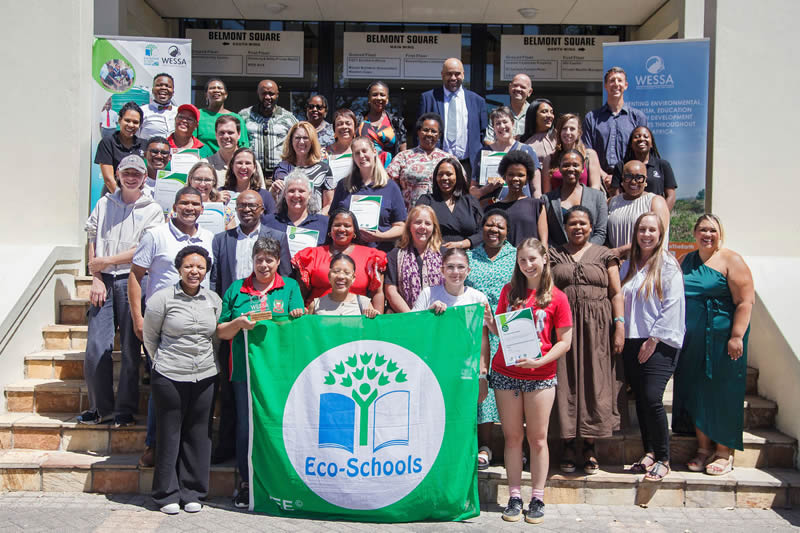
The Wildlife and Environment Society of South Africa (WESSA) honoured the schools at a ceremony held on Saturday 21 February, at the J&J Conference Centre Belmont Square in Cape Town.
The awards reflect participation in the world’s largest education for sustainable development programme, with Western Cape schools moving beyond environmental awareness into practical, school-wide action in a province acutely aware of drought, climate pressure and the value of its natural heritage.
Measurable change drives programme success
Kelly Alcock, WESSA head of education and sustainability, emphasised that the programme’s strength lies in its outcomes rather than scale.
“Eco-Schools is the world’s largest education for sustainable development programme, but what makes it powerful is not its scale, it is its measurable change,” Alcock said.
“Across our schools, learners are reducing water consumption, diverting waste from landfill, restoring biodiversity and strengthening food security through school gardens. This is education that moves beyond awareness into action.”
The awards framework recognises progressive achievement across sustainability themes, encouraging whole-school transformation through various categories.
Four schools achieved bronze awards for completing one environmental project, whilst 14 schools reached silver level with two projects across two themes. Two schools earned the internationally recognised green flag awards for implementing three projects, and three schools achieved gold awards for four projects across four themes.
At the highest levels, two schools received international flag awards for five projects across five themes, whilst two achieved platinum 2 awards, requiring additional mentorship support to other schools. Pinelands High School earned the prestigious diamond award, the highest standard within the framework.
Three ADvTECH schools were recognised within the provincial cohort, underscoring the growing commitment of independent education networks to environmental sustainability and whole-school transformation.
Decade awards recognise sustained commitment
Three Western Cape schools received decade awards for maintaining environmental commitment over ten years, demonstrating institutionalised sustainability.
Beaumont Primary School received a platinum 2 decade award, Sir Lowry’s Pass Primary School earned a platinum 1 decade award, and Newberry House Montessori School achieved a silver decade award.
Special recognition for innovation
Several schools received special awards for exceptional initiative and community impact.
Kenridge Primary School was named Waste Champion of 2025 for collecting 610 428 bottle tops and recycling 9 620 kg of waste—the highest volume among Western Cape Eco-Schools—whilst opening its recycling centre to the broader community.
American International School of Cape Town received the Green Glow Award for constructing an aquaponics centre through more than 20 student-led build sessions, embedding hands-on sustainable food production into the curriculum.
Outeniqua Primary School earned the Culture & Care Shield for linking recycling to social impact by collecting bottle caps to support a local wheelchair initiative and mentoring another school through eco-friendly twinning.
Other special awards included the Ocean Guardian Award for DF Akademie, the Clean Commute Award for Kommetjie Eco Pre-primary School, which mobilised 50 learners to cycle on World Bicycle Day, the Bright Sparks Award for Ikamvalethu Secondary School, and the Green Start Award for Fairdale Primary School, which collected 380 kg of waste within months of establishing a new eco-club.
International recognition for local student
Alexandra de Roo, a Grade 8 learner from Pinelands High School, won first prize in the photography category of the global Young Reporters for the Environment competition 2025, competing against more than 1 000 participants from 33 countries. Her winning image captured ecological resilience on Rondebosch Common.
Keynote speaker Khuthala Swanepoel from Stellenbosch University’s Centre for Sustainability Transitions described the programme as “the living expression of the curriculum” where “learning meets life and knowledge becomes action”.
“It connects environmental theory to real-world challenges, equipping young people with the confidence and capability to lead change in their schools and communities,” Swanepoel said.
As WESSA approaches its centenary year, the Eco-Schools programme reflects nearly 100 years of environmental stewardship translated into practical, youth-led climate action.
Alcock reinforced the programme’s significance: “Environmental education is not optional, it is preparation. Sustainability is not a once-off project; it is a way of thinking, leading and living. Our schools are not preparing for the future; they are shaping it.”
ALSO READ: Save a Fishie launches national Coast 2 Coast campaign with bigger impact




You must be logged in to post a comment.