



CAPE TOWN – A recent report has indicated that two gangs are vying for control of Mitchells Plain.
Mitchells Plain Community Policing Forum chair, Norman Janjies, told residents at a festive season event that the warfare that had claimed 90 lives over six months last year was mostly between two rival gangs.
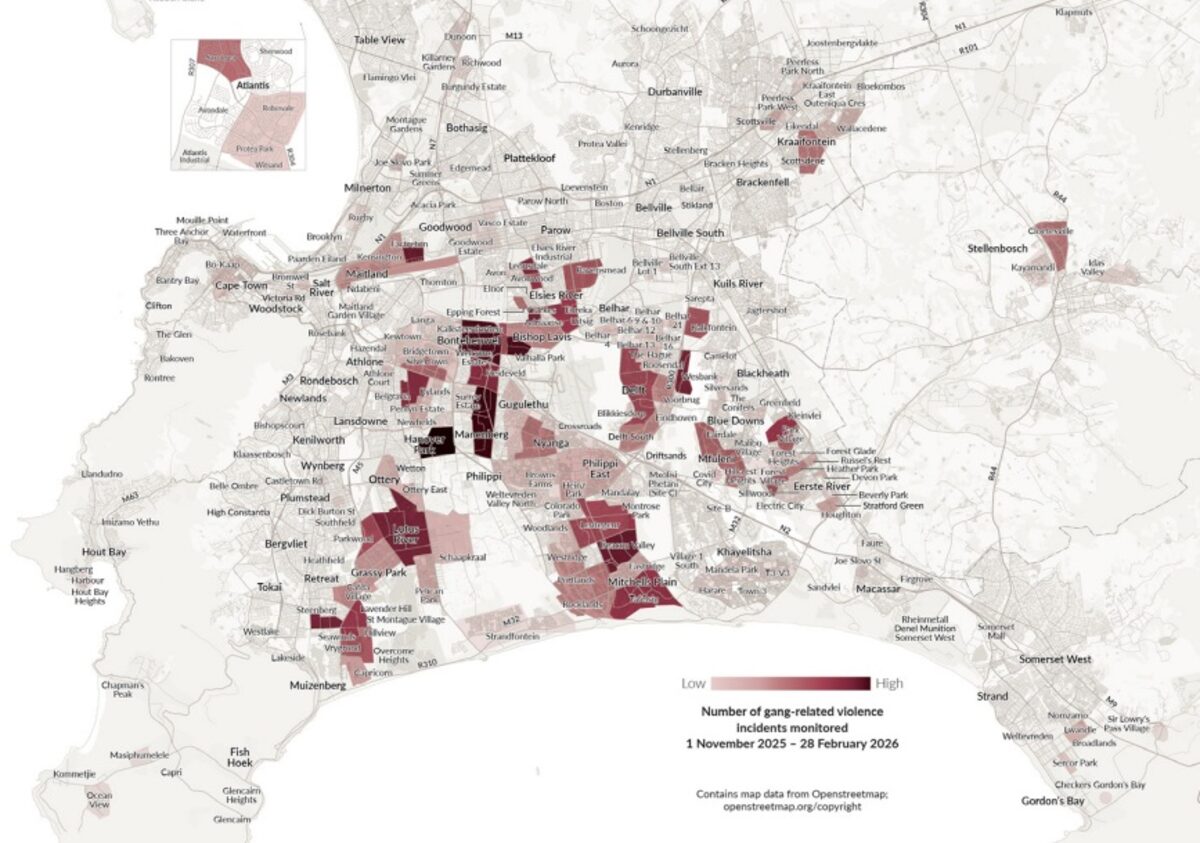
The Western Cape Gang Monitor’s quarterly report, which was released at the end of last year, confirmed this.
ALSO READ: Candlelight carols take on a sombre tone as residents reflect on death toll
The report, Issue 7, was compiled by Global Initiative Against Transnational Organized Crime’s (GI-TOC) Western Cape Gang Monitor, an output of the South Africa Organised Crime Observatory and was released on 29 December.
It says that most of the deadly violence in Beacon Valley and Lentegeur last year was between two gangs “whose numbers have surged as they absorb smaller gangs and capture turf”.
The report quotes a gang member who described gangsters changing alliances after an attack on their biggest rivals.
“They all understood that we have it better in our camp. We got more guns, more girls, more drugs, more money and more power,” he is reported as saying.

Turf war
The report identified the seven most prominent gangs in the province and while almost all of them had dealings in the Mitchells Plain area, only four were named as having strongholds in the area. Two of these four were engaged in the deadly turf war last year.
According to the report, the recent flare-up in violence began with a change in dynamic brought on by several factors, including Covid-19.
It described an “accelerating gang fragmentation” which has caused one gang to absorb its smaller rivals while targeting its biggest rival.
The report said: “Gang-related murders had already doubled between 2020 and 2024. The gangs fuelling this relentless violence have been allowed to proliferate, steadily entrenching their power and reaching crisis levels of brutality.”
Abundance of guns
The report said that another factor was the high number of guns gangs have access to, mostly due to corruption in official ranks.
An earlier gang monitor report said that guns are being smuggled in from Namibia but this report clarified that only a small number of weapons being used in the warfare are sourced this way.
ALSO READ: Report finds guns on Cape Flats were smuggled from Namibia
“Some supplies are diverted from police and military sources,” the report said, adding that others are taken in robberies and from licensed gun owners.
“This exploits the absence of a central database to track the amount of ammunition license-holders buy from different dealers, ensuring it stays within legal limits. Almost all major gang leaders reportedly have links to private security companies, which can legally purchase firearms and ammunition.”
Other factors
The report detailed eight other factors that have been fuelling the violence, including multi-national trading, corruption in police and government, the changing relationship between street gangs and prison Number gangs and money laundering through legitimate businesses in construction, property, taxis, casinos and private security.
“This has a knock-on effect for the wider economy, as gang-linked firms can undercut legitimate businesses, property prices become artificially inflated, and government tenders are left uncompleted,” the report said.
Recruiting children
“A massive uptick in child recruitment, which began during the COVID-19 lockdown in 2020, has continued and intensified, with gangs recruiting in and around schools,” the report said.
It added: “Civil society organisations working with children and in schools in gang-affected communities say gangs are increasingly targeting children as young as eight.”
The child recruits, mostly from impoverished areas, are attracted by the allure of easy money and false security and are used by gangs as “lookouts, runners, gun carriers and shooters”.
ALSO READ: ‘A crisis scaring our communities’
“Magistrates, prosecutors and court officials have observed a sharp increase in children charged with gang-related criminal offences, including drug possession, murder, attempted murder, aggravated robbery, sexual offences and assault,” the report said.
12-point strategy
The report did not only announce doom and gloom but also suggested a 12-point strategy, based on GI-TOC’s research, to mitigate the violence.
“The death toll from gang violence in the Western Cape continues to mount amid systemic failings in the government’s response in three priority areas.
“First, the lack of accountability in policing means strategic shortcomings are not addressed, police action does not lead to successful prosecutions, and police corruption is not adequately investigated. Second, there is no cohesive strategy on the prevention of gang violence. Finally, more action is needed to stem the flow of firearms and ammunition to gangs.
“The huge arsenals accumulated by Western Cape gangs in recent years have fuelled the growing loss of life in turf wars. The recommendations aim to address these three priority areas,” the report said.



You must be logged in to post a comment.