


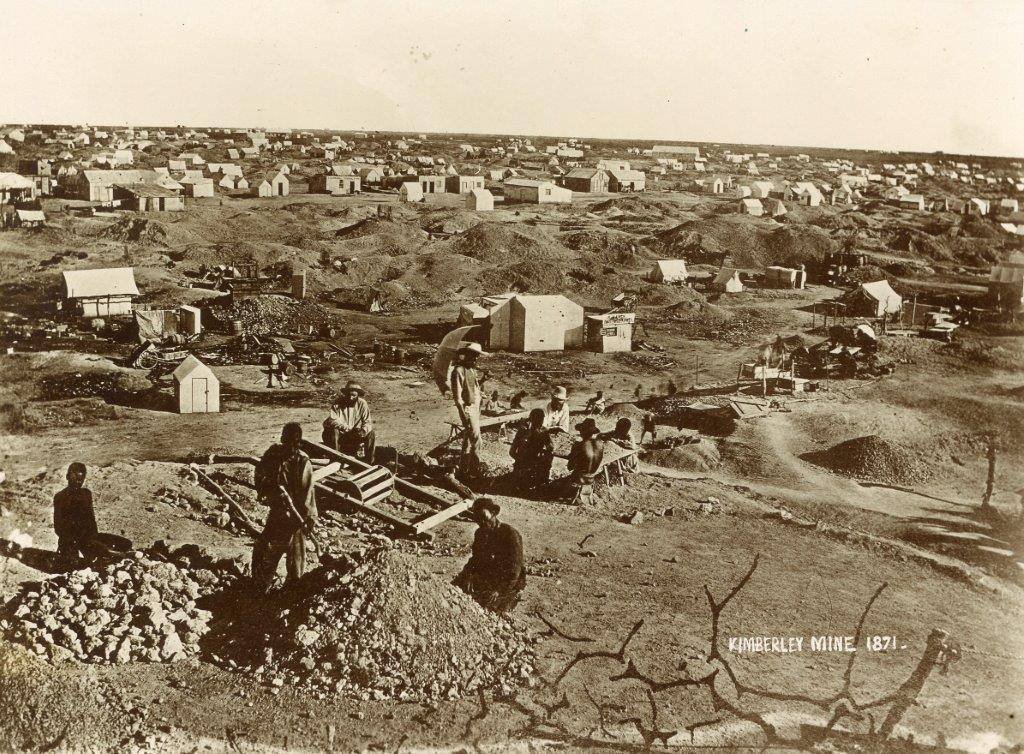
KIMBERLEY – At a recent workshop on Kimberley’s history, Robert Hart showcased his favourite photographs from the collection that documents Kimberley and Southern Africa’s mining heritage. Hart is the curator of the photographic collection at the Duggan-Cronin Photographic Gallery, which is a satellite museum of the McGregor Museum.
The workshop, “Mining lives and relations: Multi-species histories of mineral extraction in Southern Africa,” brought together historians, geologists, and archaeologists to share knowledge and discuss the region’s complex past.
“Photographs can tell us so much, but at the same time, they raise many questions. My chosen selection is somewhat random, but I have chosen images that I find particularly striking for their content and aesthetic qualities.”
Robert Hart, curator: photographic collection, Duggan-Cronin Photographic Gallery

When assisting researchers, Hart poses basic questions about each photograph: What does it show? Where and when was it taken? Who took the image? What was their purpose? Does it have a caption?
“How do you, as an individual viewer, respond to the photograph?” he asked.
“If an image is accompanied by a caption, it will affect the way that the viewer responds. So depending on the context, it is sometimes useful to display an image without an accompanying caption, to let the image speak for itself.”
Robert Hart
Hart used artificial intelligence (AI) to describe one famous image of the Big Hole, a large excavation showing mounds of earth at different levels and ropeways leading from the edge of the pit. The AI described it as “a picture of a destroyed city.”
“The caption states the picture is about working on the Kimberley mine, but to me it is a startling image,” Hart said.
“It says so much about the scramble to get diamonds out of the earth. Colesburg Kopje was demolished by hand. The diggers in the picture are just tiny specks. To me, the scene is nightmarish.”
Anthony Trollope, in his 1878 book South Africa, wrote that places where men are attracted by the desire of gain “seem to be so repulsive that no gain can compensate for the miseries incidental to such a habitation”.
Kimberley in the early years was indeed a rough and ready place.

A 1917 picture taken at Riverton shows the Vaal River in flood.
“So we also have a record of climatic conditions. The strange colours make it aesthetically pleasing. The light effects create a certain mood. Some historic pictures are therefore also artistic.”
Water was a constant challenge in early Kimberley (as it is today). There was no piped water during the diamond rush, and water was brought in by the barrel. Kimberley only got a constant water supply in 1883, when the pipeline from Riverton was completed.
Hart particularly favours a street scene portraying well-to-do people with horse-drawn vehicles and corrugated iron buildings in the background.
“It is obviously carefully staged; nothing suggests the man is a digger. Look closer and you will notice water barrels on the carts, and a dog underneath one of them.”

Another compelling image shows a young boy in a wide-brimmed hat and frilled white shirt, seated at a garden bench reading a book. He was Jack Drummond Rudd, son of Henry Percy Rudd and grandson of Charles Rudd. The boy later became a director of De Beers.
“To me, the image conjures up a whole epoch about the classes that lived in Kimberley, from lower to upper,” Hart said.


He also highlighted a picture of corrugated buildings on Old Main Street under a heavy snow blanket, from 1876. These buildings, like the James Farrelly Criterion Bakery, were constructed of prefabricated material from England, shipped to South Africa and transported by wagon until the railway arrived.

The railway line from Cape Town opened on 28 November 1885, a significant occasion. Hart recalled reading about the ceremony in local newspapers: “The day was blazing hot. The crowd endured two extra hours in increasing heat as the train was delayed. By the time the governor gave his speech, the marquee was like an oven. The fire brigade was called to hose down the tent, soaking many of the exquisitely dressed VIPs in the process.”
“You can just imagine,” Hart chuckled, “all these very important people getting soaked.
“The newspapers describe everything in detail, so they really are useful if you can pinpoint a date and find the report on events.”
Visit the Facebook page McGregor Museum for regular and fascinating posts.

28 November 1885. Photo: McGregor Museum



You must be logged in to post a comment.