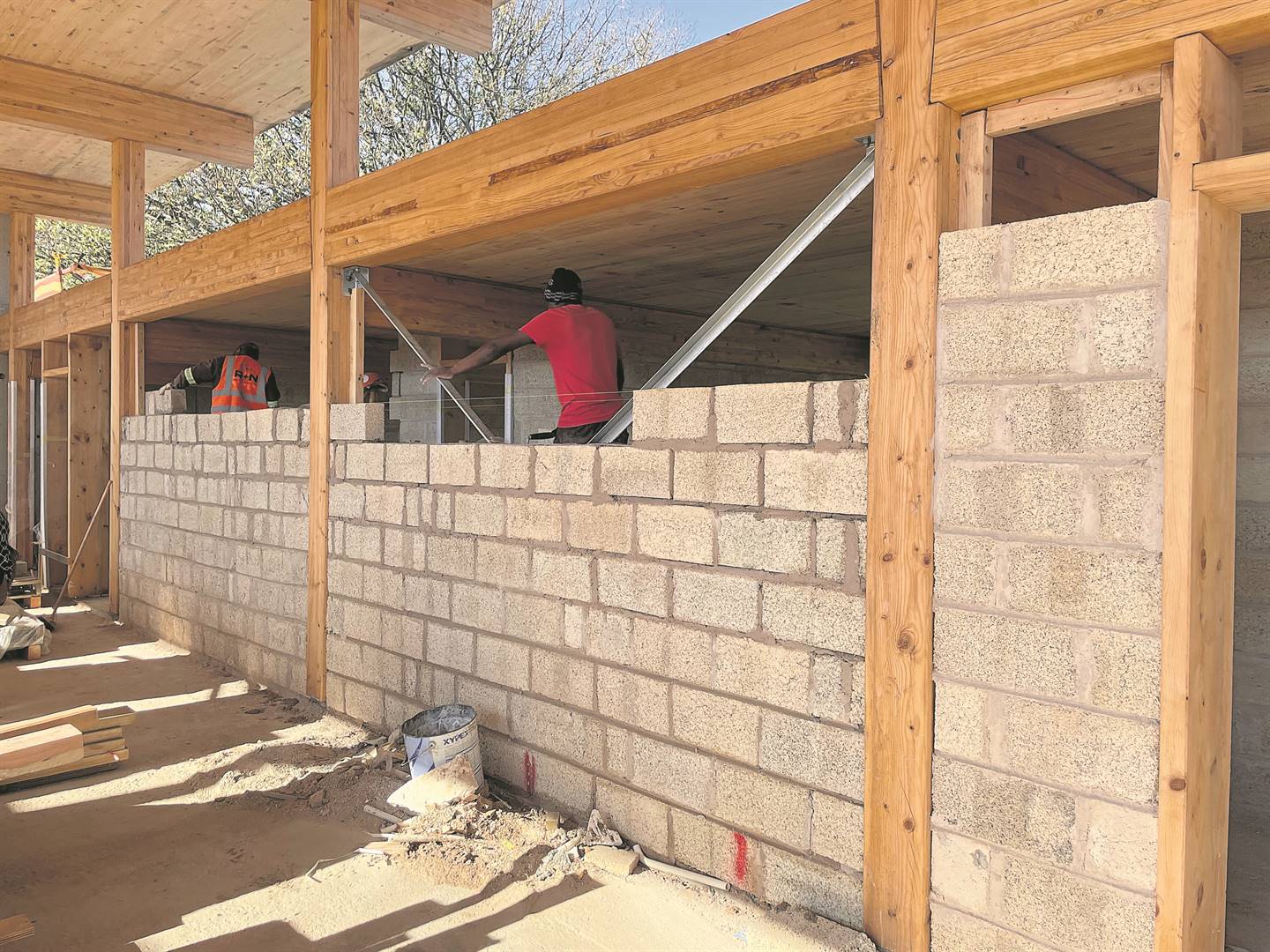
Worcester-based Afrimat has ventured into the manufacturing of hemp building materials.
According to Boshoff Muller, the company’s managing director, it started this venture as part of a research and development programme, when it looked at manufacturing more sustainable building materials.
“Afrimat has an entrepreneurial culture and is always looking for new opportunities. We are always observing global trends, and we are moving into a global era when the norm, with efforts to reduce carbon emissions, can no longer merely be a compliance function.”
The main ingredient for manufacturing hempcrete and the hempcrete building blocks is hemp. According to the Oxford dictionary hemp is a cannabis plant, especially grown for fibre. The fibre can be extracted from the stem and used to make rope, strong fabric, fireboard and plastic, among other things.
The hempcrete Afrimat produces, an alternative to concrete, is a mixture of hemp and lime-based formulation. These are also environmentally friendly due to the fact that it absorbs carbon dioxide (CO2), which is one the most important greenhouse gasses linked to global warming because it absorbs and radiates heat.
“The Afrimat Hemp hempcrete block is lime-based and totally cement-free. Hemp is one of the fastest CO2 to biomass tools available, with a full growth cycle of three to four months. It can absorb up to 15 tons of CO2 per hectare. Lime is made in a similar way to cement, but the difference is that the lime manufacturing process uses less energy than cement manufacturing. Lime also relies on CO2 absorption as setting mechanism. A popular European hempcrete company reported recently that the nett CO2 effect of hempcrete on the environment for every cubic metre of hempcrete that is built with, 75kg of CO2 is taken out of the atmosphere. Hempcrete is an insulating, in-fill construction material with exceptional fire resistance characteristics.”
Afrimat currently makes use of imported products but soon want to start using local materials.
“Local hemp is coming online, and we will soon start processing local material with our own hemp decortication and processing technology. This will have a downward effect on cost which will in turn allow us to provide a more market-related offering. We are in the process of contracting local certified farmers to grow hemp. We need more farmers in the Western Cape to come on board.”
He further explained hempcrete is slightly more expensive than conventional building materials. “But savings are gained on building costs and operational efficiencies of buildings due to the high insulation characteristics.” So far, Afrimat Hemp has been involved in 12 projects and have more projects starting later this year. “I do think hempcrete has great potential to provide employment and offer healthy durable living environments,” Muller added. The company’s manufacturing team had to undergo extensive training to produce these products. “They were also part of the research and development process.”
Afrimat Hemp is one of the first companies to receive a hemp permit from the Department of Agriculture, Land Reform and Rural Development (DALRRD). In South Africa, you can apply for an Agrément Certificate if your building material does not get covered by our building code. Afrimat Hemp is the first to receive a hempcrete innovation license in South Africa.