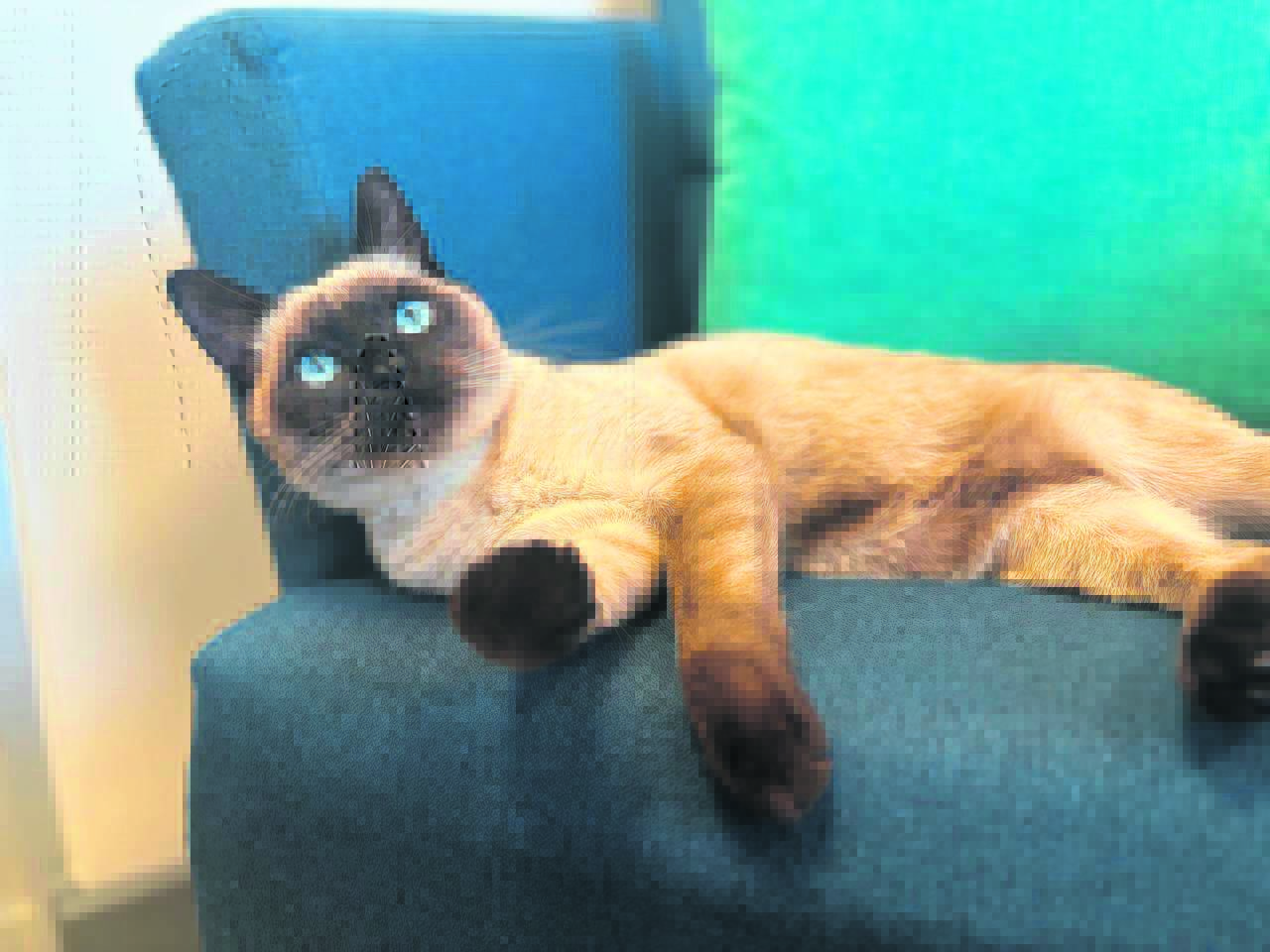
Zeus was just a four-week-old kitten when he was saved by his owner from a cat breeder while caged in horrible living conditions in Johannesburg. His trauma would give way to a life spent helping students and staff at the University of the Western Cape (UWC) to overcome trauma and mental-health challenges.
In January this year, Zeus travelled from Gauteng to Cape Town with his owner, Cayla Bergman-Ally, when she was appointed as an intern psychologist at the Centre for Student Support Services (CSSS) at UWC. She is completing her master’s degree in animal-assisted therapy research, in which Zeus has played an integral part.
“The basis for animal-assisted therapy is twofold: cats and animals. But cats, specifically their purring and energy, heal individuals. There is physical-symptom relief for people suffering panic attacks and anxiety. Zeus will sit on them and his purring decompresses patients. This helps decrease their stress levels and heart rate.”
Since the arrival on campus of the Seal Point Ragdoll cat, who resides in Durbanville when he is not working a shift, his client base has increased. His human, Bergman-Ally, says he has helped patients who initially were not fans of cats.
“He comes without judgment, so my clients often prefer to engage with him, and I will write my notes. That is amazing because I had clients coming in who were terrified of cats, and once they met Zeus their attitude and approach changed.”
The 23-year-old said there were added benefits to animal-assisted therapy, especially for patients dealing with specific trauma.
“From the clients I see dealing with a lot of grief Zeus pacifies intense loss,” says Bergman-Ally. “Students who have been sexually abused don’t want to be touched, but stroking Zeus helps them.”
The 5-month-old cat assists with 45 minutes to an hour of treatment and sees up to four patients daily. This type of treatment is physically exhausting for the intern psychologist. And her furry sidekick Zeus needs plenty of time to ‘paws’.
“We both have to be therapy-fit,” she said. “If we see four clients per day, we are exhausted. Zeus will then sleep the entire car ride home. We are now working on being therapy-fit as we aim to see more clients.
“Zeus’ way of decompressing involves taking his catnaps on my desk by the window, overlooking the campus between sessions.”
Animal-assisted therapy is a globally-used practice. Dogs are more commonly used for this form of treatment. Bergman-Ally said research in this field in South Africa was much slower compared to other countries.
“Animal-assisted therapy is mostly found in hospital settings. I would like to open a private practice and create an environment that can show that this type of treatment is beneficial in the fight against mental health issues.”
Zeus’ journey to CSSS was also challenging. Shortly after being rescued by his owner, the kitten was diagnosed with parvovirus, an often fatal illness that claims the lives of many cats and dogs.
Chances of survival were slim. But Zeus beat the odds. A few months later, though, he would face further trauma when he landed in a backyard occupied by a dog after a fall from a third-floor balcony.
He suffered severe injuries to his bladder, back and lungs, and he is currently undergoing treatment.
While on the road to recovery, Zeus is making the most of life in Sea Point.
“Zeus is a typical Capetonian,” Bergman-Ally declared.
“He likes the mountains and the beach. I am not a fan of the beach, but he forces me to go, which also benefits me.
“We hike the bottom part of Table Mountain, and he loves The Majik Forest in Durbanville, which is his favourite.”
Bergman-Ally applauded UWC’s forward-thinking approach to treating patients.
“UWC’s response to animal-assisted therapy has been great. It started with Craig Loubscher at the disability unit sorting out all the required paperwork and with my manager, Rone Gerber, who is a cat person. It was an easy transition.”
“I have great aspirations in animal-assisted therapy and believe that, together with Zeus, we can change the perception of this treatment in South Africa.”
CSSS at UWC provides broad student-centred development and professional services, programmes, training opportunities and resources to enhance students’ academic experience, graduate attributes and quality of life.
For UWC students and staff in need of help, please visit https://www.uwc.ac.za/campus-life/sds-departments/centre-for-student-support-services