An innovative new water-wise initiative, themed “Water in the City – Designing African blue-green cities for all”, has been launched in Cape Town to help countries throughout Africa incorporate new water-sensitive designs into their expanding towns and cities.
Long-time supporters of the Breede Valley’s economic development through encouraging creative entrepreneurship, the CDI Western Cape, has come up with a constructive initiative much needed at this time – a series of forums to arrive at new designs and concepts for water-wise towns and cities throughout the African continent.
Stage 1 of the initiative, themed “Water in the City – Designing African blue-green cities for all”, was launched in Cape Town on a creative exchange platform, code-named CX. The event, simultaneously streamed online, was co-hosted by the CDI (Craft & Design Institute) and the Dutch Consul-General of the Kingdom of the Netherlands in South Africa, as part of their #cocreateSANL programme to look at the bigger picture of water in South Africa.
The first of five Creative Exchange editions, bringing together people from the water sector, and design and innovation communities, was held at the end of April to discuss, engage, learn and spark new ideas on co-existing and re-connecting with nature, and the need for all to understand and value water-sensitive design in our cities.
Solutions invited from all sectors
Introducing the discussion, CDI hosted Erica Elk, Group CEO, said “The future of our planet’s natural ecosystem has never been more dependent on the design of better solutions by our human ecosystem of policy makers, government officials, water engineers and practitioners, the private sector and civil society.
“In South Africa, the challenges are made so much more complex by the need to address unequal access, and the state of our infrastructure. And as we continue to barrel into a future which is undeniably increasingly impacted by climate change, there is great urgency to bring attention to the critical state of water, where, as confirmed recently in a United Nations report, half a billion people in Africa are water insecure.
“We need innovative solutions to address the challenges, and the one way we can do so is through sharing knowledge, dialogue and inspiring new actions.”
Sebastiaan Messerschmidt, Dutch Consul General, agreed that among the many areas of collaboration between the South African and the Dutch government, the management, treatment and sustainable use of water is a key issue.
He added: “But how do you govern water? Who’s responsible for what? And, how do make sure that services are delivered to everybody and actually create a space where everybody is benefiting from the system?”
Nature-orientated cities
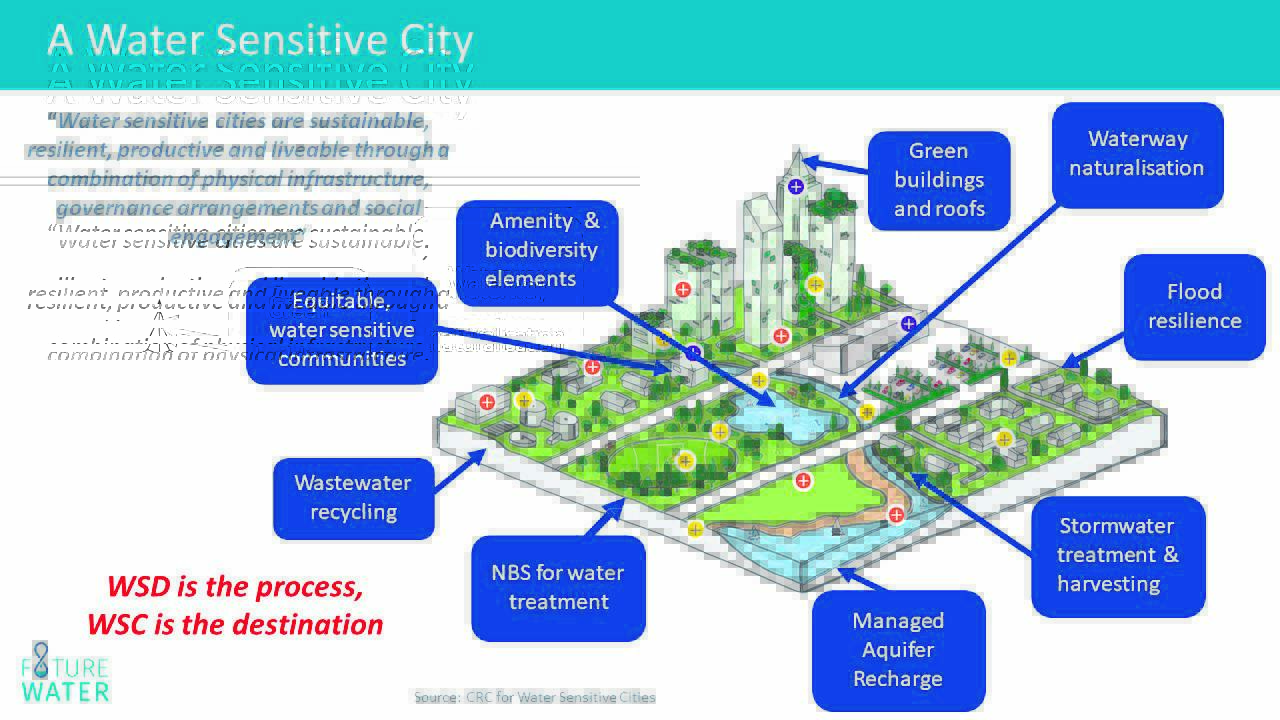
In her reply, Dr Kirsty Carden, Associate Professor of Civil Engineering and Interim Director of the Future Water Research Institute at the University of Cape Town, said a “blue-green city” aims to create a nature-orientated city that is resilient to the impacts of climate change, integrating different sectors across a city, so blue-green elements can start providing the buffer to various water-related risks such as droughts, floods and so on. Explaining that water-sensitive design included diversifying water sources, bringing in sustainable drainage elements, the naturalisation of waterways and the treatment of waste, recycling waste, water conservation and demand management.
“If we want to transform our cities, from where we are at the moment,” Carden said, “and they are really only providing water supply and sanitation, and sometimes drainage services, to that more visionary space we call a ‘water-sensitive city’, that point of transition which is going to be the point where people are more involved.
“There is still a long way to go, but there are glimmers of hope as we do have a good policy environment, particularly within the big cities, and good climate change awareness”.
In acknowledgement, Tamsin Faragher, Principal Resilience Officer at the City of Cape Town, said that the City’s Urban Waterways Programme (part of the resilience strategy) had many projects looking at rehabilitation, restoration, and natural water systems, “but I think that there’s a recognition in the built environment space that we need to start looking at how we can do things differently”.
Meanwhile, landscape architect Julia McLachlan said there’s a growing recognition that no settlement, town or city, can exist or function independently of earth’s natural systems. She said many of the earth’s systems, on which we depend, have been engineered out of our cities over the last few decades.
“I see a lot of it in landscape architecture in particular,” McLachlan said, “it’s almost retro-fitting it back into the urban setting.”
Citing examples of some successful projects in the CBD and surrounds, she added that in the design of these projects, it was not just about water systems, but new design pathways that consider people and their link to the natural environment.
Envisioning the potential of water sensitive cities, McLachlan said: “What if we could articulate water systems as urban space? Water systems as food production opportunities as part of that space? Water systems for recreation? At the moment we have turned our backs on those areas and don’t see the value.”
The need to build in harmony with nature
In conclusion, the CDI’s Erica Elk said that listening to the speakers, many of whom spoke about learning from the past, it was striking as to how much we’ve separated ourselves in our contemporary “concrete jungles” from nature.
She said: “I understand the issues of water management are complex in an environment where you have millions of people that need to be serviced, but it also feels to me that there’s a lot of common sense about how to live at one with nature that we’ve lost over time.”