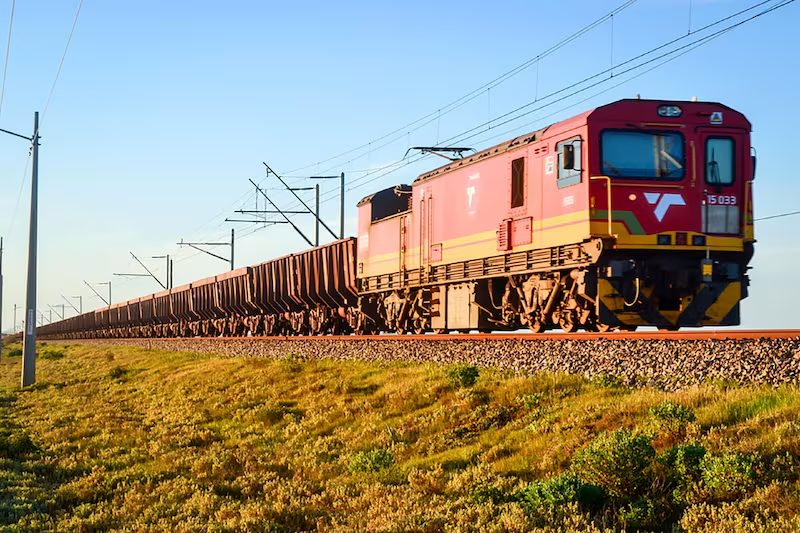
The Western Cape Government has officially launched an ambitious freight rail revival project that could revolutionize cargo transport along one of the province’s most critical agricultural corridors, potentially removing 40 000 truck trips from the N2 highway annually.
Western Cape Mobility Minister Isaac Sileku unveiled the Overberg Freight Rail Business Case and Implementation Plan during a pilot project launch recently in Bredasdorp, marking the first concrete step toward revitalising freight rail infrastructure that has been virtually abandoned for decades.
The Overberg corridor currently handles a staggering 8.9 million tons of freight annually, with an overwhelming 99.8% transported by truck and a mere 0.2% by rail. This heavy reliance on road transport has created significant congestion challenges while increasing logistics costs for agricultural producers and other freight owners.
“The Overberg Freight Rail Business Case is about bringing freight rail back on track and creating a commercially viable, data-driven freight system that cuts logistics costs, reduces congestion on the N2, and positions the Western Cape to triple its export value by 2035,” said Sileku during the launch.
The initiative represents a collaborative effort co-designed with agricultural producers, freight owners, logistics operators, investors, and government partners, all working toward reconnecting the Caledon farming hub with the Belcon Inland Terminal in Bellville and the Port of Cape Town.
Economic transformation for rural communities
Overberg District Mayor Sakkie Franken emphasized the transformative potential of the project for the region’s economy. “This project represents a turning point for our district. By unlocking rail, we are not just moving freight, we are attracting investment, creating jobs, and strengthening our region’s economy for the long term. The Overberg can once again be a thriving hub for trade, benefitting both our farmers and our communities.”
The pilot project has garnered strong stakeholder support, despite acknowledged challenges including the current deteriorated condition of the Overberg rail line. Industry representatives and government officials have expressed confidence that the comprehensive business case process will generate the necessary insights and partnerships to overcome these infrastructure barriers.
Ambitious targets and environmental benefits
The pilot project sets forth several ambitious goals that could reshape freight logistics in the Western Cape. The initiative aims to shift at least 10% of corridor freight—approximately 900 000 tons per year—from road to rail, directly removing an estimated 40 000 truck trips from the heavily trafficked N2 highway annually.
Economic benefits for exporters could be substantial, with projected logistics cost reductions of up to 30% for long-haul shipments. This cost advantage would significantly boost competitiveness for Overberg crops and other goods in international markets.
Environmental impact represents another key driver, with freight-related carbon emissions expected to decrease by as much as 70% per ton through the modal shift from road to rail transport.
The project will also focus on attracting public-private partnerships to fund and operate services, establishing reliable two-way cargo flows with export goods moving outbound and essential inputs like packaging and fertilizer traveling inbound to support agricultural operations.
The Transnet Rail Infrastructure Manager has highlighted the critical need for targeted investment, public-private partnerships, and coordinated planning to bring the existing infrastructure up to operational standards capable of supporting a significant modal shift.
The Business Case phase, led by the Western Cape Mobility Department, will continue until June 2026, focusing on validating freight volumes, assessing infrastructure capacity, and securing firm commitments from cargo owners. If the pilot demonstrates commercial viability, construction and phased operations are scheduled to begin in late 2026, with full service launch expected by 2028.
Long-term vision and provincial impact
Looking beyond the immediate pilot, the project will explore the long-term opportunity to close the 60km Protem–Swellendam rail gap, which could significantly expand the catchment area and improve overall network efficiency.
“Freight and logistics are the lifeblood for the seamless movement of goods from point of origin to final destination. With this Business Case, we aim to achieve our bold goal of moving freight from road to rail, one corridor at a time,” said Sileku.