Those attending a public talk at the West Coast Fossil Park (WCFP) on 17 June learnt that the brown locust of the Karoo, Locustana pardalina, may not be the pest it is made out to be.
This was revealed by Dr Joh Henschel, an associate of the WCFP, following a comprehensive literature review (https://doi.org/10.1016/j.jaridenv.2023.105014) recently published by him and four other scientists.
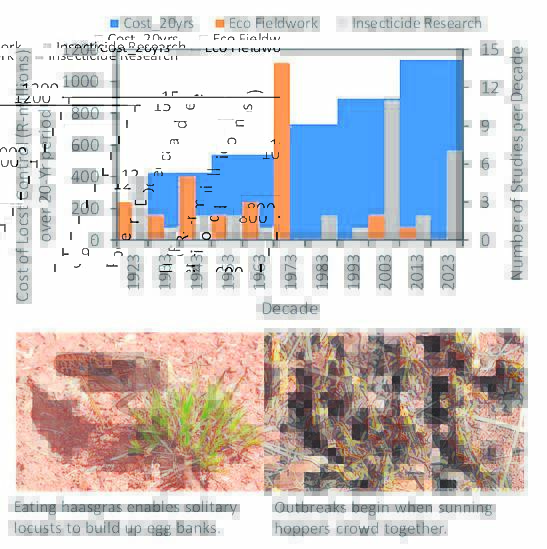
It is more than a century since the Pest Control Act 11 (1911) was promulgated. This, and subsequent regulations, makes it compulsory for Karoo farmers to report brown-locust outbreaks and to kill hoppers and adults with insecticides. However, these efforts to control locust outbreaks require ever more effort and expenditure (R90 million in 2022 alone). The repeated spreading of poisons has harmed many other species and interfered with ecological processes.
But surprisingly, the negative and positive effects of locust swarms have never been properly quantified. So the benefits of the enormous financial and environmental costs of insecticide application are still unknown.
Fieldwork-based research experienced the opposite trend of the locust control efforts mentioned above. Considerable insights into the initiation of outbreaks were gained through groundbreaking fieldwork conducted between the 1920s and 1970s. However, this knowledge was subsequently largely ignored or forgotten. Therefore, subsequent desktop research, such as remote sensing and ecological modelling, was rendered somewhat meaningless as it was not sufficiently anchored on empirical data.
The field observations mentioned above revealed that it took two to three years and about seven generations for brown locusts on their egg banks to build up densities exponentially until they initiated outbreaks. The intensity of sheep farming can influence the size of outbreaks in the Karoo. Heavy grazing opens space enabling the expansion of short, eight-day grass, also called “haasgras, wondergras, negenaaldgras, kalkgras” (Enneapogon desvauxii). Even during prolonged droughts, breeding solitary locust females and their offspring thrive on this grass and can build larger swarms where it is abundant.
Furthermore, frequent disturbance of locusts by livestock in the veld can drive locusts to crowd together until they switch from being asocial to hypersocial. This encourages them to establish swarms in the next generation, which depart searching for different pastures.
Brown locust swarms are well-adapted to cope with heavy mortalities. In the past they faced heavy predation by birds and mammals. Today, insecticides are their principal threat. Instead of continuously combating swarms in perpetual crisis management, alternative ways of preventing large swarms from forming in the first place should be found. There is potential to achieve this by managing the veld and livestock. This should include harnessing the ability of locusts to recycle nutrients to benefit the productivity of the veld for livestock. Research on findings of the first half of the previous century should find ways of incorporating beneficial locust management into farming.
The next WCFP public talk, entitled “Spines and cages: enigmatic defences against (some) mammal herbivores”, will be given by Prof William Bond on 22 July 2023.