


CAIRO, Egypt – Egypt officially opened the Grand Egyptian Museum on Saturday, a long-awaited, billion-dollar showcase of pharaonic grandeur that Cairo hopes will revive tourism and boost its battered economy.
“Today, as we celebrate together the opening of the Grand Egyptian Museum, we are writing a new chapter in the history of the present and the future,” Egyptian President Abdel Fattah al-Sisi told a gathering of dignitaries in the museum’s square.
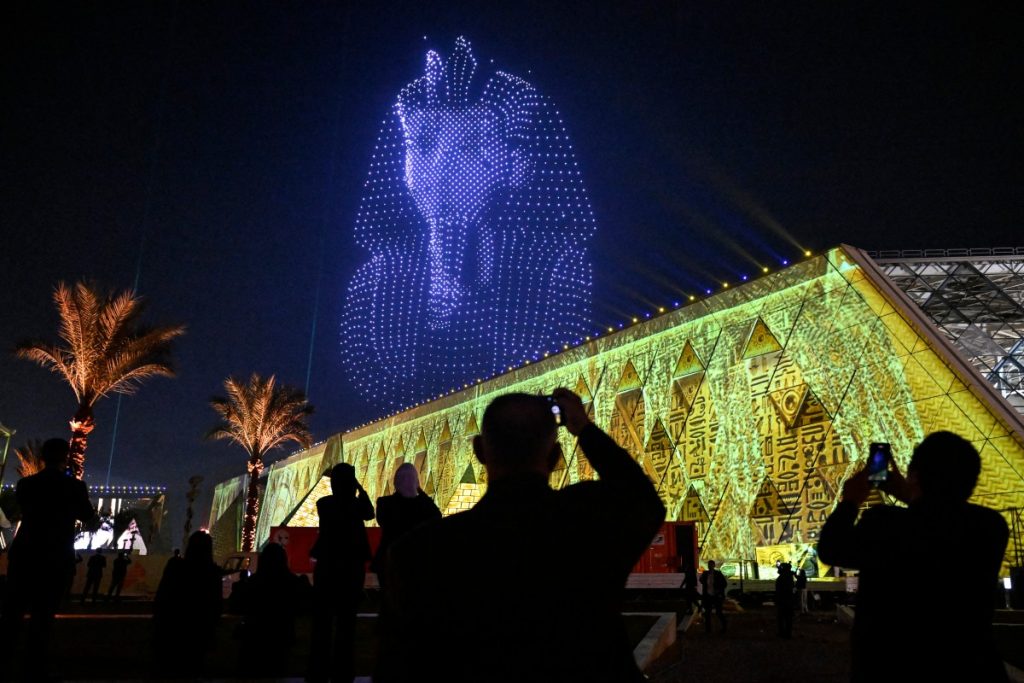
Spanning half a million square metres, the museum houses around 100,000 artefacts — half of them on display — dating back more than six millennia. The audience at the opening watched a display of lights and music, with the pyramids towering before them.
Dozens of performers dressed in elaborate Pharaonic costumes played traditional tunes as a laser show depicting pharaohs and fireworks lit up the night sky above the museum. On giant screens, scenes from celebrations in Tokyo and Rio de Janeiro played against the backdrop of Egypt’s ancient monuments.
“It is a living testimony to the genius of the Egyptian human,” Sisi said, referring to the new institution.
WATCH:
A global landmark takes shape
Roads around the museum were cordoned off Saturday morning, with security tightened ahead of the opening. Giant banners draped from buildings and stretched across streets advertised the launch.
“This is the dream that all of us imagined. We all dreamed that this project would be realised,” Egyptian Prime Minister Mostafa Madbouly told a press conference in Cairo.
Set on a gentle slope overlooking the Giza Plateau, just beyond the shadow of the pyramids, the museum was built with major financial and technical support from Japan. Madbouly said the “largest part of construction, finishing and bringing this global landmark to its current form occurred during the past seven to eight years.”
More than two decades in the making, the Grand Egyptian Museum faced multiple delays due to political unrest, regional conflicts and the Covid-19 pandemic. Egyptian officials bill it as the world’s largest collection devoted to a single civilisation.
Inside, visitors enter vast, light-filled halls with soaring ceilings and sand-coloured stone walls that echo the surrounding desert. At the centre of the main atrium stands an 83-tonne statue of Ramses II, the pharaoh who ruled Egypt for 66 years and presided over its golden age.
Unlike the cramped, century-old Egyptian Museum in central Cairo, the new facility features immersive galleries, precision lighting, virtual-reality exhibits and a children’s museum. One highlight is a live conservation lab, visible through floor-to-ceiling glass, where visitors can watch restorers assembling a 4,500-year-old solar boat buried near Khufu’s pyramid.
The undisputed star attraction is King Tutankhamun’s collection of more than 5,000 objects, many displayed together for the first time.
Tourism recovery hopes
The museum opens to the public Tuesday, showcasing thousands of funerary artefacts previously scattered across Egypt. Egypt’s tourism sector, a vital source of foreign currency and jobs, has been repeatedly shaken over the past decade and a half, from the 2011 uprising to waves of unrest and terrorist attacks.
In recent years, tourism has shown signs of recovery, with 15 million visitors travelling to Egypt in the first nine months of 2025, generating $12.5 billion – up 21 percent from the previous year.
Tourism Minister Sherif Fathy expects total tourist arrivals to reach 18 million by year’s end. He said the government expects the museum to draw five million visitors annually, adding that it currently welcomes 5,000 to 6,000 visitors daily.
“We hope to increase that to 15,000 daily,” Fathy said.
However, Monica Hanna, an Egyptologist and heritage campaigner, told AFP it was “too early to decide” whether the museum would fulfil Egypt’s tourism ambitions.
Observers remain cautious, saying the museum’s success will depend on steady visitor flow, regular maintenance and robust infrastructure. Economic pressures and regional instability – including wars in Gaza and Sudan – could challenge Egypt’s hopes of turning the museum into a major tourism driver.



You must be logged in to post a comment.