
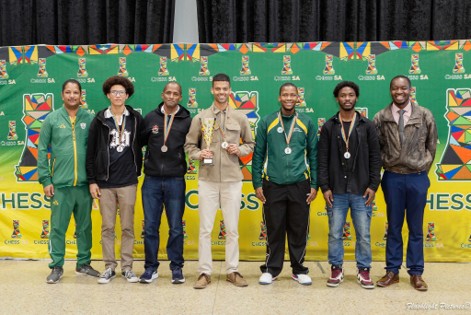
Balancing a PhD in pharmaceutical sciences with competitive chess is no small feat, but try doing so and winning a division in a national chess championship.
Despite keeping the thought of winning his chess division firmly out of his mind, University of the Western Cape (UWC) PhD student 25-year-old Harrison Abrahams from Parow in Cape Town, succeeded in achieving exactly that. Harrison captured the South African Open Chess Championships Intermediate Section, hosted from 27 June to 5 July 2026, scoring an impressive eight points from nine rounds.
Fiercely contested
The Intermediate Section was fiercely contested, with the top five finishers separated by razor-thin margins. Abrahams secured first place outright, while his four competitors, Kopa Lesetedi, Andile Siyali, Christian Maxwell, and Karl Freeks, rounded out the second through fifth spots after a tense tiebreak.
For Abrahams, the victory is a testament to his ability to balance two demanding worlds. While he is known as a formidable chess player who competes regularly, he is also deep into his PhD studies in pharmaceutical sciences, focusing on nanomedicine and tuberculosis treatment.
Reflecting on his tournament success, Abrahams described his mindset as calm yet focused. “I had a strategy, but I also reminded myself to enjoy the game. That balance made all the difference. My mindset was simply to play good chess and ensure I was well-rested and focused. I did not try going for tricks and played solidly and I honestly did not expect to win. I kept that fantasy of winning out of my mind completely, and focused on one game at a time. And it all worked out,” he said. “In chess, you calculate different possibilities and evaluate critically what the right plan is. That analytical and critical thinking is readily transferable to doing a PhD. I have to question my thought processes and research to ensure they are robust enough to help treat tuberculosis.”
Curiosity is another factor in Abrahams’s success: “Chess and nanomedicine both explore new avenues to solve the problems at hand, and being open to new ideas is key to nanomedicine and chess.”
Way to recharge
When asked about his routine, Abrahams said chess is a way to recharge. But stopping at the campus outdoor chess boards is never a temptation for him. He much prefers his break from the intensity of research, playing online, mostly as a brief 10-minute distraction and connecting with others through chess tournaments. “I started my chess journey when I was about seven years old. My uncle played against me and beat me. He taught me the basics and I remember losing almost every game at first, but I was hooked. That inspired me to improve my chess skills until I could beat him,” he joked. “Later, I played casually in primary and high school, and I, strangely enough, stopped playing chess during the pandemic and restarted it when I returned to UWC for my master’s degree in 2024, this time taking it very seriously.”
And just like that, the result becomes crystal clear: a single move can transform the entire game. Patience, foresight, and adaptability are the keys that unlock a decisive checkmate.
ALSO READ: Why doesn’t she just leave? UWC study reveals truth about abusive relationships