
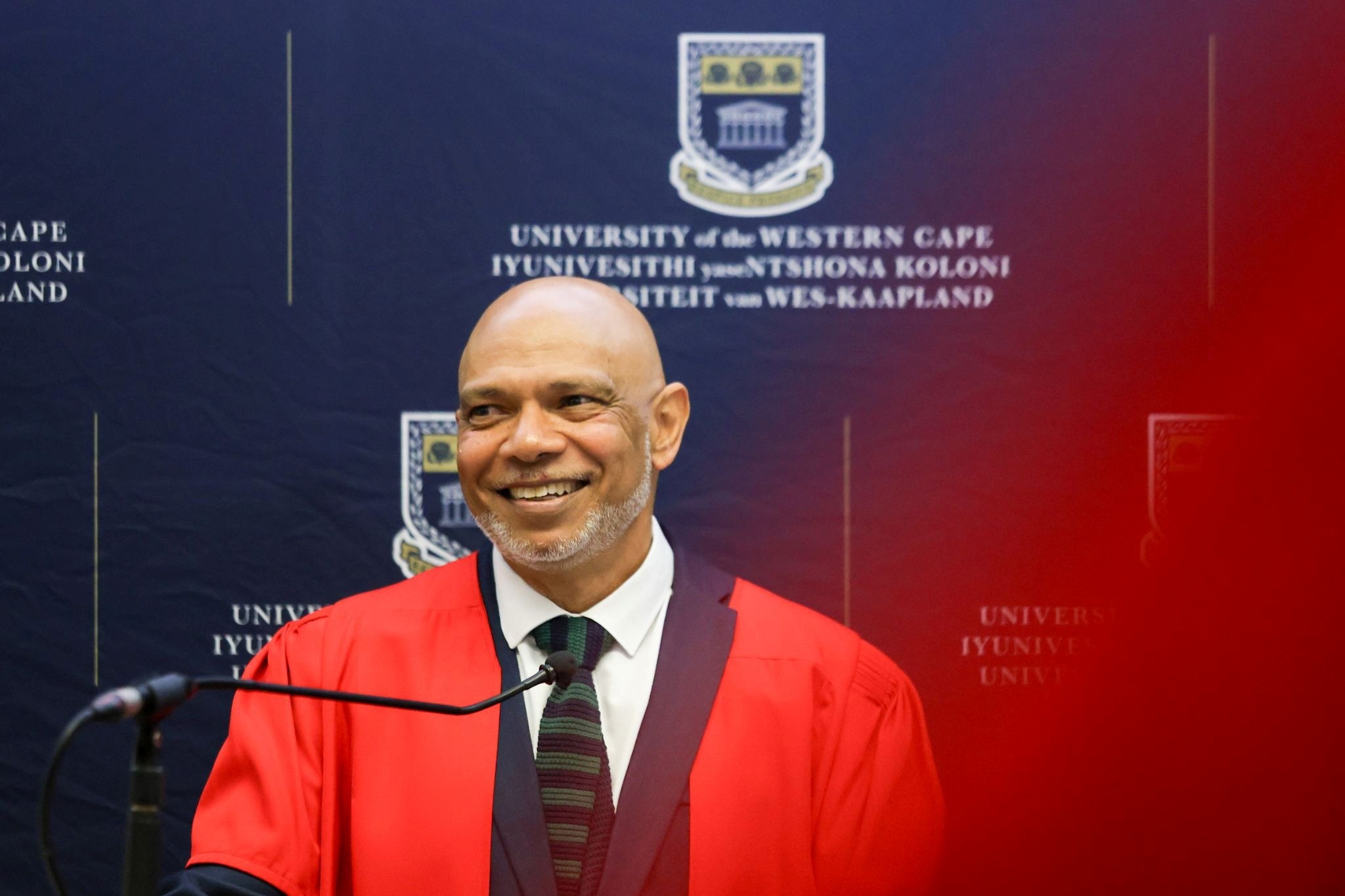
Trevor Moodley was a little boy who left KwaZulu-Natal for the Cape Flats, a teacher who never planned to teach, and a man whose life’s work has been driven by a single question: how can education improve the lives of those who are most vulnerable?
Shaped by people
Moodley, recently inaugurated as a full professor in the Faculty of Education at the University of the Western Cape (UWC), has never been defined by accolades and has been shaped by people, relationships and a deep commitment to humanity.
Born in Estcourt in KwaZulu-Natal in 1965, Moodley moved to Cape Town as a child and experienced firsthand the realities of apartheid-era schooling. The transition from a conservative Indian school in Ladysmith to a primary school in Athlone was a difficult one, marked by culture shock, bullying and exclusion. Yet those experiences helped shape the educator he would later become.
After matriculating in 1982, financial constraints prevented him from attending university. He worked briefly as a clerk before securing a teaching bursary and enrolling at Springfield College of Education in Durban. Teaching was not originally his career plan, but he soon discovered it was something more. “Teaching is my calling. So, I’m first a teacher, always first a teacher,” says Moodley.
While teaching, he studied part-time until qualifying as an educational psychologist. Teaching as a calling would eventually lead him from the classroom to the Western Cape Education Department as an educational psychologist at district level, and ultimately, to higher education. Yet throughout the different stages of his career, a common thread remained: concern for people whose opportunities were limited by circumstance.
Reality of poverty
His years as an educational psychologist exposed him to the stark realities of poverty and inequality. While schools struggled with learners who lacked basic resources, he observed systems that often spent money without addressing the real barriers facing children. He said: “The biggest contentment is when you are able to facilitate some type of support to make this vulnerable person’s life a bit better.”
That conviction continues to shape his scholarship. In his inaugural lecture, Moodley challenged dominant ideas about education, arguing that universities and schools cannot focus solely on employability and knowledge acquisition while ignoring broader human concerns. “The purpose of education is not only about skills development or knowledge acquisition. It is about moulding character.”
According to Prof Moodley, the modern educator in South Africa faces interconnected challenges that cannot be solved through narrow specialisation alone. Climate change, inequality, unemployment, migration and mental health are part of what he described as a global ‘polycrisis’ that requires education systems that promote empathy, resilience and social responsibility.
His belief in inclusive and holistic education has also guided much of his research. Rather than asking what is wrong with learners who experience barriers, he argues that educational systems should examine their own structures and practices. “In inclusive education, we do not ask what is wrong with the person. We ask how we can change ourselves and our environment to allow that person pedagogical access,” said Prof Moodley.
Away from the lecture hall, Moodley finds joy in family life. He and his wife, Colleen, have been together since their teenage years and have raised three daughters, all of whom are UWC graduates. He speaks proudly of becoming a grandfather and remains a passionate rugby supporter, admiring the sport’s emphasis on teamwork and collective effort. When asked how he would like to be remembered, his answer is characteristically simple.
Honest man
“He was an honest man,” — that is how he would like to be remembered.
“I would use the money for early childhood education to support community-based projects that are holistic in helping communities use whatever assets they have and strengthen those assets, so they can set up entities or support systems that can perpetuate their own independence. If we lay the groundwork, there’s a greater chance that more children will be lifted out of poverty. And so we will then be dealing with this issue of big inequality.
“It’s a chain reaction. If you take your own personal history: my mom hardly had any formal education, but she was my biggest fan. She pushed me, and she gave me a lot of self-confidence. Due to the poverty, I couldn’t go to university immediately after completing matric, right? But what she gave me was a lot of self-confidence. The basic necessities need to be addressed first, and then you need to ensure there is a nurturing environment. So if you can build the capacity of people working with young children, help them meet basic needs, and provide education on building young children’s self-esteem, and so on, then you’re building the next generation of people who are more resilient.”
ALSO READ: UWC programme helps unemployed youth build businesses and find jobs