
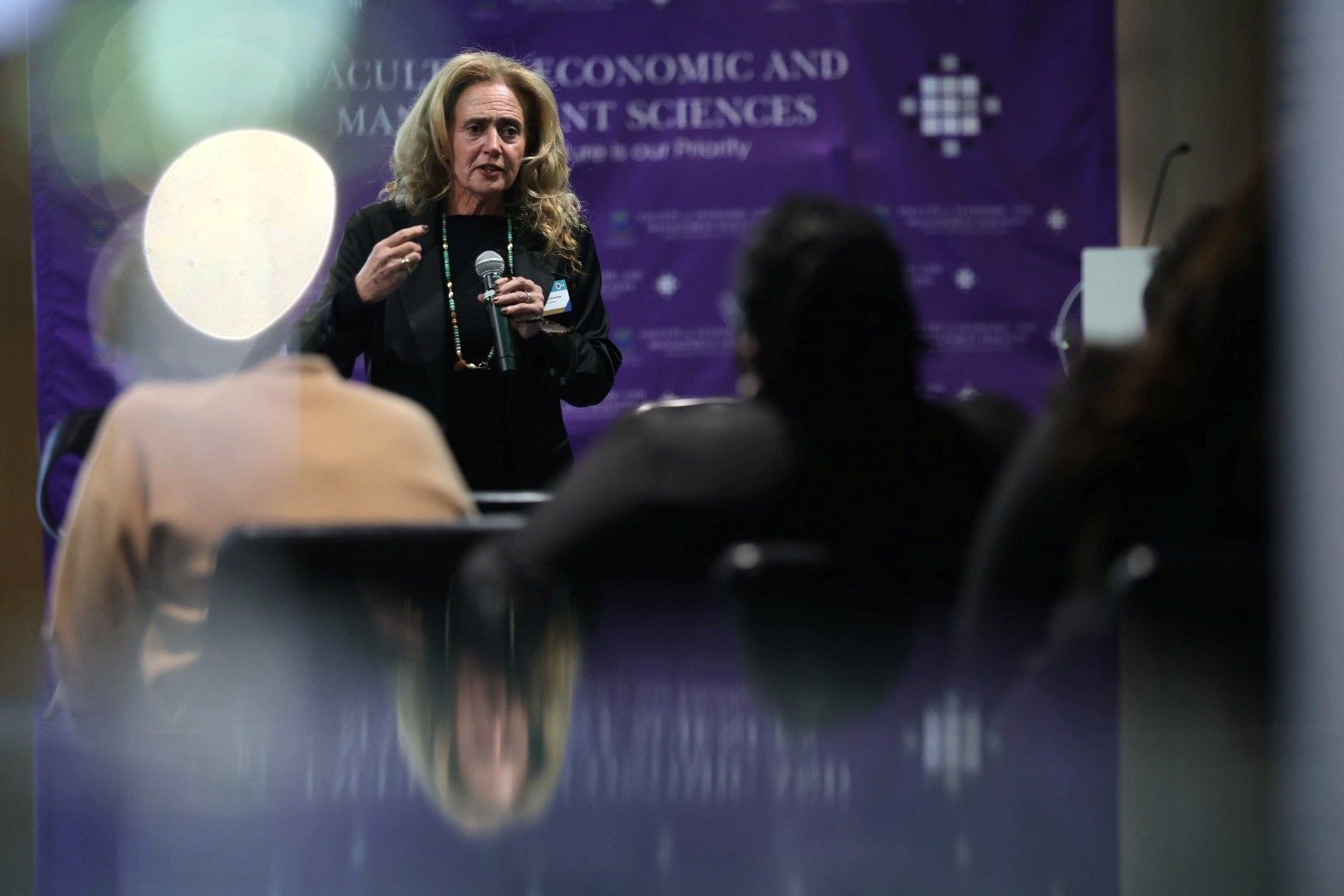
Suzanne Ackerman firmly believes that it takes courage for women entrepreneurs to overcome their challenges and build successful businesses.
Respected leader
Ackerman, a respected business leader, social change advocate, and associate professor, shared this during her keynote address at the second Leadership and Economic Growth Series. Formerly transformation director at Pick ‘n Pay, she now serves as a non-executive director.
The series, a partnership between FNB and the University of the Western Cape (UWC) Faculty of Economic and Management Sciences (EMS), laid bare the challenges women entrepreneurs still face even after three decades of political freedom. With this second instalment, the dialogue centred around the theme, Women in Leadership Supporting Enterprise Development for Women. It was held at FNB’s Portside Building on 25 August 2026.
Challenges
Reflecting on some of these challenges, Ackerman said: “As women, we have endless problems. We have them while we have three children screaming and hanging onto our apron tails, we have them while our husbands beat us up in the kitchen, we have them while our boyfriends are getting drunk on a Friday night and get petty over everything. There’s one thing that unites us – our challenges. There’s also one thing we need to overcome them: courage. We all need courage. Sometimes many of us just need that courage to wake up in the morning and get out of bed.”
Part of this courage, she said, involves not giving up after the first “no”. Ackerman is the founder of the Feed the Nation campaign, which delivered food and essentials to millions of vulnerable South Africans — particularly during the Covid-19 lockdown.
She said she started the initiative despite being repeatedly told by Pick ‘n Pay’s chief financial officer (CFO) and chief executive officer (CEO) that it would be impossible to establish during that time. She also shared that among the business principles her late father, Raymond Ackerman, who founded Pick ‘n Pay, believed in was social responsibility.
“It is your duty to put back more into society than what you take out. Something we all forget very often. You have to put back, and especially in a country like ours, right here in South Africa. I was fortunate that I had parents who fought the apartheid system. They appointed people of colour because they were not allowed to,” she said.
Economic participation
Professor Derek Yu, acting deputy dean: academic planning in the EMS faculty, said women’s economic participation is not just about entering the labour market, but also about whether their businesses can enter and thrive in the mainstream economy.
“Women continue to face significant barriers in the labour market, and entrepreneurship is therefore an important avenue through which women can generate income, sustain livelihoods, and create opportunities for others, including other women. However, participation in entrepreneurship is not necessarily the same as participation in the mainstream economy.”
He shared data from the Stats SA Quarterly Labour Force Survey, which showed that the proportion of male entrepreneurs operating in the formal sector was around 35%, but the corresponding proportion among female entrepreneurs was 25%.
Professor Yu added: “So it’s not only about encouraging women to start a business — that’s just the end of the beginning. It’s also about asking what happens after they have started. There are so many questions, such as: can they access finance; can they reach margin markets; can they participate in formal supply chains; can they scale their businesses; and can they move from operating in the margins of the economy to becoming more sustainable, profitable and competitive businesses in the mainstream economy.”
Professor Christie Swanepoel read the dean of the Faculty of Economic and Management Sciences (EMS), Professor Michelle Esau’s, speech, as she was unable to attend.
Red tape
Esau wrote that challenges such as bureaucratic red tape, rigid financial viability assessments, and steep market entry barriers continue to hold entrepreneurs back. These hurdles are even steeper for women, she added.
“Women entrepreneurs face disproportionate barriers in accessing capital, joining high-value business networks, and balancing enterprise demands with familial responsibilities. In the Global South, these challenges are compounded by patriarchal structures, informal market dynamics, and structural poverty,” she wrote.
“Universities have a vital responsibility to help map a better trajectory for current and emerging entrepreneurs. Grounded in our history as an institution of the intellectual left — once capable of mobilising across national and international borders against apartheid — the EMS Faculty acts as a network of networks. We bring together key stakeholders to tackle the systemic issues threatening democratic stability and economic access.
“Strategic ecosystem partners like First National Bank (FNB) are essential to this mission. Together, we are focused on delivering practical, scalable support for small, micro, and women-led enterprises.”
Sipho Jiyane, FNB commercial marketing lead, agreed that partnerships were important and said, “it takes a village”. Encouraging the women entrepreneurs in the audience, he said: “Start with what you have. Start where you are. It’s important just to show up. Part of what we want to hear is where we can help as a bank.”
ALSO READ: UWC programme helps unemployed youth build businesses and find jobs