

Plans to develop thousands of homes on Erf 1117, a protected biodiversity hotspot inside Koeberg’s evacuation zone, have sparked alarm among residents and environmentalists alike.
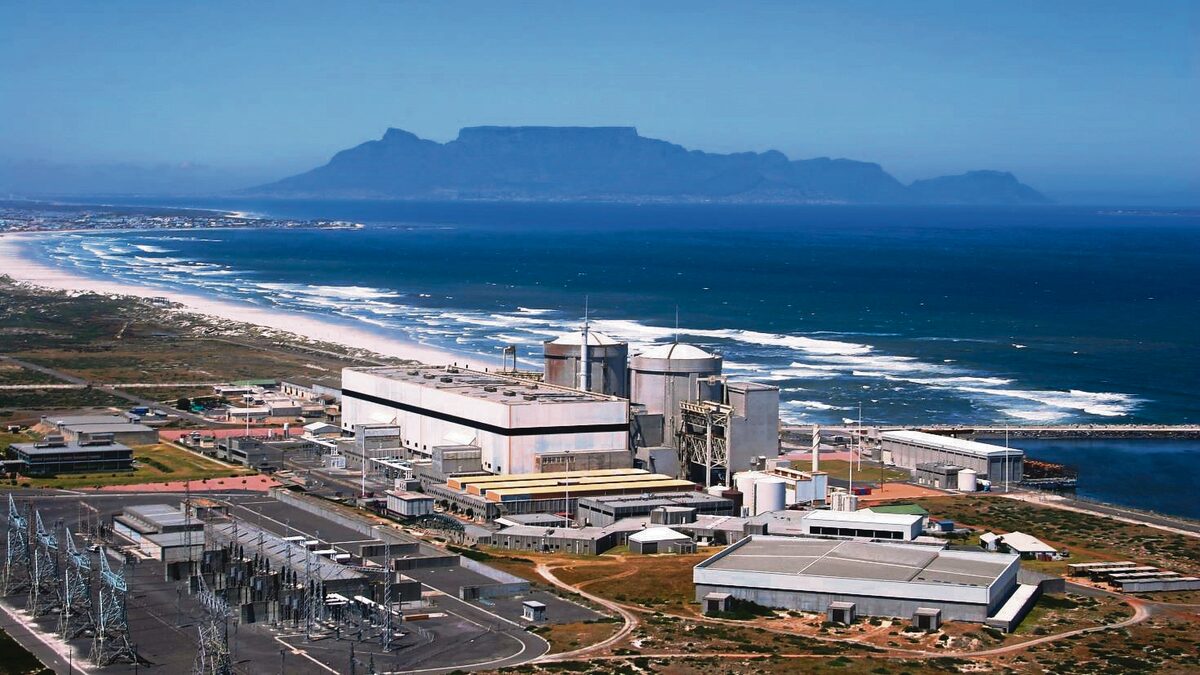
According to Michelle Collins, chair of Community Representation Blaauwberg (CRB Blaauwberg), the City of Cape Town and the Department of Public Works and Infrastructure (DPWI) are reportedly finalising a Local Spatial Development Framework (LSDF) aimed at enabling thousands of new housing units on land situated within Koeberg Nuclear Power Station’s Urgent Protective Action Planning Zone (UPZ).
While the push for housing is urgent and nationally important, the development has sparked alarm among residents, environmentalists, and political representatives for its potential threats to public safety, ecological integrity, and legal compliance.
A nuclear safety risk
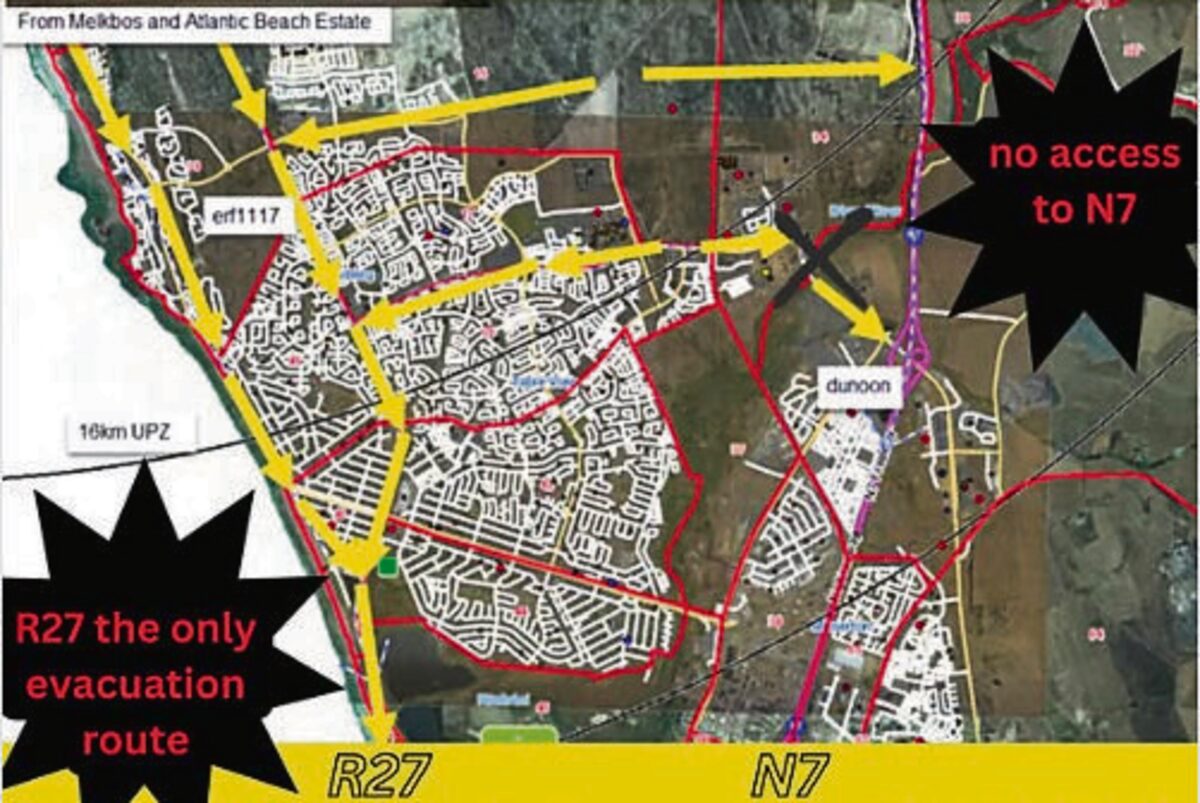
Erf 1117 lies within the 5–16 km radius of Koeberg’s UPZ, a zone where national regulations demand rigorous evacuation modelling before any major population increase. No such modelling has been submitted for this land.
“The dangers are not hypothetical,” says Collins. “During unrest on the Dunoon–Malibongwe corridor—a key evacuation route—roads were blocked and impassable. If it can happen during protest, it could certainly happen during an emergency. Concentrating thousands of households here without proven evacuation feasibility is reckless, unlawful, and violates the National Nuclear Regulator’s mandate to protect public safety.”
Local resident Mark Hutton voiced concern: “We support housing initiatives, but this is not the place. There is no way to guarantee safety in a nuclear emergency with so many people packed into this area.”
Irreplaceable biodiversity at stake
Erf 1117 is mapped in the City of Cape Town’s 2025 Biodiversity Spatial Plan as a Critical Biodiversity Area (CBA1a) and includes wetlands within the Unesco Cape West Coast Biosphere Reserve. These ecosystems are vital for water regulation, flood buffering, and sustaining biodiversity already under immense pressure.
“Destroying this land is irreversible,” says Sarah Dane, a resident from the area. “Wetlands and native habitats cannot be recreated once lost. This is not just about housing; it’s about safeguarding ecosystems for future generations.”
Collins reinforced this point: “Erf 1117 is more than just a patch of land. It’s a unique ecological asset. Housing development here would directly conflict with both safety requirements and conservation obligations.”
Contradiction with City policy
The City’s Human Settlements Strategy (May 2021) recommended that housing focus in Blaauwberg be concentrated on Du Noon and Joe Slovo, not Erf 1117. The strategy explicitly noted that development within the UPZ must carefully consider nuclear evacuation feasibility.
“Promoting Erf 1117 for high-density housing contradicts the City’s own strategy,” Collins said. “This raises serious questions about whether political expedience is taking precedence over public safety and lawful governance.”
Concerns over Public–Private Partnerships (PPP)
Reports indicate that DPWI and Human Settlements may be pursuing a Public–Private Partnership (PPP) on Erf 1117. Critics warn this could align government and developer interests in a way that overrides safety and biodiversity safeguards to meet housing targets or private profit.
“No partnership can override constitutional rights to life, safety, and a healthy environment,” Collins said.
Residents share similar apprehensions. Andre van Wyk, a local community member, said: “The process feels like a fait accompli. Residents’ input is being sidelined while decisions seem already made to benefit private interests.”
Political and regulatory pressure
Freedom Front Plus councillor Pieter Jansen van Vuuren recently called on the City to provide clarity about developments near Koeberg, including Erf 1117 and a hazardous waste site near Melkbosstrand. He highlighted that the proposed housing density of 30 000 people would be five to six times higher than surrounding areas, violating NNR guidelines for low-density development within the UPZ.
“The safety of residents must always come first,” he said. “Until proper risk and environmental assessments are made public, development here should not proceed.”
City response
Eddie Andrews, Deputy Mayor and Mayco member for spatial planning and environment, confirmed to TygerBurger that no development application has yet been submitted for Erf 1117. He noted that any future proposals would require comprehensive studies, including an Environmental Impact Assessment (EIA), Traffic Impact Assessment, and disaster management planning related to Koeberg.
Andrews also stressed that the City is not the competent authority under NEMA, and that environmental approvals fall under the Department of Forestry, Fisheries and the Environment (DFFE) or the Western Cape Department of Environmental Affairs and Development Planning (DEA&DP).
“To date, no EIA application has been lodged, and public participation will be conducted in line with legal requirements,” Andrews said.
A test for Cape Town’s planning future
The debate over Erf 1117 is more than a local planning issue; it is a litmus test for Cape Town’s approach to safety, sustainability, and lawful governance.
“Erf 1117 is a test case for the future of Cape Town,” Collins concludes. “Will planning be guided by science, law, and sustainability—or by expedience and special interests? The community deserves clarity, transparency, and safety. We cannot afford shortcuts that jeopardise lives and ecosystems.”
Resident Hutton added: “There are safer, more suitable sites for affordable housing. Putting people in harm’s way here is unacceptable.”
Calls to action
Community organisations are urging:
- Clarification from the Minister of Human Settlements that Erf 1117 was never individually gazetted as a Priority Human Settlement and Housing Development Area.
- Oversight from the National Nuclear Regulator to prohibit development in the UPZ until full evacuation modelling is completed.
- Investigation by Parliamentary committees into the LSDF process and any PPP agenda.
- Enforcement of the 2025 Biodiversity Spatial Plan and protection of the Unesco Cape West Coast Biosphere Reserve.
Collins adds: “This is not only about Erf 1117. It is a test case for Cape Town’s future: will planning be guided by safety, science, and sustainability — or by expedience and special interests? If officials force through high-density housing on Erf 1117, they will not only put thousands of families at risk and erase irreplaceable biodiversity, they will also set a precedent that Cape Town’s planning system can be bent to political will at the expense of public safety and environmental law.”