


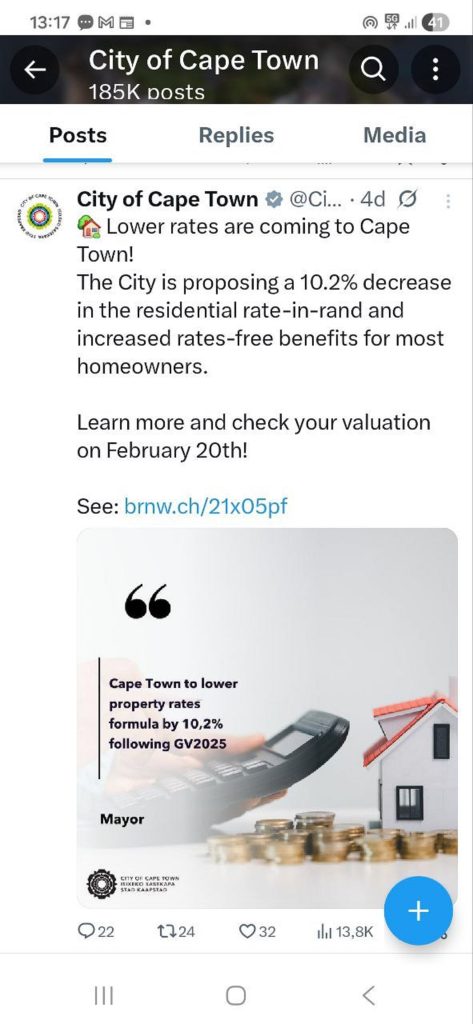
The City of Cape Town has removed its public claim that “lower rates are coming to Cape Town” following a complaint lodged by the Cape Independence Advocacy Group (CIAG) with the Advertising Regulatory Board (ARB), that the City had misled residents, according to the advocacy group.
“Property rates are calculated by applying a “cents in the rand” factor to municipal valuations. According to the City’s own figures, valuations were set to increase by an average of 17.1%, while the factor was to be reduced by 10.2%,” says CIAG co-founder Phil Craig.
However, according to CIAG, the City’s social media communication emphasised the reduction in the factor without explaining the impact of the concurrent increased valuations.
“Combined with the statement ‘Lower rates are coming to Cape Town’, this created the dominant impression that rates bills would decrease, when in fact, in most cases, they would actually increase,” says Craig. (see post below)
CIAG conducted a financial analysis of the proposed changes: View the financial analysis report.
“This analysis indicated that for property values above R550 000, homeowners would face above inflation increases in their rates payments — consistent with what many residents have experienced over the past decade. The CIAG wrote to the City, addressing correspondence to the Mayor and the Mayco member for finance, provided its analysis, and requested clarification on how the City had arrived at its claims. The City responded initially but did not address the discrepancies raised,” he says
“Thereupon a follow-up email was sent setting out these discrepancies in detail, yet no further response was received. CIAG subsequently lodged a complaint with the ARB, who then upgraded it and formally launched an investigation. In response, the City deleted its claim that ‘lower rates are coming to Cape Town’, but did not issue any clarification or correction regarding the specific post.”
“Deleting a post does not correct the public record. Residents were told that lower rates are coming. If that claim cannot be substantiated, the City should apologise and issue a retraction. It is not acceptable for a sphere of government to mislead ratepayers and to then brush it under the carpet when challenged.”
CIAG has requested that the ARB require the City to publish a retraction in the same manner and on the same platform as the original claim.
City removes post to ‘avoid misconception’
In response to a media inquiry, the City told the newspaper that the post being removed from social media does not relate to an advert or the ARB’s function, but rather a normal content post on the X platform.
“While the post prominently stated in both the caption and graphic that the City is proposing a 10,2% reduction in the rate-in-rand formula, part of the caption erroneously referred to ‘lower rates are coming’. This should have read ‘lower rates formula’, and the post was therefore removed to avoid any misperception,” says a City spokesperson noting that the post further linked to this press release for the full context: www.capetown.gov.za
“The lower rates formula reduction is one of several proposed measures that will lead to the large majority of residential property owners – around 60% – seeing a reduction or no change in their monthly rates bill despite an increase in their property value. Cape Town’s rate-in-rand is also lower than all other metros – and this gap is only widened with the proposed reduction.”
The City holds steadfast that all residential property owners will pay less rates than what they otherwise would have without these special measures.
“It has already been explained to Mr Craig that he is incorrect to cite a 17% average increase in residential property values. Rather, as the press release linked to in the post clearly pointed out, the total combined value of all residential property in Cape Town increases by 17% overall, with differing effects for the property values of individual homeowners. It is regrettable that Mr Craig repeats this misinformation in his release,” the spokesperson stated.
“While the full details of the General Valuation changes can never be captured in a social media post caption alone – especially on the X platform which has a particular brevity to its posting format and conventions, the City nevertheless strives to be as clear and simple as possible in the voluminous communications which it has issued on the GV across various platforms.”
Under Scrutiny
However, budget specialist Sandra Dickson from the GOOD party is of the belief that the City’s lower rates (in rand) claim becomes misleading in its practical effect on residents when placed in the full context of the 2026/27 draft budget and the new GV2025 property valuations.
“Property rates are not determined by the rate-in-the-rand alone. It is the product of two factors, the rate-in-rand applied and the underlying property valuation.” Dickson explains.
“While the City has emphasised the reduction in the rate-in rand factor, it has not given equal weight to the fact that property valuations are increasing by approximately 17% overall. The interaction between these two figures is what ultimately determines what residents will pay on their Municipal bill from 1 July 2026 onwards.”
According to Dickson there is a clear and unavoidable mathematical reality: if a property’s value increases by more than roughly 11%, the reduction in the rate-in-the-rand is not enough to offset that increase. In those cases, she says, the homeowner will pay more in property rates, not less.
“Given that the average valuation increase exceeds the 11% threshold, it follows that more households will experience higher bills despite the City’s headline claim that 60% of households will see a decrease or no change in their bill,” she says.
“This disconnect is further reinforced by the City’s own online calculator, which many residents rely on to estimate their future bills. The calculator prominently reflects the reduction in the rate-in-the-rand but does not clearly demonstrate the full effect of increased property valuations. As a result, it can give the impression that rates are decreasing, when in fact the combined impact of valuation increases and the adjusted rate points in the opposite direction for more than 60% of households,” she adds.
“The issue here is not whether the rate-in-the-rand has been reduced. The issue is the overall impression created by presenting that reduction in isolation.”
READ ALSO: Cape Town ratepayers brace for more hikes as new property valuations roll out
By framing the change as “lower rates,” without adequately explaining the impact of higher valuations, the City risks misleading residents about the real financial consequences they will face from 1 July 2026.

You must be logged in to post a comment.