
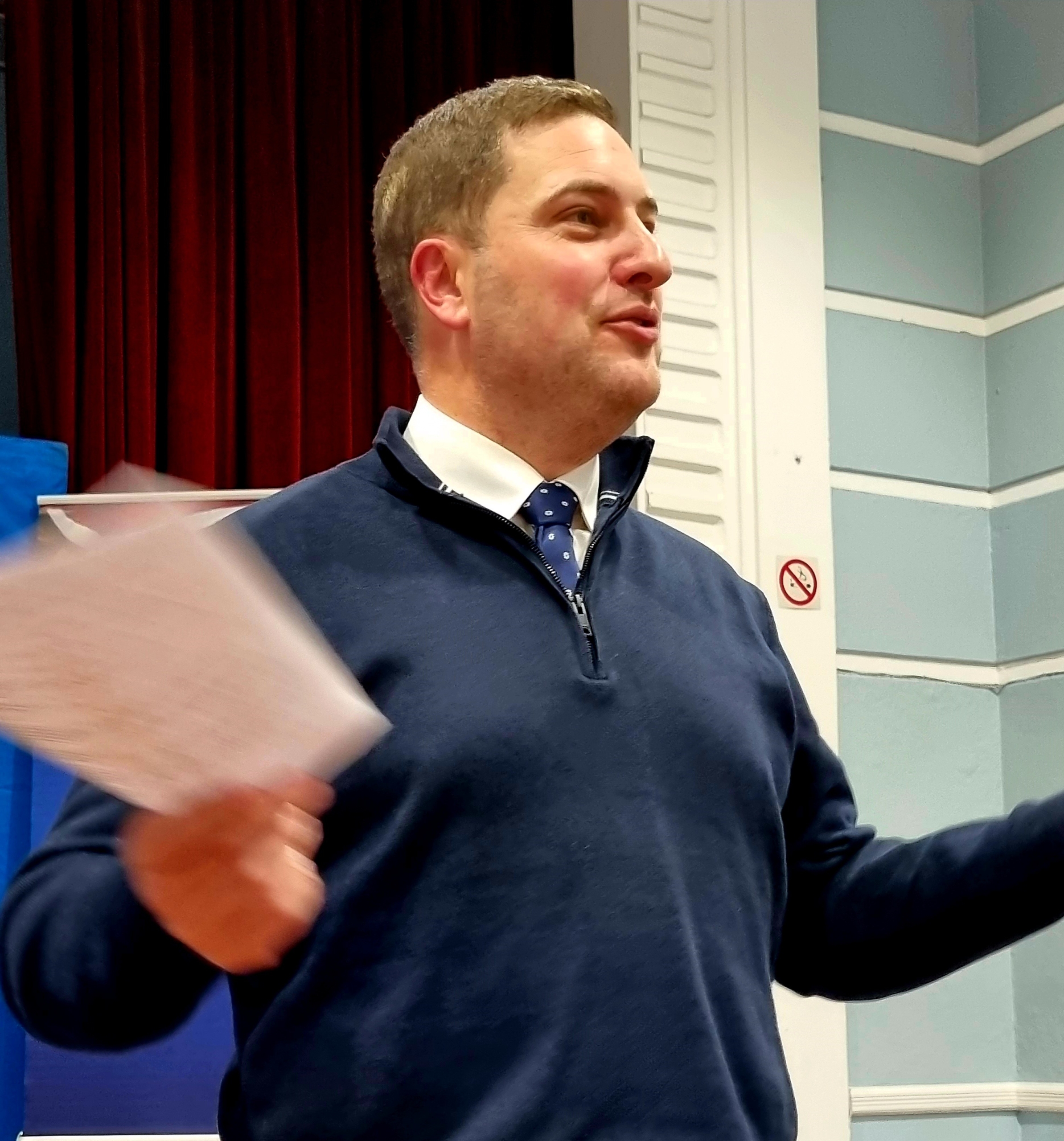
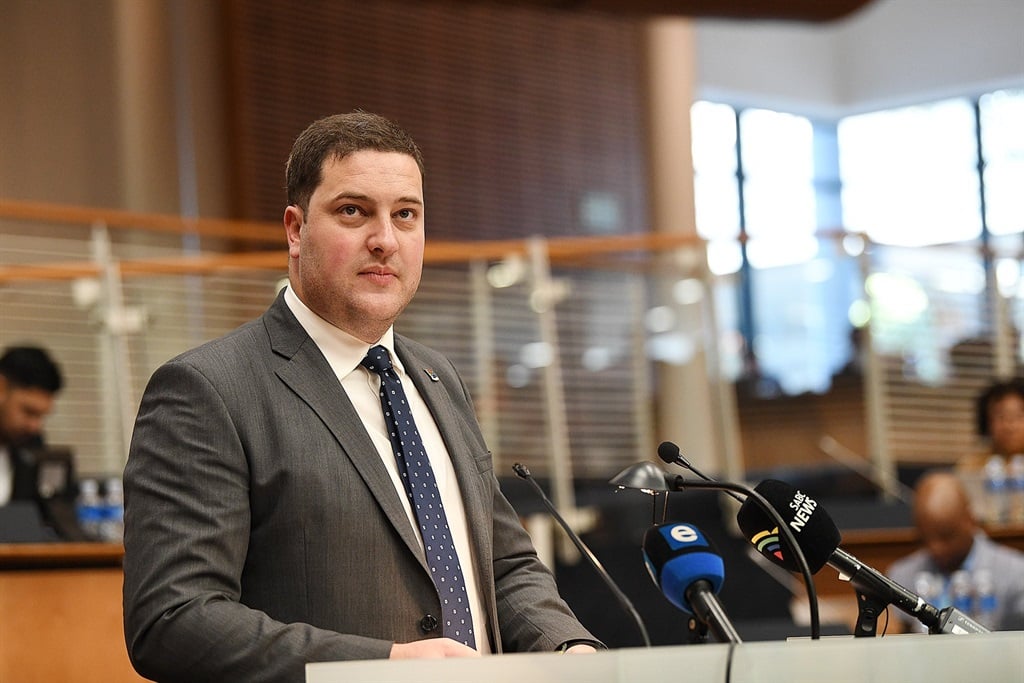
Geordin Hill-Lewis, executive mayor of Cape Town, who was recently elected as leader of the Democratic Alliance (DA), gave a positive message about the future of Cape Town at a public meeting in the Durbanville town hall on Thursday evening, 14 May.
The meeting, organised by the Tygerberg 3 Constituency of the Democratic Alliance, was attended by a full hall. The Tygerberg 3 constituency includes wards 2, 3, 21, 70 and 103 of the City of Cape Town.
“What we’ve tried to achieve in Cape Town these last four to five years, we’d like to continue to do in the future. We want to give you the peace of mind that no matter what would happen in the future in South Africa and in Cape Town, Cape Town will be prepared, ready to continue to be successful and be a good, nice place to live in and to raise our families.
Homeless encampments
“When we came out of Covid, the City had a very tough time with homeless encampments that had popped up all over the city, including here in Durbanville. The City had tried to remove those homeless encampments and was finding it incredibly difficult. We had a series of court case losses where we felt that we just couldn’t get ahead. We could feel as Capetonians that there was immense stress on our city’s infrastructure.
“The sewer system was not so much an issue here, but if you go to poorer parts of the city where enormous numbers of people have moved over the years, you will see that our sewer system is absolutely creaking and it was even worse five years ago.
“All of our major sewer plants in the city were over capacity, and our pipes were in poor form. Also the freshwater pipe system was under pressure, with lots of water bursts. Even though the City had been investing in infrastructure steadily over time, we have not been doing that at a pace that kept up with the growth of our city,” he said.
“So while we could see it was not like what we were seeing in Johannesburg, Durban or Tshwane or elsewhere where things were actually starting to collapse, I felt very strongly that unless we changed the direction, we were on a dangerous path. The truth is that if you look at what has happened in those other cities, there’s a very simple reason for it. It’s not just bad luck, it’s a deliberate decision. It was based on poor political leadership over many years that has resulted in those cities being where they are, because instead of investing in the basic things that make cities work or not work, those cities spent all their money on more salaries, bigger staff, lots of social programmes and consumption spending. Infrastructure has gone down, and the result is clear to see,” he said.
Replacing pipelines
“We are currently replacing more than four times the total number of pipes of all the other seven major cities in the country combined — including Johannesburg, Pretoria, Ekurhuleni, Durban, Port Elizabeth, East London and Bloemfontein.
“I would like to replace much more because our number of pipe bursts is not yet where we want it to be. It breaks my heart and frustrates me immensely when I visit poorer communities in Cape Town and I still see people living with daily sewer overflows, because the pipes were built for 10 000 people and now there are 50 000 people living in that area. We have to go and upgrade those pipe systems and pump stations, although it is a long and slow journey.
“We have to be clear in our political leadership that we will never allow the failure that has happened in other cities to happen here. We will start to take firm action to address the urban decay issues that were setting in the city after Covid. And we have set about doing that in a focused, disciplined way. We have nearly tripled our capital investments since four years ago, and we have put it into all the things that really matter to make the city work. We are not there yet, but we can see the light at the end of the tunnel when our three major upgrade projects that are still under construction, are completed. When those are all completed, we will actually be back where we have spare capacity for Cape Town’s future growth.
“The number of sewer spills and blockages in our city is down 30% from four years ago and the number of freshwater pipe bursts in our city is down 25% in the same period,” he said.
Traffic and congestion
“We saw that the city could not continue to feel the pressure it was feeling unless we did something to help with traffic and congestion. Because the train system doesn’t function and is not controlled by us, we put a huge investment into public transport, and we looked at the most pressurised route in the whole city, which is the M2. We started implementing the N2 Cape Flats MyCiTi expansion, which is a very large public transport investment. When it is finished sometime in the middle of next year we’ll see 300 buses running all day long along that corridor — all the way down through Philippi, Gugulethu, Hanover Park, Mitchell’s Plain and ending in Khayelitsha. It will make a major difference to commuter transport,” he said.
Massive semigration
“What has happened as Cape Town has continued to succeed and as other cities have continued to deteriorate, is we have had massive semigration. If you thought semigration was strong before Covid, we have data that shows 100 000 families — not people, but families — have moved from Gauteng to Cape Town in the last four years — mostly to Somerset West, Durbanville, the Atlantic Seaboard and Table View.
“We know why they are coming; they also want to live in a city that works, that offers a good future for their children. What that means is that we’ve had more pressure on our roads, more pressure on our infrastructure, more pressure on our schools. Our schools are bursting at the seams. And of course, more pressure on our house prices,” he said.
Office rental prices skyrocketed
“Many more companies are moving to Cape Town because their workers want to be in Cape Town, especially high-skilled companies. Engineering firms, consulting firms and accounting firms are flocking to Cape Town. You can’t get office space in the city anymore; every office space is rented out and office rental prices have skyrocketed. So, success also comes with its own pressures. It is a different pressure to a city that is collapsing and falling apart, but it is also pressure.
“The only thing that we can do is to keep going and keep investing so that we make sure that our investment is at the same pace and rate as our growth. We’ve passed a rule in Cape Town that says your infrastructure investment must at least match your population growth, so that we know that we are at least keeping up and not falling behind slowly.
“The overall message of all of this is that we have turned that trajectory of the city in a much better, healthier, more successful direction over the last four to five years — from a place where there were warning lights on the dashboard to a place where we can actually see in the near future we actually will have infrastructure that can cater for our city. I think this is something to really be very proud of,” he said.
ALSO READ: Hill-Lewis elected DA leader as new leadership team unveiled

You must be logged in to post a comment.